

Quick answer: This african grey parrot care guide starts with the essentials. African Grey parrots are among the most intelligent animals on Earth, with cognitive abilities comparable to a 4 to 6 year old child, and they live 40 to 60 years in captivity. They need a very large cage (minimum 36 x 24 x 48 inches, bigger is better), a pellet-based diet with fresh vegetables, 4+ hours of daily out-of-cage interaction, and constant mental stimulation. Without it, they develop feather plucking and behavioral problems. They are a lifetime commitment that often outlives their owners.
Contents
- Before You Buy: The 60-Year Math
- Choosing Your Bird: Breeder Green and Red Flags
- Congo vs. Timneh: Know the Difference
- The First 90 Days: Building Trust
- Building the Home: Cage and Setup
- Feeding a Genius: Diet That Protects the Brain
- The Mind That Needs a Job: Talking vs. Understanding
- Enrichment: Toys, Foraging, and the Plucking Warning
- What Health Issues Does This African Grey Parrot Care Guide Cover?
- The Decades: Years 5 to 60
- Male vs. Female: Does It Matter?
- The Real Cost
- Frequently Asked Questions
- Related Guides
Before You Buy: The 60-Year Math
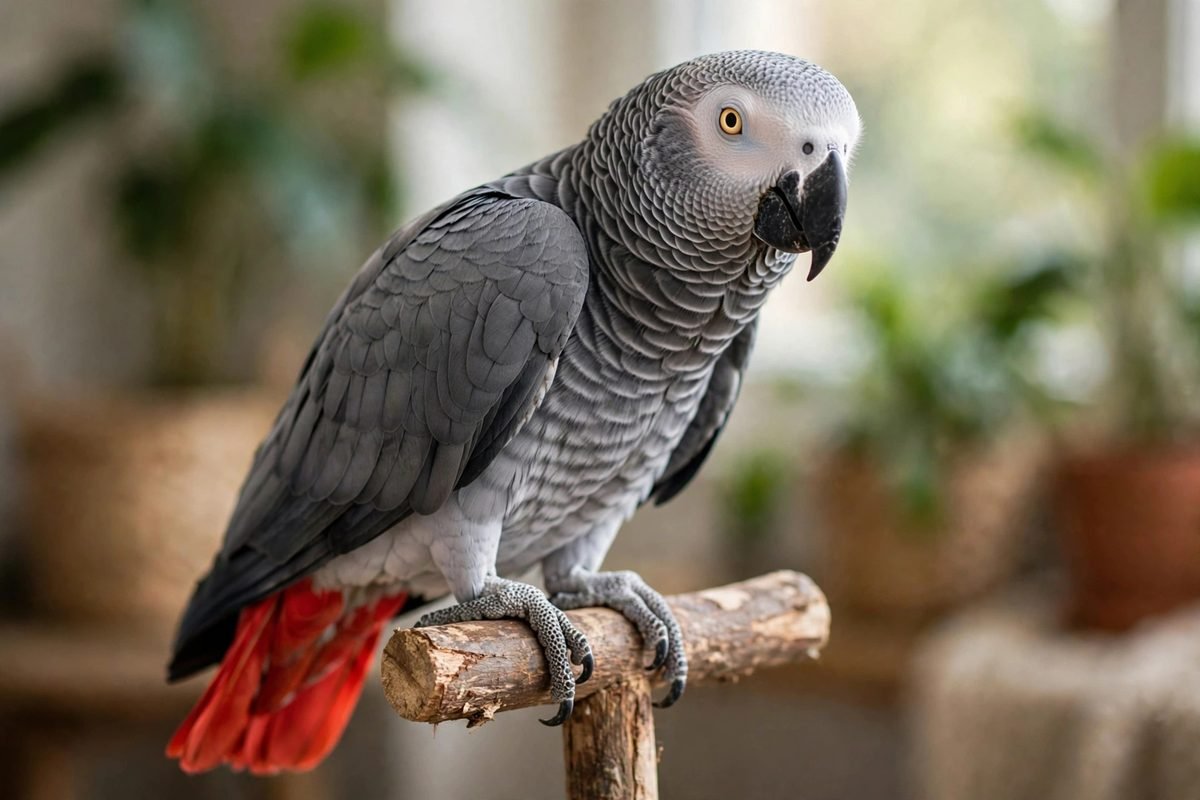
Do a small piece of arithmetic before anything else. If you are 30 and you buy a young African Grey, there is a real chance that bird attends your retirement party. These parrots routinely live 40 to 60 years with good care, and individuals passing 70 are documented. Dogs ask for a decade. Cats ask for two. An African Grey asks for the rest of your adult life.
This changes every decision. The cage you buy should last decades. The savings you set aside should cover vet bills in year 30, not just year 3. And you need a written plan for who takes the bird if you cannot. Because “we will figure it out later” is how parrots end up rehomed at age 25, confused and plucking, in their fourth home.
The trade in African Greys is regulated under CITES Appendix I, the strictest category, because wild populations were devastated by trapping. Buy only captive-bred birds from reputable breeders with proper documentation. Ask for hatch certificates and closed leg bands. A suspiciously cheap grey, or a seller vague about paperwork, is a red flag for smuggled wild-caught birds. Those birds are traumatized, often diseased, and illegal to trade.
Also be honest about noise and mess. African Greys are not the loudest parrots, but they whistle, mimic the microwave, the phone, the dog, and your laugh at full volume, often at dawn. They produce fine powder-down dust that coats everything nearby. And they are one-person birds by tendency: they usually pick a favorite human and merely tolerate everyone else.
Choosing Your Bird: Breeder Green and Red Flags
Where your grey comes from shapes the next 60 years more than any other single decision. A well-bred, well-socialized baby from a serious breeder is a fundamentally different animal from a stressed, under-socialized bird, and no amount of later love fully erases a bad start.
Green flags: the breeder asks you as many questions as you ask them. Babies are raised in the home around normal household life, not in a back-room box. You can visit and see clean conditions, parent birds that look healthy and calm, and babies that are curious rather than cowering. The breeder provides hatch certificates, closed leg bands, feeding records, and a written health guarantee. They insist babies go home fully weaned. Never let anyone sell you an unweaned chick to hand-feed unless you are trained. It is dangerous and a classic mill tactic. They have a take-back policy if your circumstances ever change.
Red flags: the seller cannot or will not show you the breeding setup. Birds are always “available now” in quantity. Prices are far below market. The bird is described as “wild caught” or the paperwork is vague. The seller pushes you to decide today. You are asked to meet in a parking lot. Any one of these is reason to walk away.
Rescue is also a real option and a noble one. African Grey rescues exist because the 60-year commitment defeats many owners around year 5 or 10. Adult greys in rescues are often wonderful birds that simply outlasted someone’s circumstances. An adult rescue shows you its true personality, talking ability, and quirks up front. The trade-off is unknown history and possibly ingrained fears that need patient rehabilitation. If you go this route, work with a parrot-specific rescue that fosters birds in homes. They can tell you honestly how the bird behaves day to day.
Congo vs. Timneh: Know the Difference
“African Grey” covers two subspecies, and the differences matter for beginners.
| Trait | Congo African Grey | Timneh African Grey |
|---|---|---|
| Size | Larger, 12-14 inches, 400-650g | Smaller, 9-11 inches, 275-400g |
| Color | Lighter silver-grey, bright red tail | Darker charcoal grey, maroon-brown tail |
| Beak | Solid black | Horn-colored upper mandible patch |
| Temperament | More sensitive, slower to trust, easily stressed by change | Often bolder, adapts faster, slightly more easygoing |
| Talking ability | Excellent mimics, huge vocabularies | Excellent mimics, often start talking younger |
| Best for beginners? | Wonderful but demanding; needs a calm, stable home | Often recommended as the slightly more forgiving choice |
Neither is “better.” Timnehs tend to be a touch sturdier in personality, which is why many breeders suggest them for first-time grey owners. Congos are the classic, the bird most people picture. Meet both if you can before deciding.
The First 90 Days: Building Trust
Your new grey will probably be terrified. That is normal. Even well-socialized babies need weeks to map a new home, and pushing too fast creates fear that takes months to undo. The first 90 days are a trust-building project, not a training program.
- Days 1-14: Be furniture. Sit near the cage, talk softly, read aloud. Let the bird watch you. Offer treats through the bars without demanding anything. Do not reach into the cage.
- Days 15-30: Open the door. Let the bird come out on its own terms in a bird-proofed room. Target-train with a chopstick: touch the stick, get a treat. This teaches the bird that interacting with you pays.
- Days 31-60: Step up. Ask for step-up onto your hand only when the bird leans toward you willingly. Keep sessions to five minutes. End every session before the bird wants to quit.
- Days 61-90: Routine. Set the daily rhythm the bird will live with for decades. That means morning uncover and breakfast, out-of-cage time, training, foraging, evening wind-down, and covered sleep. Greys thrive on predictability.
Watch body language closely. Pinned eyes can mean excitement or agitation depending on context. A fluffed, leaning-away bird is saying no. Respecting “no” is the fastest way to earn “yes” later. Biting is communication, not malice: it usually means the bird is scared, tired, or overstimulated.
Building the Home: Cage and Setup
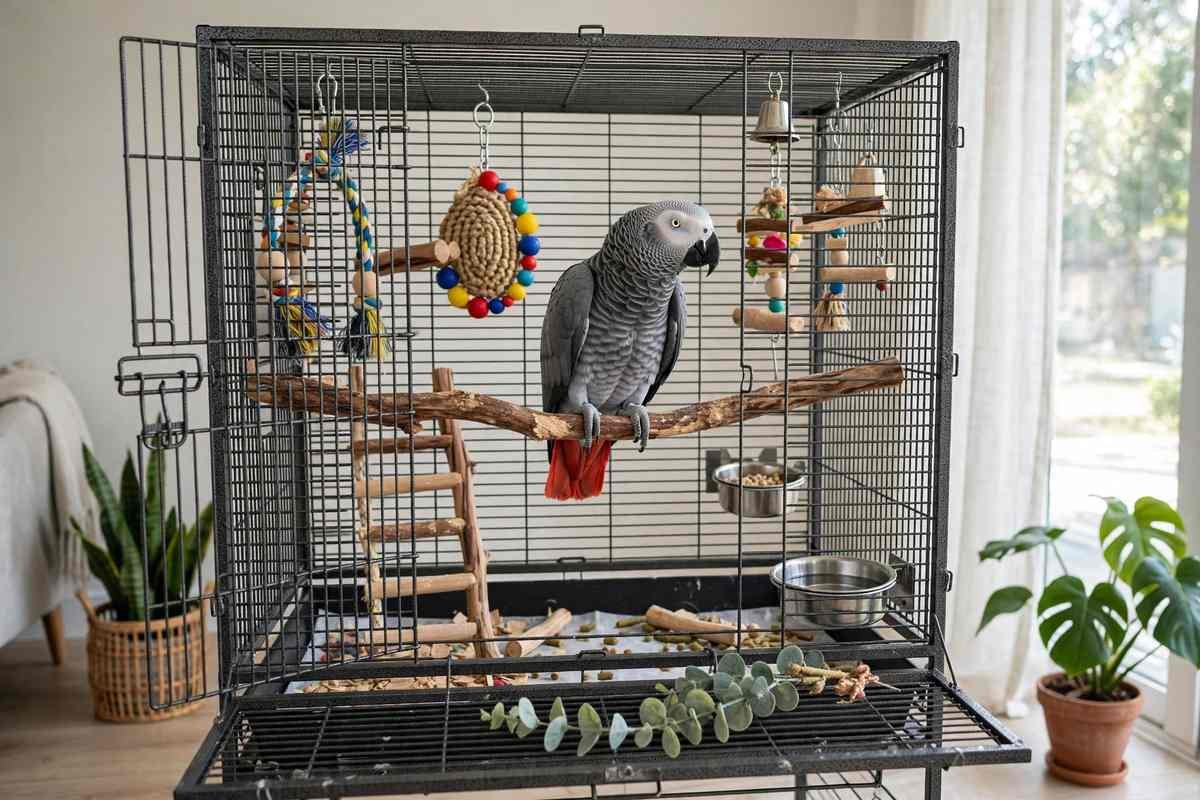
The cage is where your grey sleeps and retreats, not where it lives its life. Out-of-cage time matters more than cage size, but the cage still needs to be generous, because some days the bird stays in.
| Element | Minimum Standard | Ideal |
|---|---|---|
| Cage dimensions | 36″ W x 24″ D x 48″ H | 48″ W x 36″ D x 60″+ H, or an aviary room |
| Bar spacing | 3/4″ to 1″ | Same; wider risks head entrapment |
| Perches | 3+ natural wood perches, varied diameters | Add rope and platform perches; rotate positions |
| Placement | Against a wall in the living area, away from kitchen fumes | Same, with a sleep cage in a quiet room for 10-12 hrs darkness |
| Out-of-cage time | 4 hours daily minimum | Most of the day on a play stand, supervised |
The non-negotiable safety rules are strict. No non-stick cookware fumes (Teflon kills birds in minutes). No scented candles or air fresheners near the bird. And no avocado, chocolate, caffeine, alcohol, or onion. Ceiling fans off when the bird is out. Windows and mirrors get decals during the early months so a startled bird does not fly into glass.
Lighting matters more than people realize. Full-spectrum UV lighting on a timer supports vitamin D synthesis and healthy sleep cycles, especially for indoor birds. Twelve hours of sleep in a dark, quiet space is the target. Chronically sleep-deprived greys become cranky, plucky, and hormonal.
Feeding a Genius: Diet That Protects the Brain
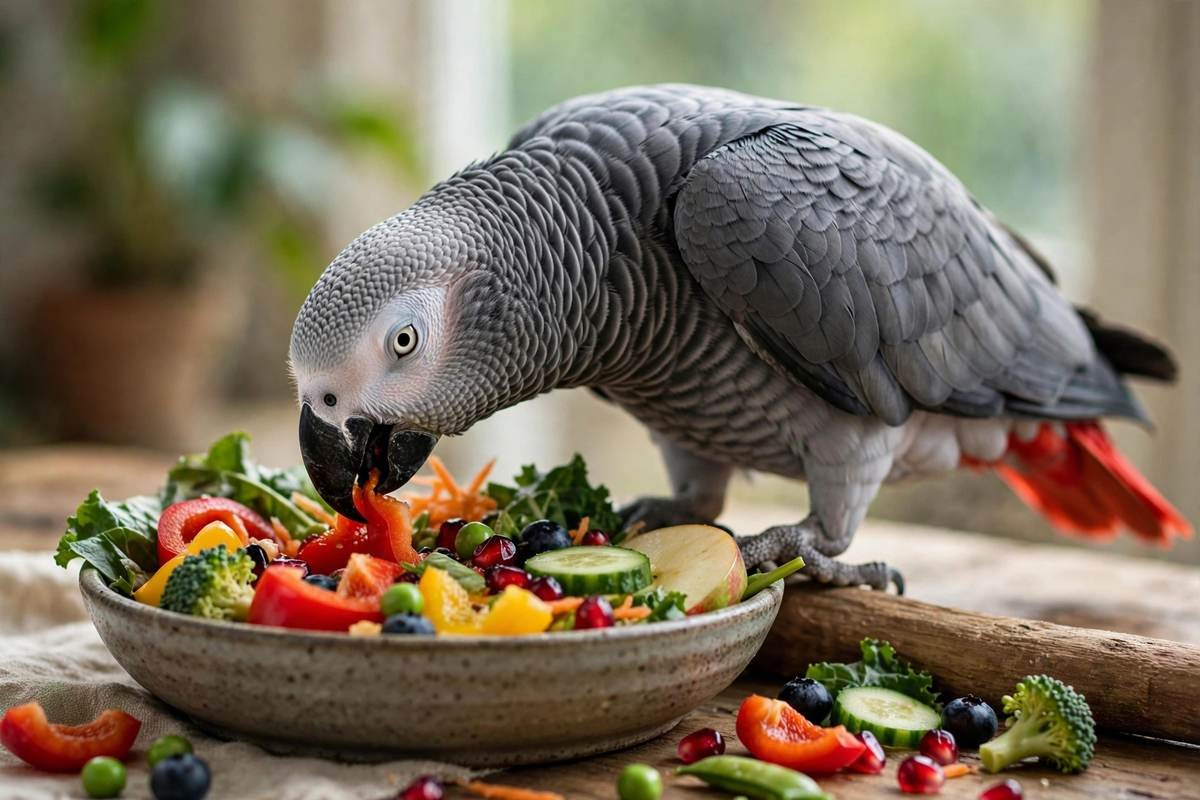
An all-seed diet is the slowest way to kill an African Grey. Seeds are high in fat and low in nearly everything else. Greys on seed diets develop fatty liver disease, vitamin A deficiency, and calcium problems. As this african grey parrot care guide stresses, the modern standard is pellets as the base plus a generous daily serving of vegetables.
| Food Group | Share of Diet | Examples |
|---|---|---|
| Quality pellets | 60 – 70% | Formulated parrot pellets, no added colors |
| Vegetables (“chop”) | 20 – 30% | Kale, broccoli, carrots, sweet potato, bell peppers, cooked squash |
| Fruits, grains, legumes | ~10% | Berries, apple, cooked quinoa, lentils, brown rice |
| Nuts and seeds | Treats only | Walnuts, almonds in shell for foraging; never as meals |
Two nutrients deserve special attention in this species. Calcium: African Greys are prone to hypocalcemia (low blood calcium), which can cause seizures. Dark leafy greens, broccoli, and cuttlebone help, and your avian vet may recommend monitoring blood levels. Vitamin A: deficiency causes respiratory and skin problems; orange vegetables like sweet potato and carrots are the fix. Full-spectrum lighting supports vitamin D, which the body needs to use calcium properly. It all connects.
Convert seed-addicted birds gradually. Mix pellets into seeds in slowly increasing ratios over weeks, offer chop every morning when hunger is highest, and eat vegetables theatrically in front of the bird. Greys are flock eaters. They want what you are having.
The Mind That Needs a Job: Talking vs. Understanding
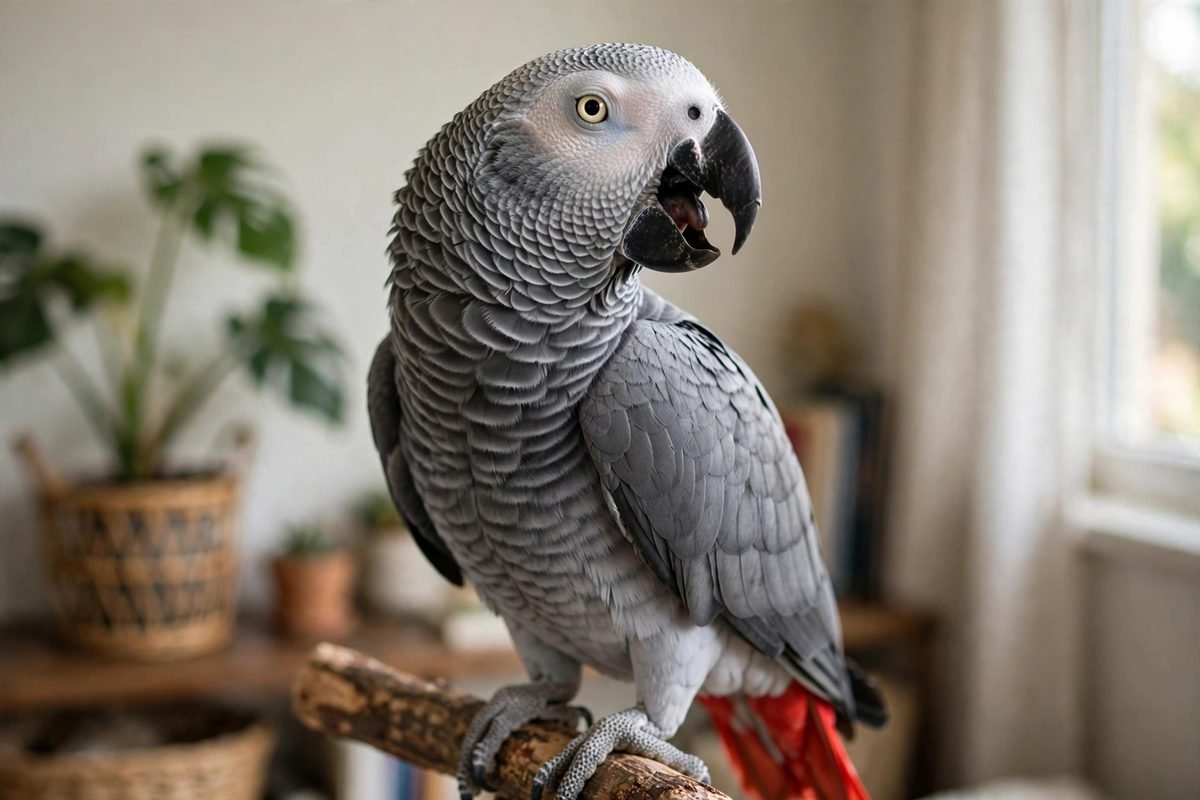
Everyone knows greys talk. Fewer people know what the science actually found. Researcher Irene Pepperberg’s decades of work with an African Grey named Alex demonstrated that these birds do not merely mimic. Alex could identify objects, count small quantities, understand concepts like bigger and smaller, same and different, and even combine words creatively. When shown a new situation, he used language to comment on it. That is cognition, not parroting.
This is wonderful and it is also the central welfare challenge of the species. A mind that capable, left unstimulated in a bare cage, does not idle peacefully. It invents problems. Feather plucking, screaming, aggression, and self-mutilation in greys are overwhelmingly boredom and anxiety disorders, not medical mysteries. The cure is a job: training sessions, foraging puzzles, novel objects, social interaction, and new things to learn, every single day, for decades.
Teach talking through context, not repetition drills. Narrate your life: “want some water?” as you fill the bowl, “good morning!” at uncovering. Greys learn fastest when words predict events. Most start with whistles and household sounds around 12 to 18 months, with real words following. Some never talk much and communicate in their own rich body language instead. That is fine. A non-talking grey is not a defective grey.
Enrichment: Toys, Foraging, and the Plucking Warning
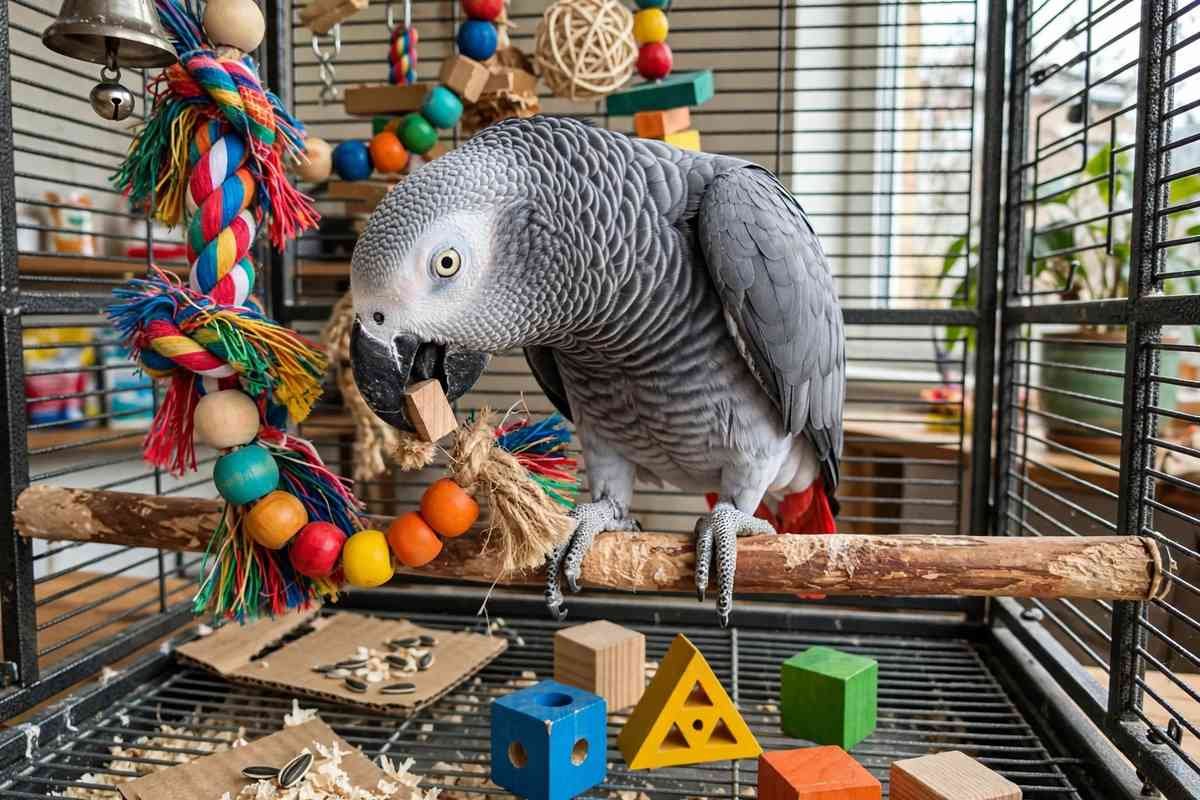
In the wild, African Greys spend most of the day foraging and problem-solving. A bowl of free food and an empty cage is, to that brain, solitary confinement. Enrichment is not optional entertainment. It is the treatment plan for the species’ most common disease.
- Foraging: Hide food in paper, cardboard boxes, woven palm toys, and puzzle feeders. Make the bird work for a share of every meal. Start easy so it learns the game, then increase difficulty.
- Destruction toys: Soft wood, cardboard, and paper toys meant to be shredded. A grey that is demolishing toys is a grey that is not demolishing its feathers.
- Rotation: Keep a toy box and rotate items weekly. Novelty is the enrichment. The same five toys for a year are wallpaper.
- Training: Five to ten minutes of trick or recall training daily. Target training, wave, turn around, flight recall indoors. Learning is the job.
- Social time: Out-of-cage time with the flock (you). Talking, preening, just hanging out on a play stand nearby while you work.
The plucking warning: if your grey starts chewing or pulling feathers, treat it as urgent. First, an avian vet visit to rule out medical causes: infections, liver disease, allergies, low humidity. If medical causes are clear, the cause is almost always environmental: boredom, insufficient sleep, lack of foraging, stress, or too little interaction. Fix the life, and the feathers usually follow. Punishing or scolding a plucking bird makes it worse every time.
What Health Issues Does This African Grey Parrot Care Guide Cover?
African Greys are powder-down birds: they produce a fine keratin dust from special feathers that conditions their plumage. It gets on everything within several feet of the cage, and it is a genuine consideration for people with allergies or asthma. An air purifier near the cage helps enormously, as do regular misting baths, which most greys enjoy and which keep the dust down.
| Condition | Signs | Prevention |
|---|---|---|
| Psittacosis (parrot fever) | Lethargy, discharge, breathing difficulty | Quarantine new birds; vet screening; hygiene |
| Aspergillosis (fungal) | Wheezing, voice change, weakness | Clean dry cage, good ventilation, no damp food |
| Hypocalcemia | Seizures, weakness, poor coordination | Calcium-rich diet, full-spectrum light, vet bloodwork |
| Feather plucking (behavioral) | Chewed or pulled feathers, bare patches | Enrichment, 12 hrs sleep, foraging, vet check first |
| PBFD (beak and feather disease) | Feather loss, beak deformity | Test new birds; no cure, strict quarantine |
Find an avian vet before you need one, not after. Annual checkups with bloodwork catch the slow problems, liver values, calcium levels, early infection, while they are still fixable. Quarantine any new bird for 30 to 45 days in a separate airspace before introductions.
The Decades: Years 5 to 60
Here is the part no other care guide puts front and center. Years 5 through 60 are the bulk of your grey’s life, and they need planning, not just love.
Write the bird into your will. This is not dramatic. It is responsible. Name a specific person who has agreed to take the bird. Set aside funds for its care, and leave detailed care instructions: diet, routine, vet, fears, favorite foods. Parrot rescues are full of greys whose owners died without a plan, and older birds rehome hardest.
Plan for your own life changes. Career moves, new partners, babies, all of it lands on the bird too. Greys bond deeply and grieve real losses. A bird that has had one stable home for 20 years handles change better than one that has bounced around. That alone is an argument for getting it right the first time.
Keep learning. Avian medicine advances. Diets improve. A grey bought in 2026 will benefit from 40 years of progress its owner must keep up with. Join a parrot club, follow avian vets, and re-examine your routines every few years.
Budget across decades. The bird will need you financially at 50 the same way at 5. Vet costs rise with age, just like in people. The cost table below is year one. Multiply the annual figure by 50 and sit with that number before you buy.
Male vs. Female: Does It Matter?
Less than sellers imply. Both sexes talk, bond, and live equally long. Males are sometimes described as slightly more outgoing and females as slightly more independent, but individual personality swamps sex differences completely. DNA sexing (a feather or blood test) is the only reliable way to know, since greys are not visually dimorphic.
One practical note: female greys can lay eggs even without a male. This happens especially if hormonal triggers stack up: too much daylight, fatty diet, excessive petting on the back, and nest-like spaces. Chronic egg laying drains calcium dangerously. Prevention is environmental: 12 hours of dark sleep, balanced diet, avoid stroking below the neck, no nest boxes. If laying starts, call your avian vet promptly.
The Real Cost
| Expense | First Year | Annual After That |
|---|---|---|
| Bird (captive-bred) | $1,500 – $3,500 | – |
| Large cage + setup | $500 – $1,200 | $0 – $100 maintenance |
| Pellets, chop, treats | $400 – $700 | $400 – $700 |
| Avian vet (checkup + labs) | $300 – $600 | $200 – $500 |
| Toys and enrichment | $200 – $400 | $200 – $400 |
| Play stand, lighting, purifier | $200 – $500 | $50 – $150 |
| Realistic total | $3,100 – $6,900 | $850 – $1,850 |
Now multiply that annual figure by 40 to 50 years. That is the true price of an African Grey, and it is the number most buyers never calculate.
Frequently Asked Questions
How long do African Grey parrots live?
40 to 60 years in captivity with proper care, and some individuals live longer. This is the single most important fact about the species: you are committing to decades, not years.
Are African Greys good for beginners?
They are demanding but not impossible for a dedicated beginner who does deep research first – starting with a full african grey parrot care guide like this one. Timnehs are often suggested as the slightly more forgiving subspecies. What beginners must have is time: hours of daily interaction, every day, for decades.
Do all African Greys talk?
Most learn words and sounds, often starting around 12 to 18 months, but there are no guarantees and vocabulary varies hugely. Research shows they can understand concepts, not just mimic. A grey that never talks can still be a wonderful, communicative companion.
Can African Greys be left alone during the workday?
A standard workday is manageable with foraging toys, background sound, and quality morning and evening time. Regular 12+ hour absences are not. These are flock animals that deteriorate in isolation.
Why is my African Grey plucking its feathers?
See an avian vet first to rule out medical causes. If the bird is healthy, plucking is almost always environmental: boredom, too little sleep, no foraging, stress, or insufficient interaction. Fixing the daily routine fixes most cases.
Is it legal to own an African Grey?
In most places, yes, but trade is regulated under CITES Appendix I due to wild population collapse. Buy only captive-bred birds with proper documentation from reputable breeders, and check your local laws before purchasing.
Related Guides
- How to Tame an African Grey Parrot: Trust-Building Steps
- Best Diet for African Grey Parrot: Seeds, Pellets and Chop
- African Grey Parrot Behavior and Body Language Decoded
- Common African Grey Parrot Diseases: Signs and Prevention
Written by the PetsVentres editorial team.
This guide is for informational purposes and doesn’t replace professional veterinary advice.