

Quick Answer: If your dog cries, whines, paces, or scratches at the door when you go to bed, they may have separation anxiety at night. The best way to help is by creating a consistent bedtime routine, providing a safe sleeping space, practicing gradual separation training, and using calming tools such as pheromone diffusers or food puzzle toys. Many dogs improve with consistent training, while severe cases may require guidance from a veterinarian or certified behavior professional.
Your dog is fine all day calm, happy, glued to your side. Then the moment the lights go off, everything changes. The pacing starts. The whining begins. Soon they’re scratching at the door or howling in the middle of the night.
You’re not doing anything wrong, and your dog isn’t being difficult. Nighttime separation anxiety is a genuine fear response, not bad behavior or manipulation. Dogs that howl, scratch, pace, or whine after bedtime are reacting to stress rather than choosing to misbehave.
The problem is that most advice online is either too generic (“just ignore it”) or too vague to actually follow. This guide fixes that. You’ll learn how to identify the signs, understand what’s causing the behavior, and use proven training strategies that help your dog feel safe and settled at night.
In this guide, you will learn:
- What nighttime separation anxiety in dogs actually is and what it isn’t
- How to identify the exact signs of separation anxiety in dogs at night
- The CALM Night Framework, a 5-step system designed for nighttime training
- The best calming aids, tools, and sleeping arrangements compared side by side
- How to crate train a dog with separation anxiety without making it worse
- Common mistakes that accidentally deepen your dog’s anxiety
- When nighttime anxiety signals something medical, especially in older dogs

Table of Contents
- What Is Dog Separation Anxiety at Night?
- Signs of Separation Anxiety in Dogs at Night
- The CALM Night Framework: 5-Step Training System
- Best Calming Aids & Tools Compared (2026)
- How to Crate Train a Dog with Separation Anxiety
- Mistakes That Make Nighttime Anxiety Worse
- Separation Anxiety in Older Dogs at Night
- When to Call a Dog Behaviorist
- Conclusion & Next Steps
- FAQ: People Also Ask
1. What Is Dog Separation Anxiety at Night?
Dog separation anxiety at night is defined as an acute stress response that occurs when a dog is separated physically or perceptually from their primary attachment person during nighttime hours. It is not a personality flaw, a training failure, or spite. It is a recognized behavioral disorder rooted in the dog’s threat-response system.
When a dog with this condition is separated from their person, the brain interprets the absence as danger. Cortisol spikes. Heart rate elevates. The dog does not choose to howl or scratch their nervous system.
While any dog can develop separation anxiety, some breeds are naturally more prone to attachment-related behaviors and distress when left alone. See our guide to Dog Breeds Most Prone to Separation Anxiety to learn whether your dog’s breed may play a role.
Why Nighttime Is Harder Than Daytime
Most dog owners are surprised to discover their dog handles daytime absences better than nighttime ones. The reason is specific:
- The house goes completely silent. During the day, ambient sounds, traffic, voices, movement provide low-level distraction. At night, everything disappears. The anxiety becomes the loudest thing in the dog’s experience.
- The separation feels absolute. Your dog can smell you and hear you settle into bed but cannot reach you. To their nervous system, that’s not comfort. It’s proof that you’re nearby and still choosing not to come.
- Duration is unknown. A dog that’s learned to tolerate a 6-hour workday absence still has no concept of “nighttime = 8 hours and then morning.” The uncertainty amplifies distress.
- Sleep deprivation becomes a cycle. Your dog’s anxiety disrupts your sleep. Your elevated stress hormones the next day are detectable by your dog which increases their anxiety. It escalates without intervention.
Is It Separation Anxiety or Something Else?
Not every dog that cries at night has separation anxiety. Rule these out before starting any training program:
| Cause | Defining Feature |
| True separation anxiety | Starts precisely when you separate; resolves when you return |
| Boredom / under-stimulation | Settles within minutes when given a chew or puzzle toy |
| Pain or physical discomfort | Occurs at random times; may include changes in posture or movement |
| Canine cognitive dysfunction (older dogs) | Disorientation, circling, glassy eyes, worse after dark |
| New environment | Present only in the first few days in a new home |
| Insufficient exercise | Dog has not had adequate physical activity that day |
The clearest diagnostic test: Set up a phone or cheap pet camera aimed at your dog’s sleep area. Review footage 10–20 minutes after you go to bed. A dog with true separation anxiety begins distress behaviors within the first 30 minutes of separation not gradually, not randomly. The onset is immediate and tied directly to the moment of separation.
2. Signs of Separation Anxiety in Dogs at Night
Signs of separation anxiety in dogs at night follow a predictable pattern. Recognizing them correctly is what separates effective treatment from wasted weeks of wrong approaches.
Primary Behavioral Signs
These are the behaviors that show up specifically and repeatedly at bedtime or after you close the door:
- Dog howling or whining persistent, starts within minutes of separation
- Dog scratching door particularly the bedroom door or any barrier between dog and owner
- Panting and drooling despite a comfortable temperature; a physiological stress response
- Pacing repetitive back-and-forth movement in the sleeping area
- Inability to settle lying down, immediately getting up, repeating
- Shadowing before bed following you from room to room as you do your bedtime routine, visibly anxious
Dogs that constantly follow their owners from room to room often display what’s known as shadowing behavior. If you’ve noticed this during the day, read Why Does My Dog Follow Me Everywhere? to understand the connection between clinginess and separation-related stress.
Secondary Signs That Confirm Anxiety (Not Just Bad Behavior)

- Refusing food the following morning (stress suppresses appetite)
- Excessive licking or chewing at paws during nighttime hours
- Dilated pupils and tucked tail when you pick up your phone and head toward the bedroom
- Trembling or shaking that begins as you dim the lights
The Key Diagnostic Question
How can I tell if my dog has separation anxiety?
The answer is context. If the distress begins when you prepare to separate picking up your phone, dimming lights, heading toward the bedroom and it stops when you return or open the door, you are looking at separation anxiety, not general restlessness.
Pro Tip: The behavior also tends to escalate over time if untreated. A dog that whines and gets a response learns that distress produces contact. The anxiety threshold lowers and the problem intensifies week by week. Early, consistent intervention is always more effective than waiting.
3. The CALM Night Framework: 5-Step Nighttime Training System
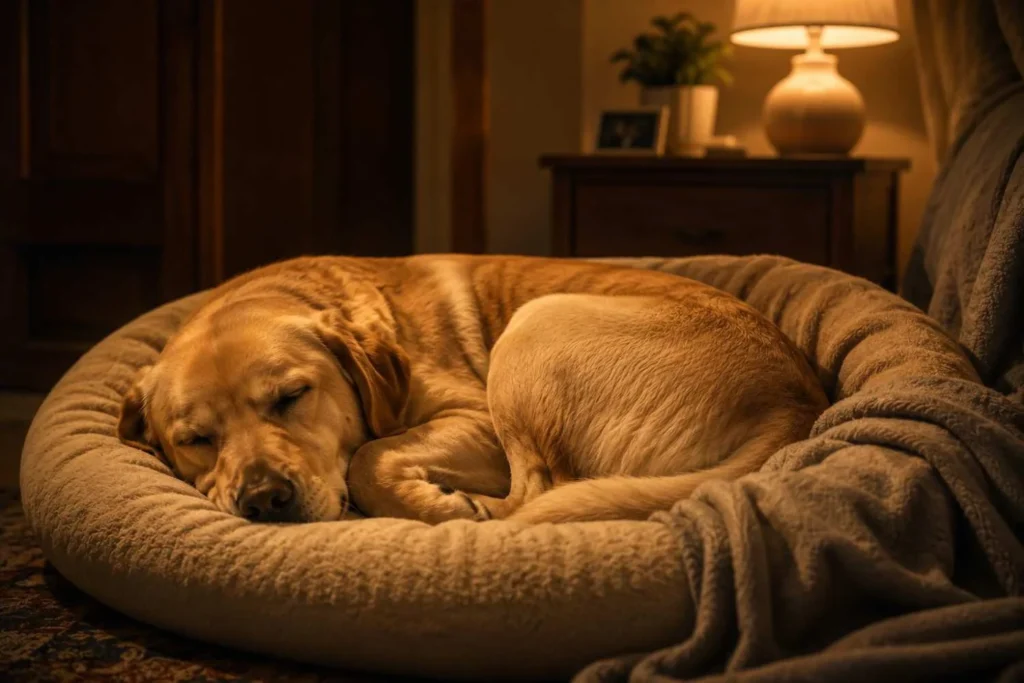
Original Framework: The CALM Night Framework is a structured behavioral approach designed specifically for nighttime separation anxiety in dogs. It integrates graduated desensitization, routine anchoring, and management tools into a single, followable system.
Most training advice focuses on daytime separation but dog separation anxiety training for nighttime requires its own protocol, because the triggers, duration, and environment are all different. The CALM Night Framework addresses this directly.
Step 1 Create a Safe Sleep Space (C)
Your dog needs a designated sleep location they associate with calm and safety not isolation or punishment. This is non-negotiable. Without it, every other step fails.
How to set it up:
- Choose a consistent location (not changed nightly)
- Place a worn T-shirt or pillowcase carrying your scent in the sleeping area
- Add a white noise machine or fan ambient sound reduces the dog’s perception of your absence
- Keep the space at a comfortable temperature with familiar bedding
- Start the crate or bed close to your bedroom door not in a separate room and move it gradually over weeks, not days
Dogs that sleep in a completely unfamiliar space with no scent anchors and no sound buffer are set up to fail. The safe space comes first.
Step 2 Anchor a Pre-Bed Ritual (A)
A dog’s nervous system responds powerfully to predictable sequences. A consistent pre-bed ritual teaches the brain: “This sequence of events ends in calm sleep.” After enough repetitions, the ritual itself becomes a calming signal.
Your pre-bed routine should include:
- A 20–30 minute walk or active play session ending at least 60 minutes before bed
- A quiet wind-down period no rough play, no high-energy interaction
- A long-lasting chew or frozen food puzzle given as you begin your bedtime routine
- The same verbal cue every single night: “Time to settle” or “Bed time” said calmly, not as a command
Consistency matters more than perfection. The same sequence, same time, same tone every night.
Step 3 Layer in Desensitization (L)
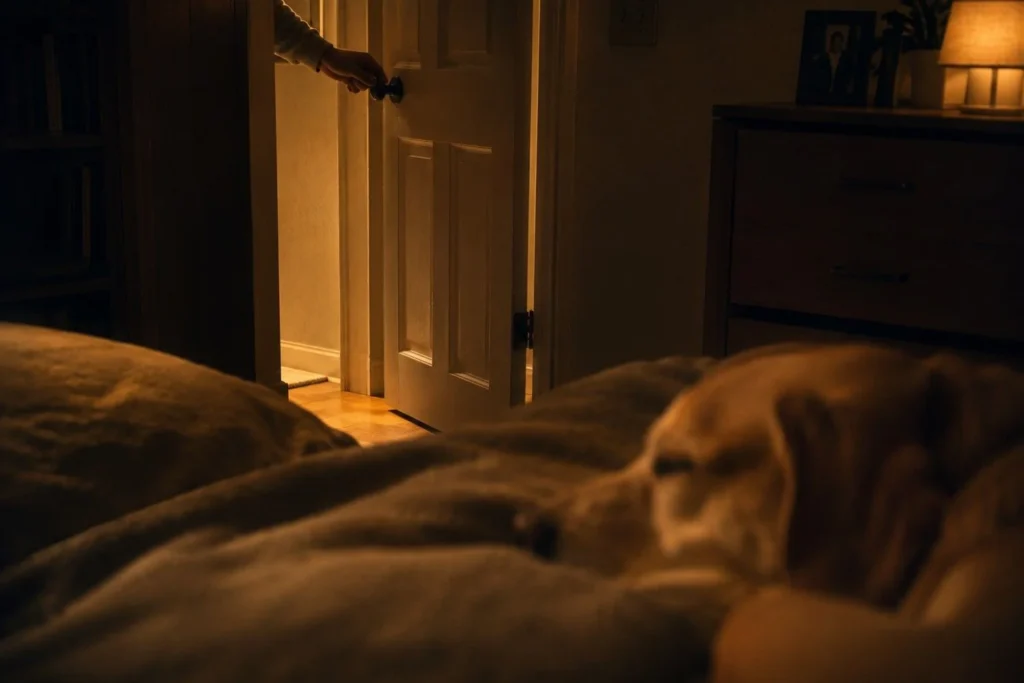
Desensitization is the systematic reduction of an anxiety response by repeated, low-intensity exposure to the trigger. For nighttime dog separation anxiety training, this means practicing micro-separations during the day first before attempting any overnight change.
During Week 1: Daytime Practice
- Ask your dog to stay in their designated sleep space
- Step just outside the doorway 5 to 10 seconds
- Return before any anxiety response begins
- Mark calm behavior with a calm “yes” and a small treat
- Repeat 6–8 times per session, twice daily
During Week 2: Extend Duration
- Increase to 30 seconds → 1 minute → 3 minutes → 5 minutes
- Extend only when the dog remains calm at the current duration
- Never return when the dog is actively anxious wait for even a brief pause in the behavior, then re-enter
By Weeks 3–4: Transfer to Nighttime
- Begin applying the same incremental approach at actual bedtime
- Use a baby gate instead of a closed door initially the dog can see and smell you
- Progress to a partially closed door, then a fully closed door over days
This graduated process is what separates lasting improvement from temporary quiet followed by regression.
Step 4 Manage Without Punishing (M)
Punishment makes separation anxiety worse. This is not an opinion, it is the single most well-supported finding in canine behavioral science on this topic. Shouting through the door, using spray bottles, or applying shock collars teaches the dog that being alone is both frightening and painful. The anxiety deepens.
What works instead:
- Baby gate instead of a closed door in early stages maintains visual and scent connection without full access
- Calming tools (covered in Section 4) used consistently
- Neutral, unemotional re-entries when you do go to your dog, keep it calm. No dramatic reunions.
And the hardest rule: Never go to your dog after they begin crying if you haven’t planned to do so. Going in after 20 minutes of howling teaches the dog that 20 minutes of howling = owner appears. That is a lesson you do not want to teach.
Step 5 Night-by-Night Progress Tracking (N)
What gets measured gets improved. A simple nightly log transforms vague progress (“I think it’s getting a little better?”) into clear data.
Track nightly:
- Time dog was settled in sleep area
- Time first anxiety behavior appeared (if any)
- Duration before resettling
- Calming aids used
- Any deviations from the routine
Most dogs with mild to moderate dog anxiety when left alone at night show measurable progress within 2–4 weeks of consistent CALM Night Framework application. Severe cases with long anxiety histories may require 8–12 weeks
Some dogs respond to nighttime separation by barking, whining, or repeatedly targeting doors and barriers. Our guide on How to Stop a Dog From Barking at the Door covers practical training techniques that can help reduce this behavior.
[IMG: Step-by-step illustration of dog desensitization training at night alt: how to train dog with separation anxiety at night step by step]
4. Best Calming Aids & Tools Compared (2026)
What to give a dog for separation anxiety at night depends on severity. The table below covers every major option so you can make the right choice for your dog’s specific situation.
Nighttime Calming Aids: 2026 Comparison
| Aid Type | How It Works | Best For | Approx. Monthly Cost | Effectiveness Rating |
| Pheromone diffuser (DAP) | Synthetic calming pheromone released into air | Mild to moderate ongoing anxiety | $25–$40 | ★★★★☆ |
| Anxiety wrap (e.g. Thundershirt) | Gentle, consistent pressure — activates calming response | Situational or predictable anxiety | $45–$55 (one-time) | ★★★☆☆ |
| Heartbeat plush toy | Simulates heartbeat and warmth of littermate | Puppies, newly adopted dogs | $35–$45 (one-time) | ★★★★☆ |
| Frozen food puzzle (Kong, etc.) | Engagement + positive association with alone time | Pre-bed routine, all anxiety levels | $5–$10 per use | ★★★★☆ |
| Vet-prescribed medication | Regulates serotonin / reduces anxiety threshold | Moderate to severe cases | Varies (requires vet) | ★★★★★ |
Winner for most dog owners in 2026: Combine a pheromone diffuser running continuously in the sleep area with a frozen food puzzle given at bedtime. This addresses the physiological component (calming chemistry) and the behavioral component (positive association with alone time) simultaneously. Add the Thundershirt for dogs that also show anxiety during thunderstorms or triggers outside of nighttime.
Separation Anxiety Toys for Dogs at Night
Separation anxiety toys safe for unsupervised overnight use:
- Frozen Kongs stuff with peanut butter, wet food, or banana and freeze the night before. The challenge keeps the dog engaged for 20–30 minutes after you leave the room.
- Snuffle mats hide small treats throughout for a calming scent-focused activity before lights out
- Heartbeat plush toys (SmartPet Love Snuggle Puppy is the most widely recognized option) particularly effective for puppies and recently rehomed adult dogs
- Lick mats the repetitive licking motion triggers endorphin release; effective as a pre-sleep calming activity
Expert Insight: Calming aids and toys reduce the dog’s anxiety enough to make training more effective but they do not replace training. A dog that sleeps calmly because of a pheromone diffuser will still panic the night the diffuser runs out. The goal is building genuine emotional resilience through behavioral work.
5. How to Crate Train a Dog with Separation Anxiety at Night
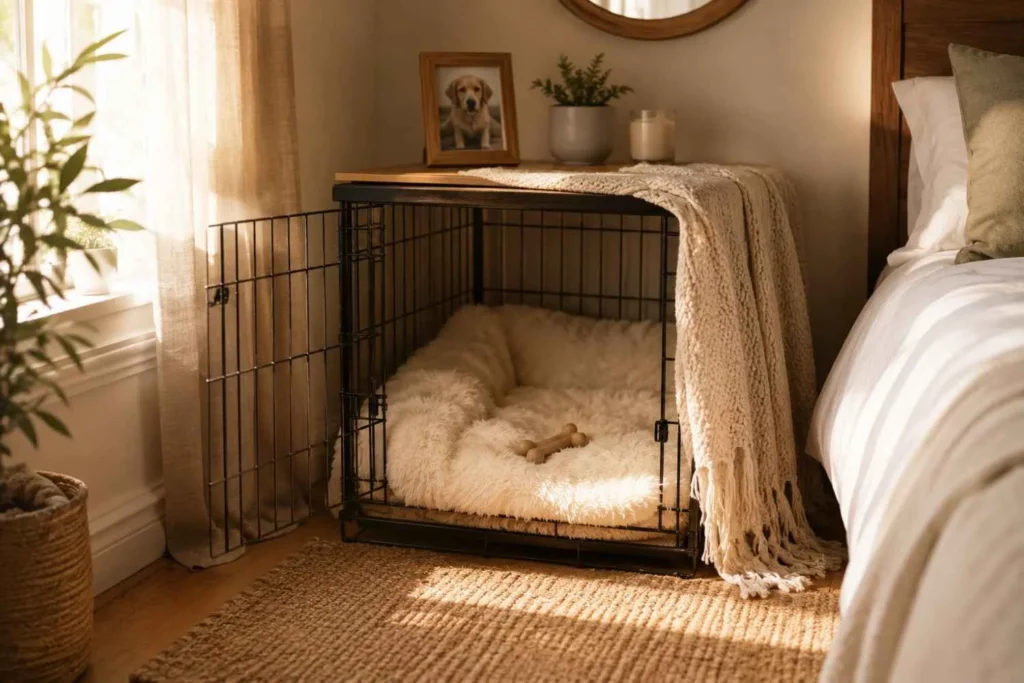
How to crate train a dog with separation anxiety is one of the most searched questions on this topic because most people approach it backwards. They put the dog in the crate too fast, too soon, with no foundation of positive association and end up with a dog that’s anxious everywhere, including in the crate.
Done correctly, a crate becomes the dog’s den: a small, enclosed, scent-familiar space that signals safety rather than confinement.
Not every dog with separation anxiety benefits from the same sleeping arrangement. Before deciding between confinement and freedom, read Crate Training vs Free Roaming: Which Is Better for Your Dog? to compare both approaches.
The 5-Stage Nighttime Crate Training Process
Stage 1 Introduction (Days 1–5) Leave the crate in the dog’s space with the door open and high-value treats scattered inside. No pressure. Let the dog explore freely at their own pace.
Stage 2 Mealtime Association (Days 5–10) Begin feeding every meal inside the crate with the door open. Do not close the door. The goal is: crate = food = good.
Stage 3 Brief Door Closure (Days 10–14) Close the crate door for 30–60 seconds while the dog eats. Open before they finish eating. Gradually extend over days never past the point of calm.
Stage 4 Location Placement Move the crate to the nighttime location starting next to your bed, then gradually moving it further over 2–3 weeks. Cover the crate with a heavy blanket to reduce visual stimulation and create a den-like environment.
Stage 5 Overnight Transition Begin with the dog in the crate for 1–2 hours at night (not the full night), in a calm, non-anxious state. Extend incrementally. Use a worn clothing item inside the crate throughout.
The Non-Negotiable Rule: A dog with active, unresolved separation anxiety should not be locked in a crate for hours before trust is fully established. Forced confinement during peak anxiety can cause physical injury, broken teeth, bloody paws from digging and significantly deepen the behavioral problem.
6. Mistakes That Make Nighttime Anxiety Worse
These are the errors that most dog owners make not out of negligence, but because the advice sounds logical until you understand the behavioral science behind separation anxiety.
Mistake 1: Responding to Crying at Night
This is the most common mistake. The moment you go to your dog after they’ve been crying, you have reinforced the behavior. Not intentionally but behaviorally. The dog has learned: “Crying at 2 AM produces my owner.” That is now a strategy.
This is intermittent reinforcement, the most powerful reinforcement schedule in behavioral learning. Every time you respond sometimes but not always, the behavior strengthens.
Mistake 2: Big Emotional Bedtime Goodbyes
Long, loving, apologetic goodbyes even with the best intentions teach the dog that your departure is a major, concerning event. Keep bedtime departures matter-of-fact. No drama in either direction.
Mistake 3: Moving Too Fast
Going from sleeping in your bedroom together to sleeping alone in the kitchen is not a step, it’s a leap. Separation anxiety responds only to gradual, incremental change. Every jump that’s too large resets progress.
Mistake 4: Skipping Exercise
A dog that hasn’t burned energy is physiologically unable to fully relax. Daily exercise is not optional for a dog with dog anxiety when left alone it is part of the treatment. Under-stimulated dogs hit their anxiety threshold faster at night because their nervous system was already primed during the day.
Mistake 5: Treating It Like Disobedience
Punishment shouting, spray bottles, shock collars, leash corrections does not address the emotional root of dog separation anxiety. It creates an association between aloneness and pain. The anxiety worsens. This approach has no place in modern behavioral treatment.
7. Separation Anxiety in Older Dogs at Night
Separation anxiety in older dogs at night deserves its own section because the causes, presentation, and treatment are often completely different from puppy or young adult anxiety.
In dogs aged 8 and above, sudden or worsening nighttime distress may indicate:
Canine Cognitive Dysfunction Syndrome (CCDS) the canine equivalent of dementia. One hallmark feature is sundowner behavior: disorientation and anxiety that worsens after dark. An older dog pacing, staring at walls, or seeming confused at night is showing CCDS signs not classic separation anxiety.
Pain onset arthritis, dental disease, and organ discomfort worsen at night when the dog is still and there are no distractions. A dog that was perfectly settled at night and suddenly isn’t in pain.
Vision or hearing deterioration sensory decline makes the dark and quiet of nighttime genuinely disorienting. Night lights placed low to the ground can make a meaningful difference for dogs with declining vision.
Metabolic and hormonal changes affect sleep regulation and can produce anxiety-like symptoms indistinguishable from behavioral separation anxiety.
If your dog’s nighttime anxiety appears suddenly with no change in environment or routine, a veterinary examination comes before any behavioral training. Treating behavioral anxiety in a dog that is actually in pain does nothing. Treating the pain often resolves the nighttime distress completely.
8. When to Call a Dog Behaviorist for Separation Anxiety
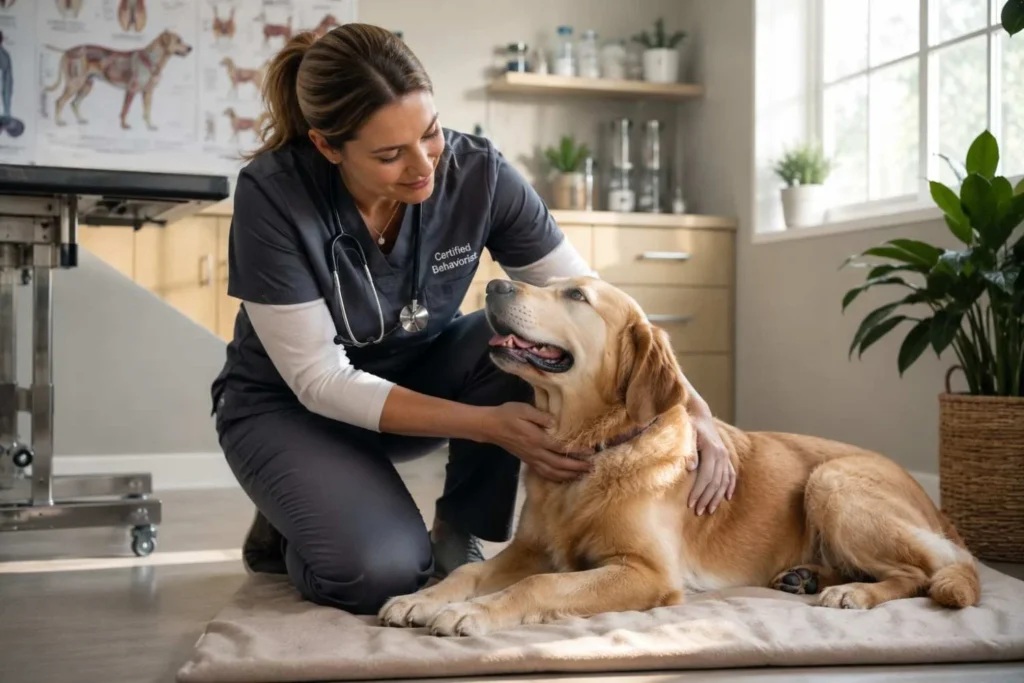
A dog behaviorist for separation anxiety should be your next step when:
- Your dog has caused self-injury during anxiety episodes (bleeding paws, broken nails, damaged teeth from crate chewing)
- You have followed a structured training program for 8+ weeks with no measurable improvement
- The dog’s anxiety is so severe that even brief 5-minute daytime separations produce a full panic response
- Sleep deprivation has become a safety or health issue for you or your household
- Other people in your home children, elderly family members are being disrupted every night
Which Professional Do You Need?
- Certified Applied Animal Behaviorist (CAAB) requires a graduate degree in behavioral science; the highest non-veterinary credential for dog behavior
- Diplomate of the American College of Veterinary Behaviorists (DACVB) a veterinarian with specialist behavioral training; can prescribe medication; appropriate for severe cases
- Certified Separation Anxiety Trainer (CSAT) a specialized credential focused specifically on separation anxiety treatment; many work remotely via video
Remote behavioral consultations have become significantly more accessible in 2026. Many certified trainers now offer video-based programs specifically for separation anxiety dog training, which allows them to review your pet camera footage and provide personalized protocols without requiring in-person visits.
Nighttime Calming Aids: Full Comparison at a Glance
| Option | Key Feature | Best For | Cost | Rating |
| Pheromone diffuser (DAP) | Continuous calming pheromone | Ongoing mild–moderate anxiety | $25–$40/mo | ★★★★☆ |
| Thundershirt / anxiety wrap | Deep pressure stimulation | Situational anxiety events | $45–$55 one-time | ★★★☆☆ |
| Frozen Kong | Engagement + reward association | Pre-bed routine anchor | $5–$10/use | ★★★★☆ |
| Heartbeat plush toy | Simulates littermate warmth/heartbeat | Puppies and newly adopted dogs | $35–$45 one-time | ★★★★☆ |
| Vet-prescribed medication | Serotonin modulation | Severe, treatment-resistant anxiety | Varies (vet Rx) | ★★★★★ |
Recommended starting combination for most dogs: Pheromone diffuser (running 24/7 in sleep area) + frozen Kong at bedtime + consistent CALM Night Framework application. This covers physiological, environmental, and behavioral components simultaneously without requiring medication.
9. Conclusion & Next Steps
How to help a dog with separation anxiety at night comes down to three truths that every dog owner in this situation needs to hear:
First: Your dog is not being manipulative. Nighttime dog separation anxiety is a fear response and fear requires patience, structure, and consistency to resolve, not punishment.
Second: The CALM Night Framework works when applied consistently. Most owners see real improvement within 2–4 weeks. The ones who don’t are the ones who skip steps or give in inconsistently.
Third: If the anxiety appears suddenly especially in an older dog see a vet before you start any training. Medical causes require medical solutions first.
Your dog can learn that nighttime is safe. They can learn that your absence means rest, not danger. But you have to teach them one small, consistent step at a time.
10. FAQ: People Also Ask
What is dog separation anxiety at night?
Dog separation anxiety at night is a behavioral condition in which a dog experiences acute distress howling, scratching, panting, or destructive behavior specifically when separated from their primary attachment person during nighttime hours. It is a genuine fear response driven by the dog’s threat-detection system, not deliberate misbehavior or manipulation.
How do I know if my dog has separation anxiety at night?
The defining feature of separation anxiety in dogs is context-specificity: the distress begins precisely when you separate when you close the bedroom door or go to bed and it reduces or stops when you return. Setting up a pet camera to observe behavior 10–20 minutes after you go to bed is the fastest and most accurate way to confirm it.
Why is my dog anxious at night all of a sudden?
Sudden nighttime anxiety especially in a dog that was previously calm most often has a medical trigger. Pain onset, vision or hearing loss, hormonal changes, or canine cognitive dysfunction are the most common causes. A veterinary examination should always be the first step before starting any behavioral training when the anxiety appears suddenly.
How to help a dog with separation anxiety at night without medication?
You can help a dog with separation anxiety at night without medication by applying the CALM Night Framework: create a consistent safe sleep space, anchor a pre-bed ritual, practice graduated daytime desensitization, use a pheromone diffuser and frozen food puzzle, and track progress nightly. Mild to moderate cases typically respond to behavioral training alone within 4–8 weeks of consistent application.
Is it okay to let my dog sleep in my bed if they have separation anxiety?
Co-sleeping does not cause separation anxiety but it can delay the development of the emotional independence the dog needs. If your dog cannot tolerate sleeping separately, co-sleeping is a short-term management option. The long-term goal should always be building the dog’s ability to feel safe alone, because life will inevitably require periods of separation.
What are the best calming aids for dog separation anxiety at night?
The best calming aids for nighttime dog anxiety when left alone include pheromone diffusers (DAP/Adaptil), anxiety wraps, frozen food puzzles, heartbeat plush toys (for puppies and recently rehomed dogs), and lick mats used before bed. For severe cases, veterinary-prescribed medications are the most effective option and should always be discussed with a licensed vet.
How to fix my dog’s separation anxiety at night quickly?
There is no overnight fix for dog separation anxiety at night but consistent application of the CALM Night Framework produces measurable improvement within 2–4 weeks in most cases. The fastest results come from combining a structured pre-bed routine, graduated desensitization, and appropriate calming aids at the same time. Shortcuts punishment, forced confinement, or simply ignoring the behavior consistently make the condition worse.
How to leave a dog home alone with separation anxiety at night?
Before leaving a dog alone overnight, ensure their sleep space has: a worn piece of your clothing for scent comfort, a frozen food puzzle for engagement, a pheromone diffuser running, and ambient sound (low-volume radio or TV). If your dog has active separation anxiety, practice extended daytime alone periods before attempting a full overnight absence.
Can separation anxiety in dogs be cured completely?
Many dogs with mild to moderate separation anxiety achieve full resolution with consistent behavioral training. Severe or long-standing cases may require ongoing management rather than complete cure but even these dogs can reach a quality of life where nighttime distress is minimal and manageable. Starting treatment early significantly improves the prognosis.
What are the signs of separation anxiety in dogs at night specifically?
The most specific signs of separation anxiety in dogs at night are: whining or howling that begins within minutes of you going to bed, scratching at the bedroom door, panting without physical cause, inability to settle, pacing, and loss of appetite the following morning. These behaviors are context-specific; they appear at separation and resolve when you return.