

If your dog follows you everywhere, it’s usually because they feel safe, comfortable, and connected to you. Many dogs naturally stay close to their owners due to social instincts, daily routines, and strong emotional bonds. In some cases, however, constant following can be linked to boredom, fear, age-related changes, or separation anxiety especially if your dog becomes distressed when left alone.
You stand up to grab a glass of water, and before your foot even hits the floor, your dog is already up too trailing half a step behind, like you’re attached by an invisible leash. Shut the bathroom door and a nose slides underneath it within seconds. Some days it feels sweet. Other days you wonder if your dog has ever once chosen to be in a different room than you, voluntarily, for fun. Why does my dog follow me everywhere? It’s one of the most-asked questions any dog owner types into a search bar at 11pm, usually right after tripping over their own pet for the third time that day and the honest answer is that it’s almost never just one reason.
Dogs that shadow their humans through every room are nicknamed “Velcro dogs,” and the behavior sits on a spectrum of healthy attachment and instinct on one end, separation anxiety on the other. A large-scale reassessment of dog behavior survey data found that roughly 9.3% of dogs show separation-related behavior at a clinically meaningful level, while broader owner-reported surveys put proximity-seeking and follow-around behavior in a far larger share of pet dogs. Figuring out where your own dog sits on that line loving shadow or genuinely anxious is exactly what this guide is built to help you do.
In this guide, you’ll learn:
- The 7 real reasons dogs follow their owners everywhere instinct, hormones, breed, and learned behavior
- How to tell the difference between healthy attachment and separation anxiety signs
- What changes when a rescue dog, an older dog, or a dog that follows you to the toilet specifically does it
- A step-by-step framework for reducing clingy following without damaging your bond
- When nighttime following is a different problem than daytime following and what to do about it
- Answers to the 8 most common follow-up questions owners search for
This guide pulls from veterinary behaviorists, peer-reviewed canine anxiety research, and established clinical training advice then goes further into the breed-by-breed data, the hormone science, and the night-specific patterns that most articles skip. Let’s start with the table of contents.
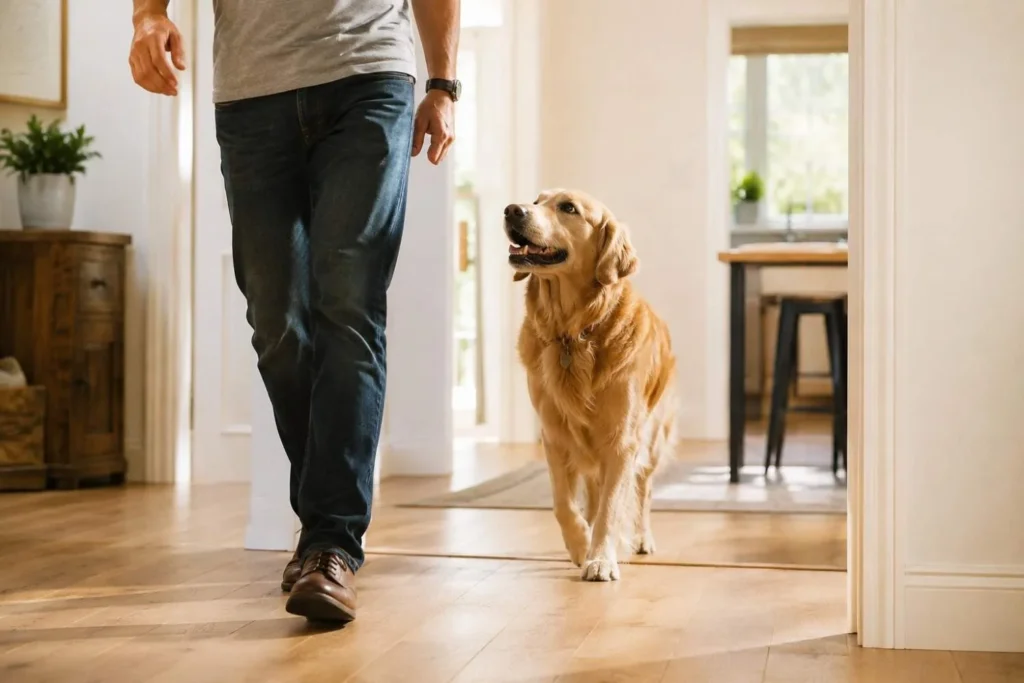
Table of Contents
- What It Means When Your Dog Follows You Everywhere
- The 7 Real Reasons Dogs Follow Their Owners
- Velcro Dog vs. Separation Anxiety: How to Tell the Difference
- Why Does My Dog Follow Me to the Toilet Specifically?
- Why a Rescue Dog or Older Dog Follows You Differently
- The Following Behavior Comparison Table
- The 5-Step Calm Independence Framework
- Common Mistakes That Make Following Worse
- When Following Turns Into Nighttime Separation Anxiety
- Conclusion & Next Steps
- FAQ: Why Does My Dog Follow Me Everywhere?
What It Means When Your Dog Follows You Everywhere
Velcro dog behavior is defined as a pattern where a dog consistently follows one or more household members from room to room, often resisting being left alone in any space without them. It is not a diagnosis, it’s a description of a behavior that can come from several different underlying causes.
The question “why does my dog follow me everywhere” doesn’t have a single textbook answer because dogs follow for fundamentally different reasons depending on age, breed, history, and what’s happening in the house that day. A 6-month-old Labrador puppy trailing you to the kitchen is doing something biologically different from a 9-year-old rescue dog who panics the moment you’re out of sight.
Pro Tip Expert Insight: Veterinary behaviorists point out that puppies from birth to roughly six months old can imprint on their owners much the way they would on their mother which is why following is strongest and most automatic in young dogs, and why it should gradually soften as they mature.
The 7 Real Reasons Dogs Follow Their Owners Everywhere
Why does my dog follow me everywhere? The short answer: instinct, hormones, habit, and sometimes anxiety, layered on top of each other. Here’s the breakdown.
1. Pack Instinct and Domestication
Dogs descend from animals that survived in cooperative social groups, and that wiring didn’t disappear with domestication. Pack mentality in modern dogs translates into your household becoming their group, and staying near the group is the default, low-effort strategy for feeling secure. This is why your dog follows you everywhere in the house even when nothing interesting is happening. Proximity itself is the reward.
2. Oxytocin and the Human-Dog Bond
When dogs interact with someone they’re attached to, their bodies release oxytocin, the same hormone involved in human bonding and trust. This is a measurable physiological response, not just a behavioral guess. It’s part of why being near you can feel rewarding to your dog in a literal neurochemical sense, similar to how it functions in human relationships.
3. Positive Reinforcement (Often Unintentional)
If your dog gets attention, treats, or plays every time they’re near you, following becomes a learned strategy for getting good outcomes. Even scolding counts as attention in a dog’s mental model so a dog that gets told “no” for following you around may still keep doing it, because any reaction beats being ignored.
4. Breed-Specific Following Tendencies
Dogs bred for centuries to work in close physical coordination with humans herding breeds, retrievers, and many companion breeds are generally less independent than breeds developed to work alone, like terriers and livestock guardians. This is a real, documented behavioral difference, not just owner perception, and it’s why my dog always follows me everywhere and gets a different answer depending on whether you own a Border Collie or a Basenji.
5. Boredom and Under-Stimulation
A dog with pent-up energy and nothing to do will often find you more interesting than an empty room. Following becomes a form of self-entertainment. If your dog watches you brush your teeth like it’s premium content, under-stimulation is a likely contributor.
6. Fear, Noise Sensitivity, and Seeking Reassurance
Dogs that are startled by thunderstorms, fireworks, or unfamiliar sounds often treat their owner as a safety base and stay close until the perceived threat passes. A large-scale study tracking nearly 13,700 pet dogs found that noise sensitivity was the single most common anxiety-related trait, present in about 32% of dogs and noise-sensitive dogs showed significantly higher rates of general fearfulness and separation-related behavior as well. If your dog’s following spikes specifically around loud noises, this is likely the driver, not separation anxiety in general.
7. Separation Anxiety
This is the reason that actually warrants concern. Separation anxiety in dogs is defined as a distress response that occurs specifically when a dog is left alone or separated from its primary attachment figure, with measurable physiological stress markers not simply a preference for company. Prevalence estimates vary a lot by methodology: rigorous clinical-criteria studies put separation-related behavior at roughly 9%–17% of dogs, while broader owner-questionnaire surveys report figures as high as 33%–55%, depending on how loosely “anxiety” is defined. Separate survey data suggests around a third of pet owners believe their dog suffers from separation anxiety, but the gap between owner perception and clinical diagnosis is real and significant, meaning plenty of “Velcro dogs” are simply affectionate, not anxious.
Velcro Dog vs. Separation Anxiety: How to Tell the Difference
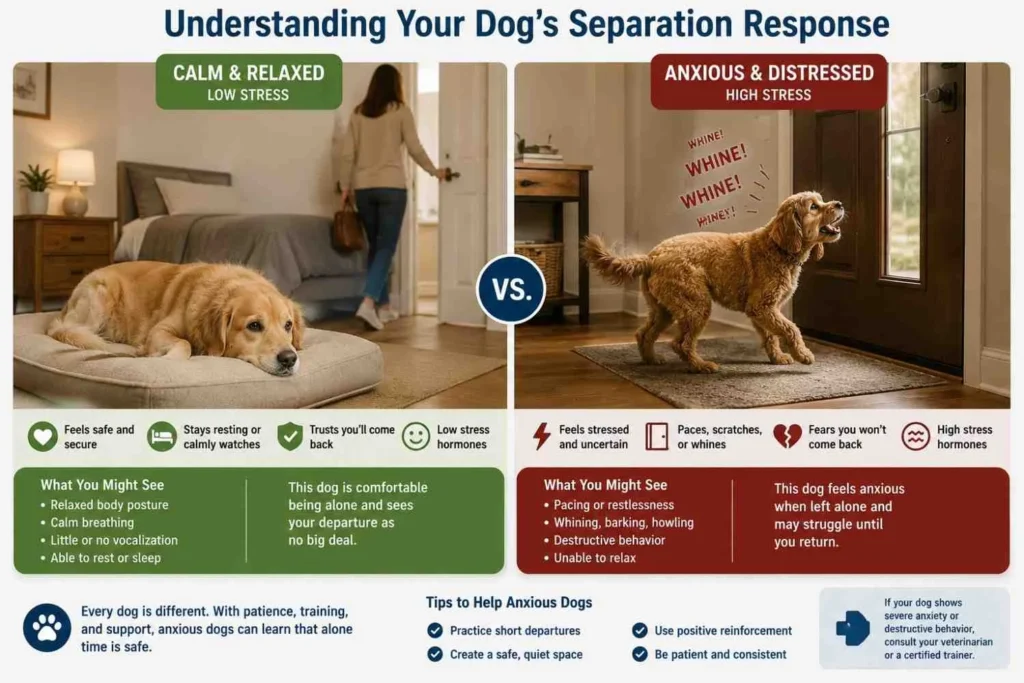
This is the single most important distinction in this entire guide, and it’s the one most articles blur together. A dog that loves your company is not automatically a dog with a disorder.
The Following Behavior Spectrum (an original framework for this guide) places dogs on a continuum from Companionable to Clinical:
- Companionable Follower: Stays near you by choice, but settles calmly in another room, eats normally when alone, and shows no panic at departure cues.
- Habitual Follower: Follows out of boredom or routine reinforcement; mildly inconvenient but not distressed when separated.
- Anxious Follower: Becomes visibly distressed before you leave pacing, panting, whining at departure cues like picking up keys or putting on shoes.
- Clinical Separation Anxiety: Shows destructive behavior, prolonged vocalization, and inappropriate elimination within minutes of being left alone, regardless of how much exercise or attention they got beforehand.
Pro Tip Expert Insight: If you’re unsure where your dog falls, set up a phone or camera and leave for 5–10 minutes. Dogs that bark a few times, settle, then bark again occasionally are typically bored. Dogs that escalate continuously from the moment the door closes are showing genuine anxiety signs, not boredom.
| Signal | Companionable / Habitual | Separation Anxiety |
| Behavior before you leave | Calm or mildly curious | Pacing, panting, whining at departure cues |
| Behavior in first 5 minutes alone | Settles within minutes | Escalating barking, howling, or destruction |
| Bathroom-door following | Sits outside, calm | Scratches, whines, can’t settle |
| Eating/treats while you’re gone | Normal | Often refuses food |
| Response to crate training or a safe space | Adapts within days | Resists, escapes, or injures self trying to get out |
Why Does My Dog Follow Me to the Toilet Specifically?
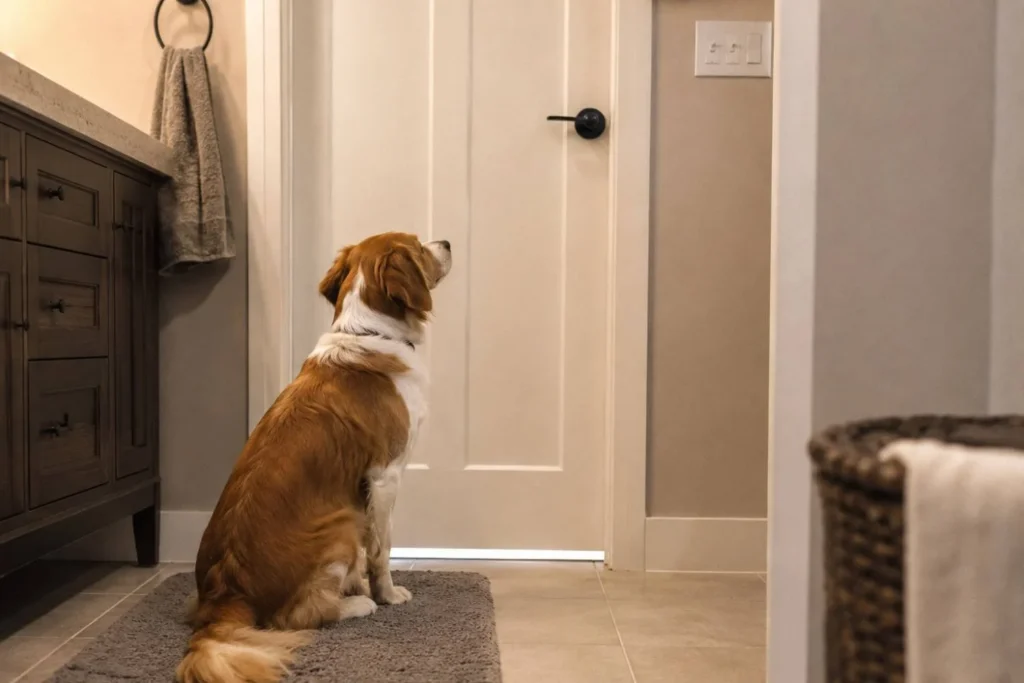
Why does my dog follow me to the toilet is one of the most-searched variations of this question, and the answer is almost always benign. Closed doors are unusual in a dog’s world most rooms in the house are open to them, so a closing door reads as a potential departure cue, triggering the same instinct that makes them follow you to the front door or the car.
There’s also a simpler explanation: some behaviorists note dogs may be drawn by the specific sounds and smells involved, and the closed door itself becomes the trigger rather than anything mysterious about bathroom habits specifically. If your dog is calm everywhere else in the house but frantic at a closed bathroom door, it’s the door, not separation anxiety.
Why a Rescue Dog or Older Dog Follows You Differently
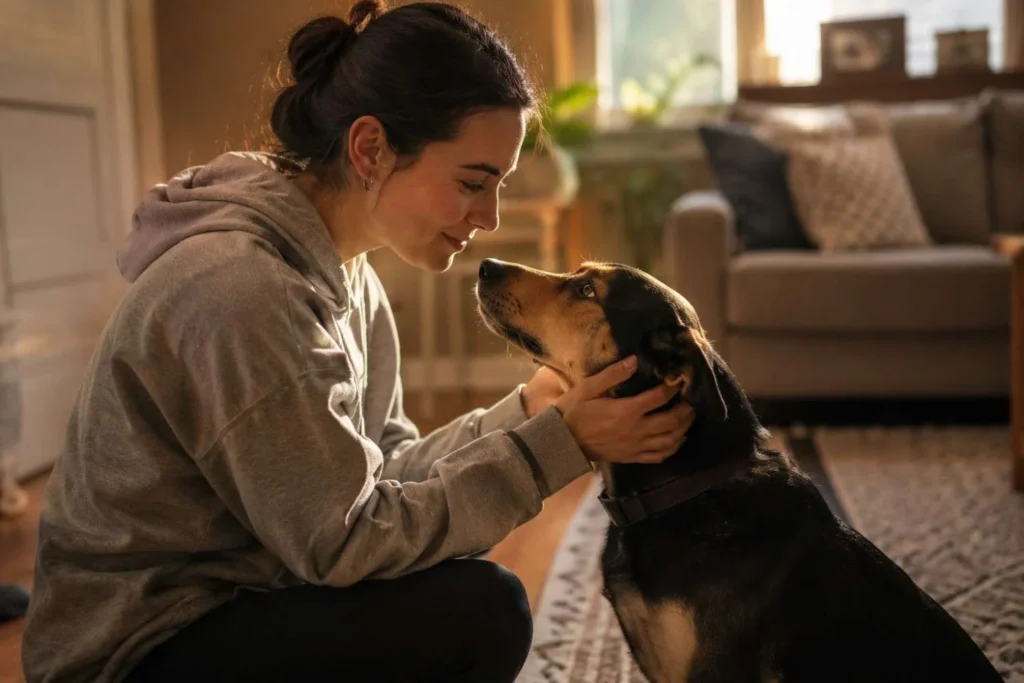
Why does my rescue dog follow me everywhere and has a different baseline than other dogs? Rescue dogs frequently come from backgrounds involving rehoming, shelter stays, or inconsistent caregiving, and attaching intensely to a new, stable person is a common and often temporary adjustment response. Give a newly adopted rescue dog several weeks of predictable routine before treating heavy following as a long-term problem; for many dogs, it eases naturally as trust builds.
Why does my older dog follow me everywhere can point to a different cause entirely: cognitive changes. Senior dogs sometimes develop canine cognitive dysfunction syndrome (CDS) , the canine analog to dementia which can cause confusion, disorientation, and a sudden increase in clinginess, especially as daylight fades. If an older dog’s following behavior appeared suddenly rather than gradually, a veterinary checkup should come before any behavior training, since pain and cognitive decline both mimic anxiety symptoms.
Why is my dog following me everywhere suddenly in dogs of any age is a phrase worth taking seriously. A sudden change (as opposed to a gradual lifelong pattern) is one of the clearest signals that something specific shifted: a new household stressor, a medical issue, a missed meal schedule, or even mild pain that makes your dog want backup nearby. Sudden-onset following always deserves a vet visit before a training plan.
The Following Behavior Comparison Table
Why Does My Dog Follow Me Everywhere Comparison by Likely Cause:
| Cause | Key Sign | Best For | Typical Fix | Vet Visit Needed? |
| Pack instinct / bonding | Calm following, settles easily | Most healthy adult dogs | No action needed | No |
| Boredom | Follows during downtime, ignores you when busy elsewhere | Under-exercised dogs | Puzzle toys, more exercise | No |
| Reinforcement habit | Follows specifically around mealtimes/treat times | Dogs trained accidentally via attention | Reward calm independence, not following | No |
| Breed predisposition | Lifelong pattern since puppyhood | Herding/retriever/companion breeds | Manage expectations, structured training | No |
| Rescue attachment | Appeared after adoption, easing over weeks | Newly adopted dogs | Patience + consistent routine | Only if not easing after 4–6 weeks |
| Cognitive decline (senior dogs) | Sudden onset, confusion, nighttime worsening | Senior dogs (7+ years) | Veterinary evaluation first | Yes, immediately |
| Separation anxiety | Distress before/during departure, destructive behavior alone | Any age, any breed | Desensitization + possible vet-guided treatment | Yes |
The Verdict: If your dog’s following is calm, settles when you ask, and doesn’t escalate into panic when you’re out of sight, you’re almost certainly dealing with healthy attachment with no intervention needed. If it includes pre-departure panic, destructive behavior, or sudden onset, move to the framework below and involve your vet.
The 5-Step Calm Independence Framework
This is an original, named process for this guide built specifically to reduce excessive following without breaking the trust that makes dogs bond to people in the first place.
Step 1: Stop Reinforcing the Follow Don’t greet, pet, or talk to your dog the instant they follow you into a room. Wait until they’re settled elsewhere before offering attention. This single change removes the reward loop driving habitual following.
Step 2: Build a Designated Safe Space Set up a bed or crate training space with familiar bedding in a room you’re not currently in. Reward calm time spent there with a stuffed chew or puzzle toy, separate from any interaction with you.
Step 3: Practice Micro-Separations Leave the room for 10–30 seconds at a time, returning before your dog shows distress. This is desensitization in its simplest form: building tolerance to brief absence before attempting longer ones.
Step 4: Extend Duration Gradually Once your dog tolerates seconds calmly, stretch to minutes, then to a full room-to-room separation while you’re still in the house, then to short departures outside the home.
Step 5: Add Physical and Mental Exercise Before Independence Practice A tired dog settles faster. Schedule a walk or active play session before independence training, not after, so your dog has less spare energy fueling the urge to follow.
Real-World Example
A 2-year-old rescue Labrador mix named Biscuit followed her new owner into every room, including the shower, within her first month home. Her owner applied this exact framework ignoring the following, rewarding settled time in a dedicated bed near (not in) the kitchen, and building separations from 15 seconds to 20 minutes over three weeks. By week four, Biscuit could stay calmly in her bed while her owner showered with the door shut, a change owners frequently report once reinforcement and gradual separation are applied consistently.
Common Mistakes That Make Following Worse
- Making departures and returning emotional events. A big, excited “I’m back!!” teaches your dog that your absence is something dramatic, which heightens anxiety about future departures rather than reducing it.
- Punishing the dog for following. Scolding still counts as attention in a dog’s mind, often reinforcing the very behavior you’re trying to stop.
- Skipping the vet visit on sudden-onset cases. Treating new, sudden clinginess as a training problem when it’s actually pain or cognitive decline delays real treatment.
- Going straight from 0 to a full day alone. Jumping straight to a full workday departure without building tolerance through shorter separations first is one of the most common triggers for true separation anxiety to develop or worsen.
- Confusing a Velcro dog with an anxious one. Applying anxiety-level interventions (medication, intensive desensitization) to a dog that’s simply affectionate wastes effort and stresses the dog unnecessarily and the reverse, ignoring genuine anxiety signs because “he’s just clingy,” delays needed help.
When Following Turns Into Nighttime Separation Anxiety
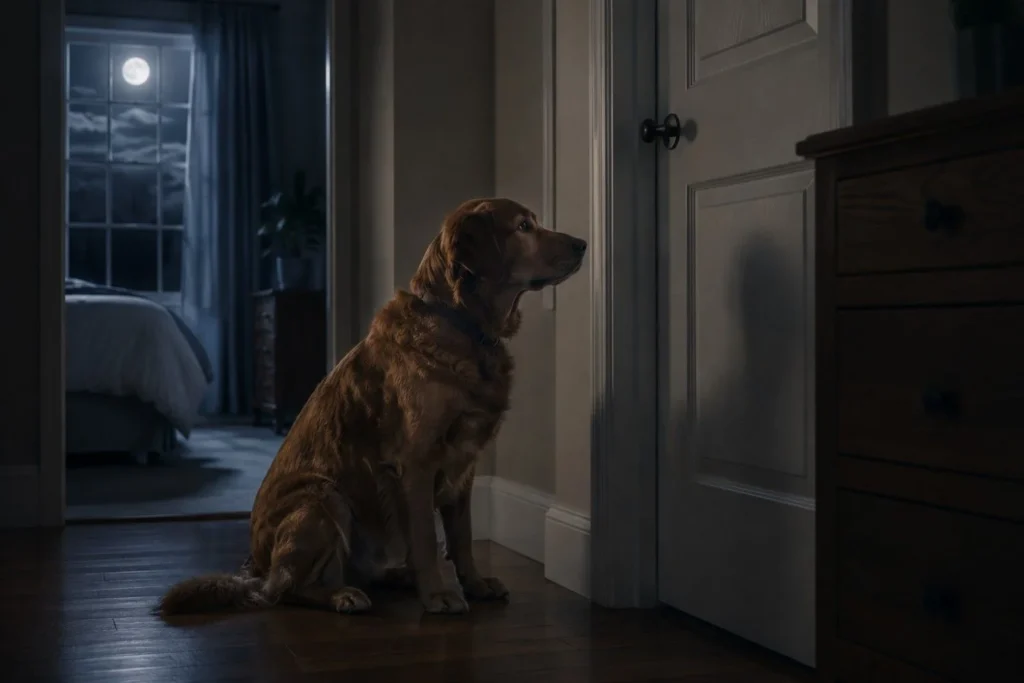
Daytime following and nighttime following are not the same problem, and this is the gap most general “why does my dog follow me everywhere” guides skip entirely. At night, the environment is darker, quieter, and longer in duration than a typical daytime separation which means a dog who follows you calmly all day can still struggle significantly once the bedroom door closes. Nighttime anxiety in dogs often shows up as whining, pacing, or scratching at a door specifically at bedtime, even in dogs who show zero distress during the day.
If your dog follows you everywhere by day but the real struggle happens at lights-out escalating whining, scratching at the bedroom door, or an inability to settle without physical contact, that’s a distinct condition with its own causes and its own fix.
Our complete guide on how to help a dog with separation anxiety at night breaks down bedtime-specific routines, where to place a dog’s bed relative to yours, and how to use calming aids like pheromone diffusers safely for overnight use go there next if nighttime is your dog’s specific trigger point.
Conclusion
Why does my dog follow me everywhere? Most of the time, the answer is instinct, bonding hormones like oxytocin, and learned habits not a disorder. The real work is distinguishing a Companionable Follower from a dog showing genuine separation anxiety signs, because the right response is completely different for each.
Next steps:
- Run the 5–10 minute camera test from this guide to see exactly how your dog behaves once you’re out of sight
- Start the 5-Step Calm Independence Framework if your dog’s following is reinforced habit rather than panic
- Book a vet visit immediately if the following is sudden, your dog is a senior, or distress signs appear before you even leave the room
FAQ: Why Does My Dog Follow Me Everywhere?
Why does my dog follow me around everywhere?
Most dogs follow their owners because of pack instinct, learned habits, and a strong emotional bond. Being close to you feels safe and rewarding for your dog. In most cases, this behavior is completely normal. It only becomes a concern if your dog shows signs of panic or distress when separated from you.
Why does my dog follow me everywhere I go, even outside?
Dogs that follow outdoors as well as indoors are usually showing strong attachment plus a desire to monitor your movements, since outdoor spaces feel less predictable to a dog than the home. This is typically normal unless paired with stress signals like panting or tucked ears in calm conditions.
Why does my dog follow me everywhere in the house but ignore me outside?
This usually points to indoor boredom rather than attachment. Your dog may find you more interesting than an empty room. Outside, there are many sights, sounds, and smells to explore. Because of this extra stimulation, following you becomes less important.
Why is my dog following me everywhere suddenly when they never used to?
Sudden-onset following, especially in an adult or senior dog, often signals a new stressor, pain, or in older dogs, the early stages of cognitive decline. A veterinary visit should come before any behavioral training plan.
Why does my dog follow me to the toilet every single time?
Closed doors trigger a dog’s instinct to monitor potential departures, since most doors in a home stay open. The bathroom is rarely about anything specific; it’s the closed door, not the room, that prompts the following.
Why has my rescue dog followed me everywhere since I adopted them?
New rescue dogs often form a strong attachment to their first stable caregiver. This is part of the adjustment process in a new home. In many cases, the behavior eases after a few weeks of routine and consistency. If it doesn’t improve after 4–6 weeks, structured independence training can help.
Why does my older dog follow me everywhere all of a sudden?
In senior dogs, sudden clinginess can be an early sign of canine cognitive dysfunction syndrome. It may also appear alongside nighttime confusion or disorientation. This behavior should be evaluated by a veterinarian. Don’t assume it is simply a normal part of aging.
Is it normal for my dog to constantly follow me everywhere?
Yes. Constant following is common in many dogs, especially companion and herding breeds. It is usually normal if your dog can relax when left alone. Watch for signs of panic or distress when separated. If your dog cannot settle independently, the behavior may require further evaluation.