

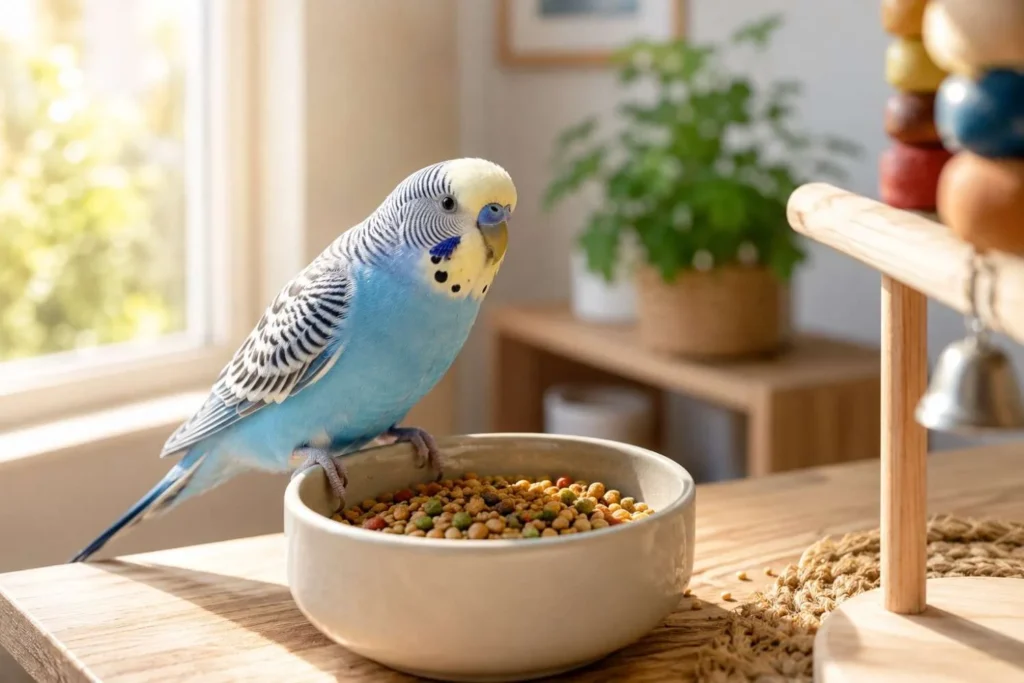
Most feeding problems in pet birds aren’t about what’s in the bowl they’re about when and how much. An owner who knows the right food but feeds it at random times, in the wrong amount, still ends up with an overweight, undernourished, or stressed bird. Learning how to feed pet birds at home properly means building a routine, not just picking a diet.
This guide focuses specifically on that routine: how often to feed, how much to serve, when in the day to feed, and how to set up bowls so feeding time stays consistent and low-stress for both of you. Think of it as how to feed pet birds for beginners, step by step, without assuming prior experience. If you’re also wondering exactly what pet bird food should contain specific foods, nutrients, and safe options, that’s a separate deep dive worth exploring once this routine is in place.
In this guide, you’ll learn:
- How often birds actually need to eat, by age and species
- How to work out portion size without guessing
- The best times of day to feed a pet bird
- How to set up feeding bowls so mess and waste drop
- How to transition a bird from seed to pellets without a hunger strike
- The most common feeding mistakes that quietly cause health problems
Key Takeaways:
- Feeding frequency should match species and age small birds need near-constant access, large parrots do better with two structured meals
- Portion size depends on species, age, and activity level, not a single fixed cup measurement
- Morning and evening are the two best feeding windows, mirroring a bird’s natural activity peaks
- Pellet transitions should happen gradually over 4–6 weeks, never all at once
- Weekly weight checks are more reliable than judging intake from the bowl
Let’s start with what a proper feeding routine actually looks like.
Table of Contents
- What “Feeding a Pet Bird” Actually Involves
- Why a Consistent Pet Bird Feeding Schedule Matters
- How Often Should Birds Eat?
- How Much Food Does a Bird Need?
- Best Time to Feed Pet Birds: A Daily Routine
- Seed vs Pellet: How to Manage the Switch
- Feeding Bowl Setup and Foraging Feeding
- Feeding Chart by Bird Species
- Bird Feeding Mistakes to Avoid
- Frequently Asked Questions
What Feeding a Pet Bird Actually Involves
How to feed pet birds at home is defined as the combination of feeding frequency, portion control, timing, and bowl setup that keeps a bird’s intake steady and predictable. It’s a routine, not a single decision made once at the pet store.
Birds regulate their appetite differently than cats or dogs. Most species are natural grazers that would eat small amounts frequently throughout the day in the wild, foraging as they go. A pet bird fed once, in one big serving, tends to overeat early and go hungry later which is part of why bird feeding routine for beginners so often goes wrong in the first few weeks.
Why a Consistent Pet Bird Feeding Schedule Matters
A pet bird feeding schedule does more than prevent overeating it’s one of the strongest signals of safety and predictability a bird can receive. Birds that know food arrives at roughly the same times each day show less food-guarding behavior and settle into a household routine faster.
Inconsistent feeding, on the other hand, tends to show up as one of two problems: a bird that gorges the moment food appears (because it’s learned meals are unpredictable), or a bird that picks at food and leaves most of it, making it hard to tell whether it’s actually eating enough.
Pro Tip: If you’re not sure whether your bird is eating enough, don’t just watch the bowl weigh your bird weekly on a small gram scale. Bowl level is misleading because birds scatter and hull seeds, making a full-looking bowl deceptive.
How Often Should Birds Eat?
How often should birds eat? Most pet birds need access to fresh food at least twice a day, though small, fast-metabolism species like budgies and canaries do better with food available closer to constantly, refreshed once or twice daily.
Wondering how many times a day feed a bird needs, by species? A general breakdown:
- Small birds (budgies, canaries, finches) Constant access to pellets/seed mix, with fresh food and water refreshed morning and evening
- Medium birds (cockatiels, lovebirds, conures) Two main feedings (morning and evening) plus a small midday fresh-food offering
- Large parrots (African greys, amazons, macaws) Two structured meals daily, often with foraging opportunities spread through the day rather than free-feeding
Feeding young vs adult birds also changes frequency. Young, growing birds, especially those recently weaned, often need smaller, more frequent feedings than a settled adult of the same species, since their energy demands per body weight are higher.
How Much Food Does a Bird Need?
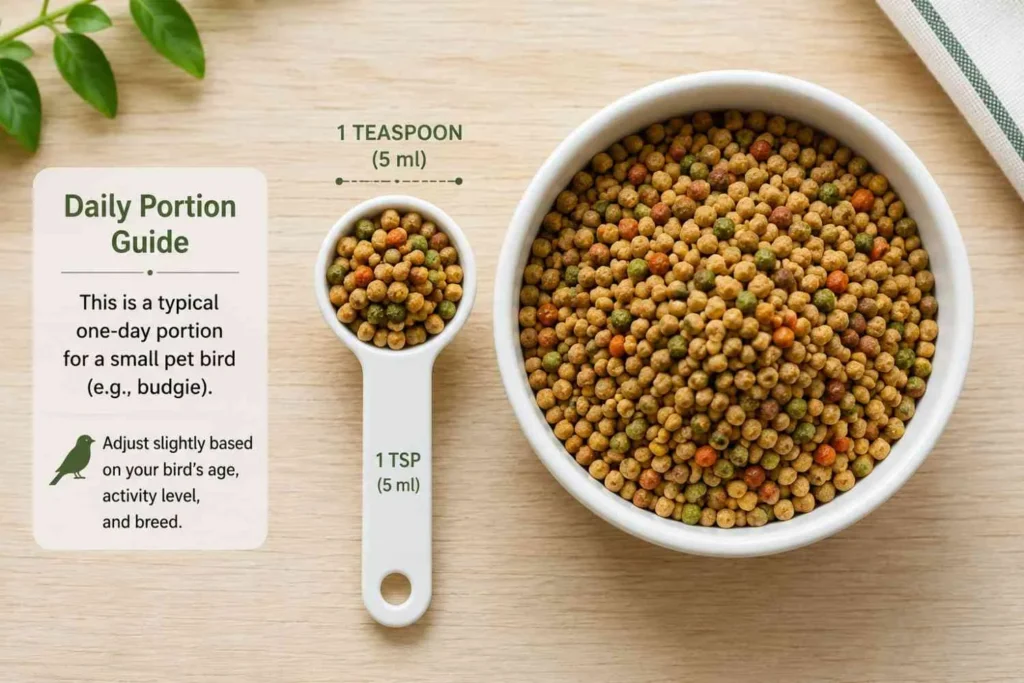
How much food does a bird need in a day depends on body size, species, and activity level; there’s no single “correct” cup measurement that works across all pet birds.
The Species-Age-Activity (SAA) Portion Formula an original framework for estimating a fair starting portion:
- Species baseline Start with roughly 1–2 tablespoons of base pellet/seed mix per day for a small bird (budgie-sized), scaling up proportionally for larger species
- Age adjustment Increase slightly for growing juveniles; hold steady or reduce slightly for older, less active birds
- Activity adjustment A bird with several hours of daily out-of-cage flight and foraging time can handle a slightly larger baseline than one that’s mostly cage-bound
This isn’t a substitute for species-specific veterinary guidance, but it gives new owners a reasonable starting point rather than guessing blind. From there, weekly weight checks tell you whether to adjust up or down.
Portion size for pet birds should also account for waste. Birds hull seeds and discard shells into the bowl, which can make an empty-looking bowl misleading and always check what’s actually been eaten, not just what’s left.
Feeding is just one piece of a bird’s daily routine for the full picture, including supplies, sleep, cage cleaning, and bonding, see the complete [Pet Bird Care Guide].
Best Time to Feed Pet Birds: A Daily Routine
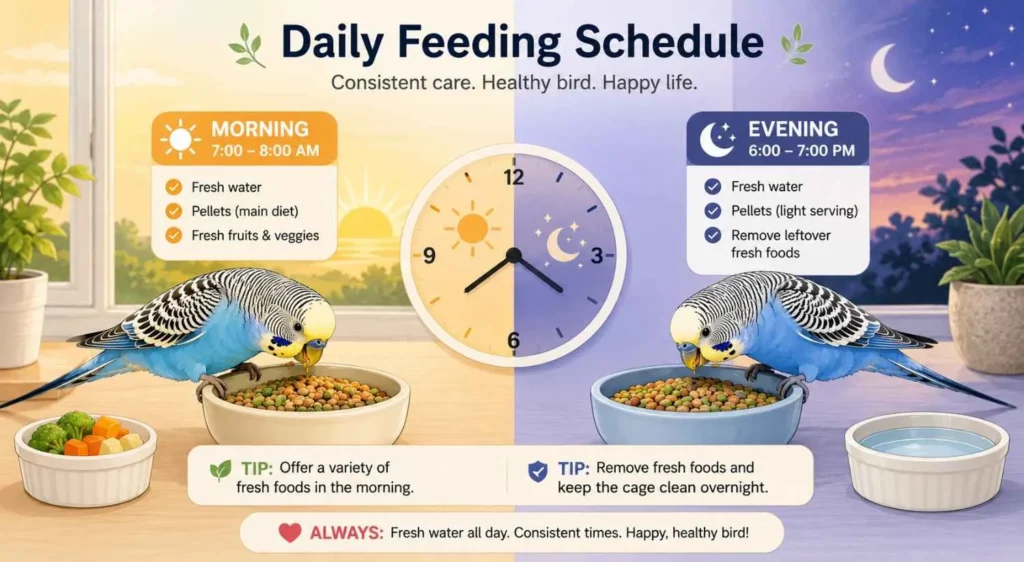
The best time to feed pet birds is early morning and early evening, mirroring when wild birds are most active foraging heavily at sunrise and again before settling down for the night.
A simple daily feeding routine:
- Morning (within an hour of waking) Offer fresh pellets/seed mix and any fresh food for the day; this is typically the largest feeding
- Midday (optional, species-dependent) A small fresh-food or foraging offering for medium-to-large species with structured meals
- Evening (an hour or two before the bird’s usual bedtime) Top up or offer a second feeding, then remove any perishable fresh food before covering the cage for the night
Real-world example: A first-time cockatiel owner who fed only once in the evening noticed her bird screaming and pacing every afternoon. Switching to a morning-and-evening routine matching the bird’s natural activity peaks resolved the afternoon restlessness within about a week, without changing anything else about the diet itself.
Keeping a simple daily feeding checklist for birds food refreshed, water changed, bowls checked at midday turns this routine into a habit instead of something you have to remember from scratch each day.
Seed vs Pellet: How to Manage the Switch
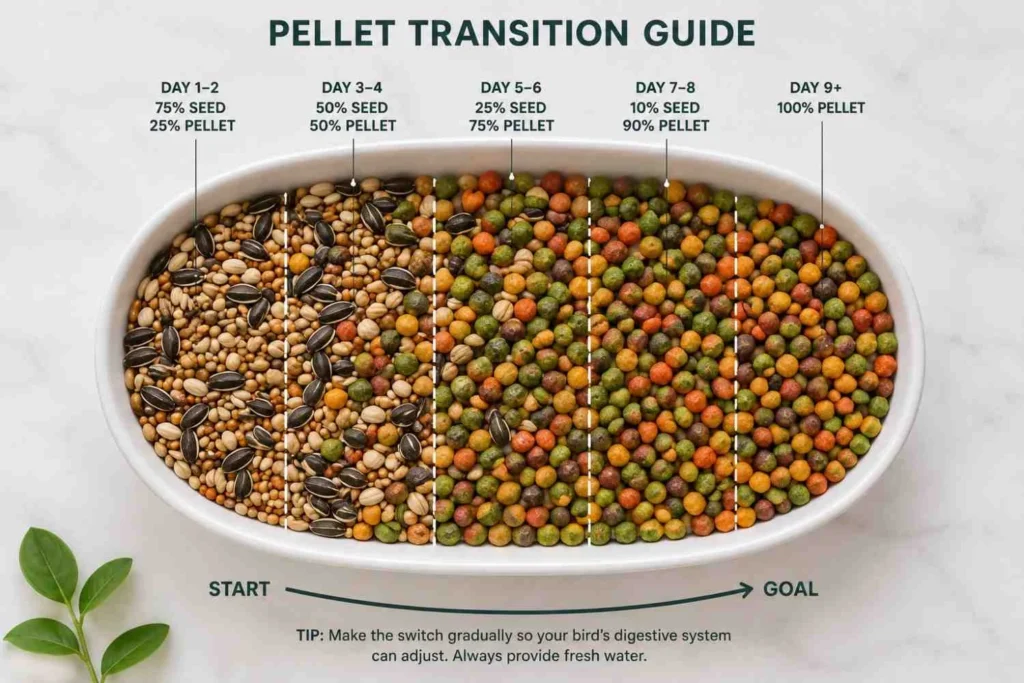
Seed vs pellet diet for birds is less a nutrition debate here and more a feeding-process question: how do you actually get a seed-dependent bird onto pellets without it going hungry?
Transitioning a bird to a pellet diet or transitioning bird to pellet diet, in shorter search terms typically works best gradually rather than all at once:
- Week 1–2: Mix a small amount of pellets into the existing seed bowl so the bird encounters them without pressure
- Week 3–4: Gradually increase the pellet ratio while slightly reducing seed volume
- Week 5+: Offer pellets as the base diet, with seed used sparingly as a treat rather than a staple
Expert Insight: Never remove seed entirely on day one to force a switch to pellets. Birds can refuse unfamiliar food long enough to become genuinely malnourished; a slow transition with close weight monitoring is safer than an abrupt one.
Feeding Bowl Setup and Foraging Feeding
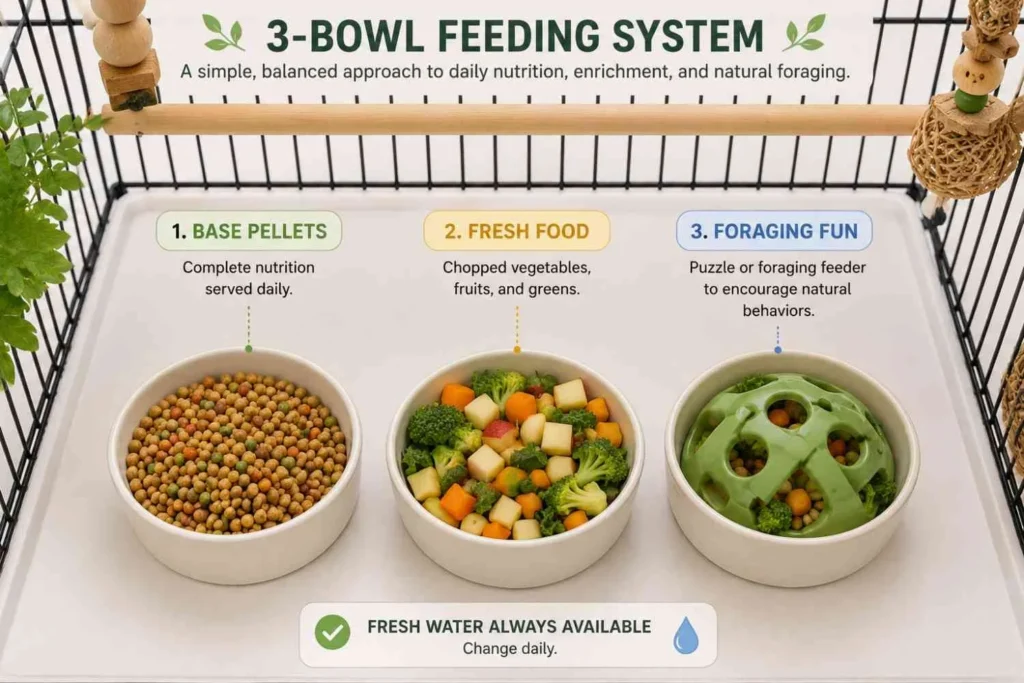
The feeding bowl setup for birds affects both mess and how naturally a bird eats. The 3-Bowl Feeding System is a simple way to structure it:
- Bowl 1 Base diet bowl: Holds the daily pellet or seed mix, refreshed each morning
- Bowl 2 Fresh food bowl: Used for the day’s fresh offering, removed after a few hours to avoid spoilage
- Bowl 3 Foraging/enrichment feeder: A puzzle feeder or scatter-style setup that makes the bird work for part of its food, mimicking natural foraging behavior
Foraging feeding for pet birds isn’t just enrichment; it slows down fast eaters, reduces boredom-driven behaviors, and keeps a bird mentally engaged during the parts of the day it would otherwise spend idle in the cage.
Bowls should sit away from beneath perches to avoid droppings contamination, and at a height the bird can reach comfortably without straining.
Feeding Chart by Bird Species
How to Feed Pet Birds at Home: Feeding Chart by Species
| Species | Daily Feedings | Approx. Portion | Feeding Style | Seed-to-Pellet Ratio (Adult) |
| Budgerigar | Near-constant access | 1–2 tbsp base mix | Free-feed + foraging | 20% seed / 80% pellet |
| Cockatiel | 2 main meals | 2–3 tbsp base mix | Scheduled + midday fresh food | 20% seed / 80% pellet |
| Lovebird | 2 main meals | 2–3 tbsp base mix | Scheduled + foraging feeder | 15% seed / 85% pellet |
| Canary | Near-constant access | 1–2 tsp base mix | Free-feed | 30% seed / 70% pellet |
| African Grey | 2 structured meals | 4–6 tbsp base mix | Scheduled + heavy foraging | 10% seed / 90% pellet |
Recommendation: Treat this chart as a starting baseline, then adjust using weekly weight checks individual metabolism, activity level, and health status all shift the right portion for a specific bird.
Bird Feeding Mistakes to Avoid
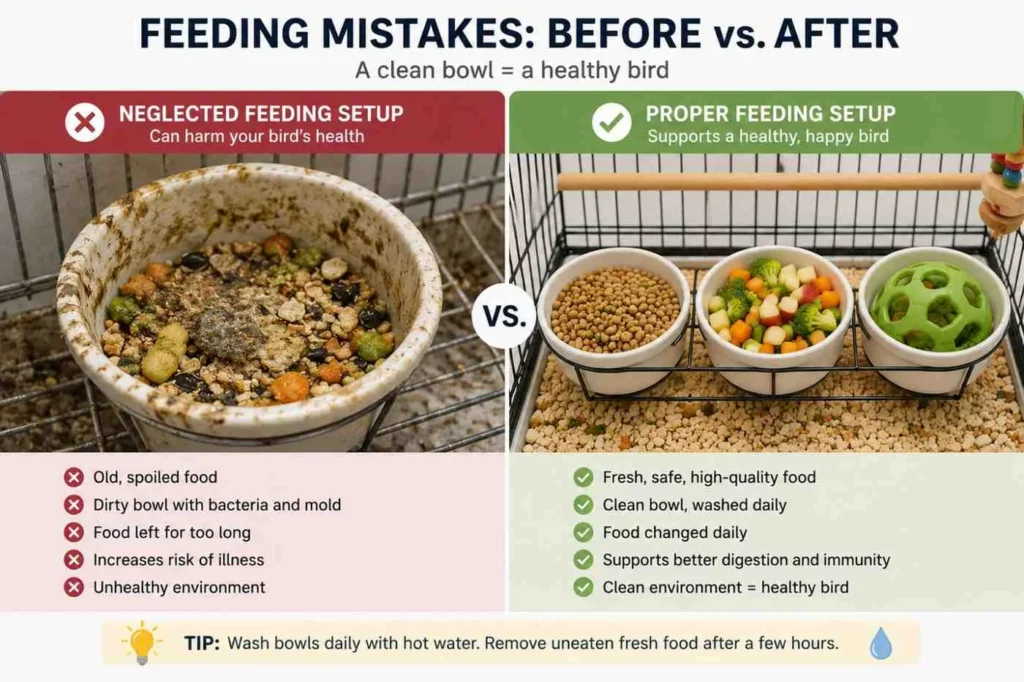
Bird feeding mistakes to avoid the ones that come up most often with new owners:
- Free-feeding large species indefinitely Structured meals matter more for bigger parrots, which are more prone to obesity than small, high-metabolism birds
- Leaving fresh food in the cage all day Perishable food left too long grows bacteria fast, especially in warm rooms
- Switching diets abruptly Sudden full swaps from seed to pellet can lead to a bird refusing to eat at all
- Feeding by bowl level alone Hulled seed shells make bowls look fuller than they are; weight checks are more reliable
- Skipping the midday check Water and food can spoil or run low faster than expected, especially in warm weather
Pro Tip: If a bird that normally eats well suddenly stops, don’t assume its pickiness. Sudden appetite loss is one of the more common early signs of illness in birds and is worth taking seriously rather than waiting out.
Conclusion
Getting how to feed pet birds at home right comes down to three things: a consistent schedule, a portion size based on the bird in front of you rather than a generic chart, and a bowl setup that keeps food fresh and engaging. Diet quality matters, but a great diet fed inconsistently still causes problems. The routine is what makes the nutrition actually work.
Quick Summary:
- Feed on a consistent schedule morning and evening are the two anchor windows for most species
- Size portions using species, age, and activity level, then fine-tune with weekly weight checks
- Transition seed-to-pellet gradually over 4–6 weeks, never abruptly
- Use a 3-bowl setup (base diet, fresh food, foraging feeder) to reduce mess and boredom
- Judge intake by weight, not bowl level hulled seed shells make bowls misleading
Next steps:
- Pick two consistent feeding times and stick to them for at least two weeks before adjusting
- Start a weekly weight-check habit instead of judging intake by bowl level
- If your bird is still on an all-seed diet, begin the gradual pellet transition outlined above
Frequently Asked Questions
How do I feed pet birds at home for the first time?
Start with the species’ recommended base diet, offer it at consistent morning and evening times, and monitor weekly weight rather than guessing from the bowl. Most first-time feeding problems come from inconsistent timing, not the wrong food.
How often should birds eat in a day?
Small birds like budgies do best with near-constant access to fresh food, while medium and large species typically do well with two structured meals a day. Frequency should also account for age, since young birds often need more frequent feeding than adults.
How much does a bird eat a day?
A small bird typically eats 1–2 tablespoons of base diet daily, while larger parrots may need several times that amount. Exact portions vary by species, age, and activity level, so weekly weight checks are the most reliable way to fine-tune it.
What is the best time to feed a pet bird?
The best times are early morning and early evening, matching a bird’s natural activity peaks in the wild. Feeding only once, especially late in the day, often leads to restlessness or excess vocalization earlier in the day.
How do I transition my bird from seed to pellets?
Transition gradually over four to six weeks by mixing increasing amounts of pellets into the existing seed bowl rather than switching all at once. An abrupt switch risks the bird refusing to eat the unfamiliar food entirely.
What is a good feeding bowl setup for birds?
A practical setup uses three bowls: one for the daily base diet, one for fresh food that’s removed after a few hours, and one foraging or puzzle feeder for enrichment. This keeps food fresher and gives the bird natural foraging activity.
What are the most common bird feeding mistakes?
The most common mistakes are free-feeding large species without structure, leaving fresh food in too long, switching diets abruptly, and judging food intake by bowl level instead of actual weight. Each of these can lead to either overfeeding or unnoticed undereating.
Does feeding frequency differ between young and adult birds?
Yes, young and recently weaned birds generally need smaller, more frequent feedings than settled adults of the same species, since their energy needs per body weight are higher during growth.