

Quick answer: This beagle care guide starts with the basics. A Beagle is a small-to-medium scent hound (20-25 lbs) with an extraordinary nose, a merry temperament, and legendary stubbornness. Beagle care means scent-based exercise, escape-proof fencing, strict portion control (they’re always hungry), and patient, reward-based training. Beagles live 12-15 years.
Contents
- What Is a Beagle?
- Beagle Temperament: Sweet, Stubborn, Ruled by the Nose
- The Recall Problem: Why Your Beagle Won’t Come Back
- How Much Exercise Does a Beagle Need? (Think Sniff, Not Sprint)
- Beagle Diet: The Breed That Never Feels Full
- Grooming a Beagle: Easy Coat, Surprising Shed
- What Health Issues Should a Beagle Care Guide Cover?
- Beagle Lifespan
- Cost of Owning a Beagle
- Adoption vs. Breeder
- Is a Beagle Right for You? (Quick Quiz)
- Frequently Asked Questions
What Is a Beagle?
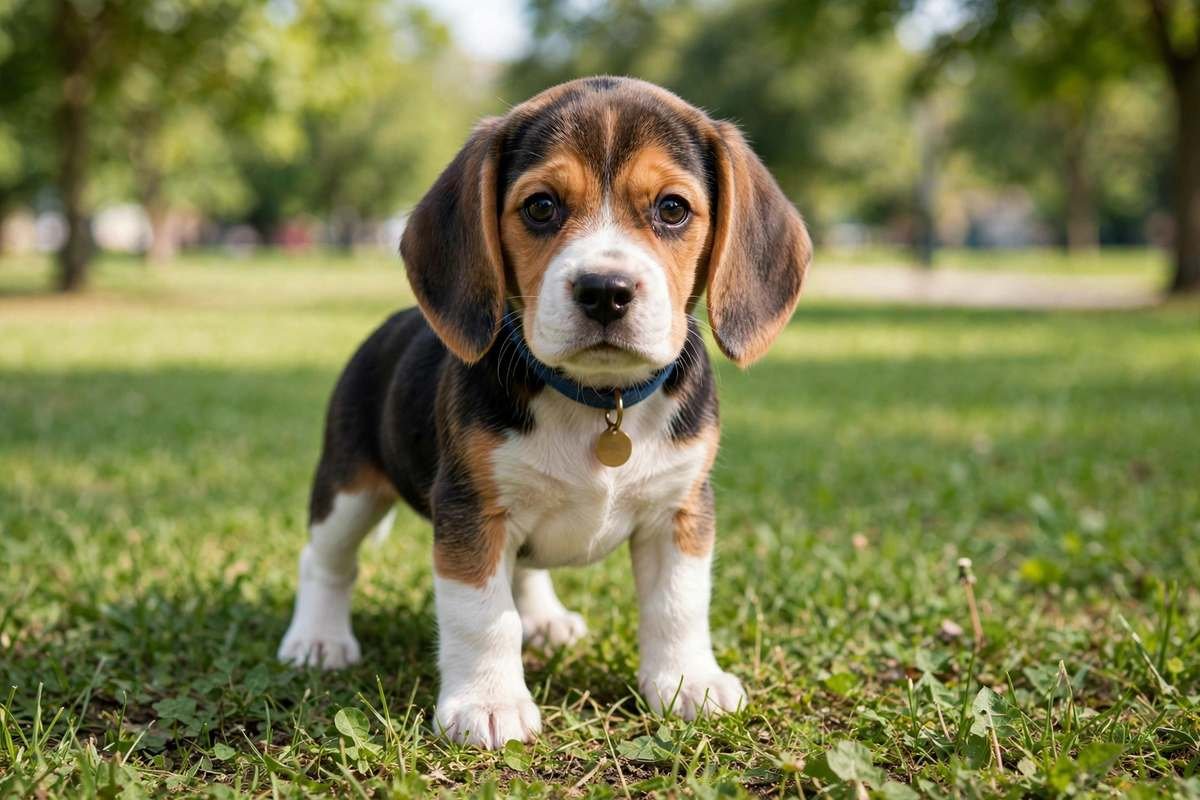
A Beagle is a small-to-medium scent hound developed in England for hunting rabbits in packs – “beagling.” Adults stand 13-15 inches at the shoulder and weigh 20-25 pounds. They have the classic tricolor coat (black, tan, and white), long soft ears, and a white-tipped tail bred to stay visible in tall grass.
What defines the breed isn’t size or looks but the nose. A Beagle carries roughly 220 million scent receptors (humans have about 5 million). That puts their sense of smell among the very best in the dog world. It is why Beagles work as airport detection dogs and bedbug-sniffing dogs. That nose is the source of nearly everything wonderful and everything maddening about living with one.
Beagles consistently rank among the most popular breeds for families, and deservedly so. They’re sturdy, cheerful, good with children and other dogs, and small enough for most living situations. But “small” fools people into thinking “low maintenance.” A Beagle is a working hound in a compact body, and it behaves like one.

Beagle Temperament: Sweet, Stubborn, Ruled by the Nose
The Beagle temperament is famously merry – the breed standard literally describes them as cheerful. Beagles are affectionate without being clingy, playful without being hyper, and sociable with just about everyone: children, strangers, other dogs. They were bred to live and work in packs. So companionship (canine or human) is close to a need, not a preference.
The flip side of that hound nature:
- Selectively deaf. A Beagle that hears a fascinating scent stops hearing you. This isn’t disobedience in the defiant sense – the nose genuinely overrides the ears. Training has to account for it rather than fight it.
- Vocal. Beagles bay – a deep, carrying howl-howl developed to alert hunters. They also bark and whine. Apartment neighbors will have opinions.
- Driven, not eager-to-please. Unlike retrievers, Beagles weren’t bred to take direction; they were bred to follow a trail independently. They learn perfectly well, but “because I said so” is not a compelling argument to a Beagle.
- Mischievous and food-obsessed. A bored Beagle is a counter-surfing, trash-raiding, escape-plotting Beagle. Trash cans need lids, food needs to be out of reach, and boredom needs a plan.
None of this makes them bad dogs. It makes them hounds. Owners who embrace the hound-ness (scent games, sniff walks, puzzle feeders) get a delightful companion. Owners who expected a small Labrador get frustrated.
The Recall Problem: Why Your Beagle Won’t Come Back
Let’s address the breed’s most famous trait head-on: most Beagles cannot be trusted off-leash in unfenced areas. When a Beagle catches an interesting scent, the ancient hunting sequence takes over. Nose down, brain off, gone. This is the number-one reason Beagles end up lost. “Lost Beagle” is practically a shelter category.
Practical rules that keep Beagles safe:
- Never off-leash outside fenced areas. Not “once he’s trained,” not “just this once.” A long line (20-30 feet) gives freedom safely.
- Fence like you mean it. Beagles dig under and squeeze through. Fences should extend below ground level or have a dig barrier, with no gaps wider than a Beagle head.
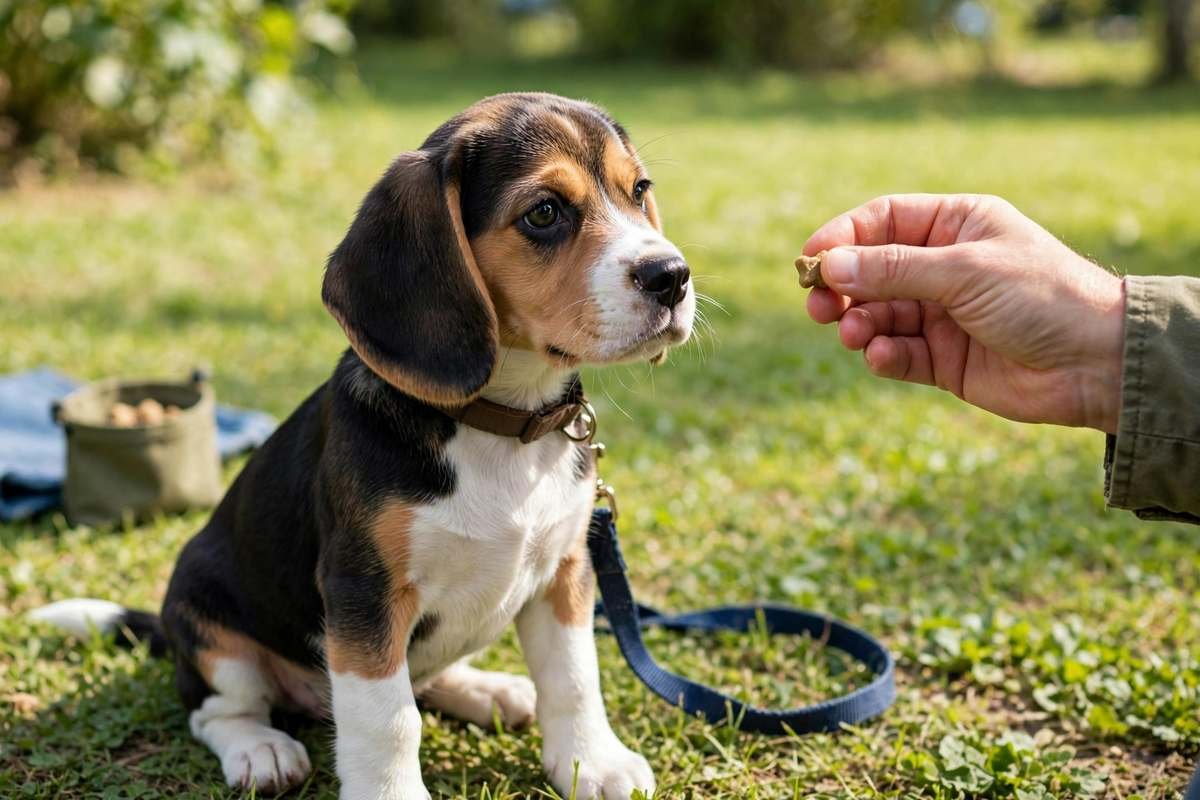
- Train recall anyway. A strong recall won’t override a hot scent trail, but it works beautifully in low-distraction settings and might save your dog’s life near a road. Train it as the best game ever – jackpot rewards, never punishment for slow returns.
- Microchip and ID tags, always. Non-negotiable for this breed.
Training a Beagle works best when you stop fighting the nose and start using it. Scent work, tracking games, and “find it” exercises channel the breed’s deepest drive into something you can reward. A Beagle doing nose work is a Beagle too tired and satisfied to plot escapes.
How Much Exercise Does a Beagle Need? (Think Sniff, Not Sprint)
An adult Beagle needs 1-1.5 hours of activity daily. But here’s what most guides get wrong: for a Beagle, a sniff-heavy 45-minute walk beats a 45-minute jog. Mental stimulation through the nose tires them profoundly. A “sniffari” – a walk where the dog sets the pace and sniffs everything – is legitimate, high-value Beagle exercise.
Puppies follow the same growth-plate caution as all breeds: about 5 minutes of structured exercise per month of age, twice daily, plus free play. Beagle puppies are also teething land-sharks, so chew outlets matter as much as walks.
| Time | Activity | Why it works for a Beagle |
|---|---|---|
| Morning | 30-40 min sniff walk | Burns mental energy through the nose; sets a calm tone for the day |
| Midday | 10 min “find it” scent game indoors | Channels hunting drive; great for rainy days |
| Evening | 30-40 min walk + 10 min training | Physical exercise plus brain work; training when slightly tired works best |
| Weekly | 1-2 longer adventures (trail, new neighborhood) | Novel scents are the ultimate Beagle enrichment |
Under-exercised Beagles don’t just get chubby – they get loud, destructive, and ingenious about escaping. The baying that annoys neighbors is very often a boredom signal.

Beagle Diet: The Breed That Never Feels Full
No beagle care guide is complete without the food talk. Beagles share the Labrador’s curse: many carry a gene variant linked to food obsession and reduced satiety. Ask any Beagle owner. Their dog acts starving approximately always, regardless of meals eaten. Obesity is the breed’s most common owner-created health problem. It worsens nearly every other condition Beagles face, from joint strain to breathing difficulty.
- Measure everything. Two measured meals a day for adults; three for puppies under 6 months. Never free-feed.
- Ignore the bag. Feeding guidelines on packaging are generous; adjust to your individual dog’s body condition.
- Treats ≤10% of daily calories – and for training a food-obsessed breed, use pea-sized treats or even kibble from their measured meals.
- Slow feeders and puzzle bowls turn a 30-second inhale into a 10-minute activity – enrichment and portion control in one.
The rib test applies here exactly as with Labs: ribs easily felt under light pressure, visible waist from above. A Beagle should look athletic, not like a sausage with legs. If strangers describe your Beagle as “sturdy,” that’s a polite warning.
For portion charts, food types, and the weight-loss plan for chubby Beagles, see our Beagle Diet and Feeding Guide.
Grooming a Beagle: Easy Coat, Surprising Shed
The short, dense Beagle coat looks wash-and-wear. And mostly it is. But it sheds steadily year-round, with heavier seasonal blows. The hair is short and barbed, which means it weaves into upholstery and car seats with remarkable permanence. A rubber curry brush once or twice a week keeps it manageable.
- Brushing: weekly (2-3x during seasonal sheds) with a hound glove or rubber curry.
- Bathing: every 6-8 weeks or when smelly. Beagles can develop a characteristic “hound odor” – regular brushing and bedding washes control it better than frequent baths.
- Ears: check weekly. Long, heavy ears trap moisture and debris; clean with a gentle, dog-safe ear cleaning solution and watch for redness or odor.
- Nails: every 3-4 weeks – Beagles’ nails grow fast and clicking nails change gait, stressing joints.
- Teeth: brush several times weekly; small-to-medium breeds are prone to dental disease.
What Health Issues Should a Beagle Care Guide Cover?
Beagles are generally healthy, hardy dogs, but watch for:
- Obesity – the gateway problem; keep them lean and you prevent a cascade of secondary issues.
- Epilepsy – Beagles have a higher-than-average incidence of idiopathic epilepsy, usually manageable with medication.
- Hypothyroidism – underactive thyroid causing weight gain, lethargy, and coat thinning; diagnosed by blood test, treated with daily medication.
- Cherry eye – prolapsed tear gland appearing as a red mass in the eye corner; often needs surgical correction.
- Ear infections – those long ears again; prevention beats treatment.
- Intervertebral disc disease (IVDD) – less common than in long-backed breeds, but excess weight raises the risk.
Choose breeders who health-test (hips, eyes, thyroid at minimum). And keep the weight off – it cannot be said enough with this breed.
Beagle Lifespan
Beagles live 12-15 years, notably longer than many similarly sized breeds – one more reason to love them, and one more reason the obesity battle matters (those extra years should be healthy ones). Senior Beagles (10+) slow down gracefully; keep them moving with sniff walks, watch the waistline as metabolism slows, and shift to twice-yearly vet checks.
Cost of Owning a Beagle
| Expense | Typical range (USD/year) |
|---|---|
| Food (quality, portioned!) | $400-$650 |
| Routine vet care + vaccines | $300-$550 |
| Preventatives (flea/tick/heartworm) | $200-$350 |
| Training classes | $150-$350 (first year) |
| Secure fencing / long lines / puzzle toys | $150-$400 (first year) |
| Grooming supplies | $80-$150 |
| Pet insurance (recommended) | $350-$600 |
| First-year total | $1,500-$3,000+ |
Beagles are cheaper to feed than big breeds, but budget for the escape-artist infrastructure: good fencing, a GPS tracker collar, and puzzle toys aren’t optional extras for this breed.
Adoption vs. Breeder
Adoption: Beagle rescues exist in nearly every region, full of lovely dogs – many are young adults surrendered for baying or escaping (both manageable with the right setup). Fees typically $200-$500.
Breeder: $800-$1,800 from a responsible breeder who health-tests (hips, eyes, thyroid), socializes puppies, and takes dogs back for life. Meet the mother, see the premises, and verify health paperwork. Avoid pet stores and sight-unseen online sellers.
Beagle Puppy: Surviving the First Month
Beagle puppies are adorable chaos machines with teeth. Week one: establish the crate and start potty routines. Beagles can be slower to housetrain than average, so use patience, not punishment. Puppy-proof ruthlessly: trash cans secured, shoes elevated, food behind closed doors. A Beagle puppy left unsupervised for twenty minutes can achieve remarkable destruction.
Weeks two to four: begin name games and “sit.” Introduce the leash and collar as no-big-deal equipment, and start sound socialization (vacuum recordings, doorbells, traffic sounds at low volume). Enroll in puppy class after vet clearance. The socialization matters, and so does learning to focus around other dogs, which doesn’t come naturally to this breed. Expect the “land shark” biting phase to peak around 3-4 months. Redirect to frozen carrots and chew toys, never hands.
Enrichment: Beating Beagle Boredom
A bored Beagle is a baying, digging, escaping Beagle. Ten minutes of setup saves hours of trouble:
- Snuffle mat or scattered kibble – turn one meal a day into a forage session on the lawn.
- “Which hand” and “find it” games – hide treats around a room and let the nose work.
- Frozen Kongs – peanut butter (xylitol-free) and kibble, frozen overnight; 30 minutes of occupation.
- Dig pit – a sandbox corner where digging is legal beats a destroyed garden.
- Rotating toy box – keep half the toys hidden and swap weekly; novelty is free enrichment.
Rotate, don’t accumulate: five toys in rotation beat twenty toys scattered permanently.

Is a Beagle Right for You? (Quick Quiz)
- You find baying charming (or at least tolerable) – and so do your neighbors
- Your fencing is secure, or you’re committed to leash/long-line life
- You’ll measure every meal and resist the starving act – every single day
- You want a companion for sniff walks and scent games, not off-leash hikes
- Someone’s around enough that a pack-oriented hound isn’t lonely all day
If you need reliable off-leash freedom, silence, or a dog motivated by praise alone – a Beagle will break your heart. If you want a merry, sturdy, hilarious companion and can laugh at the stubbornness – welcome to the club.
Related Guides
- Beagle Diet and Feeding Guide – portions and beating the food obsession
- Beagle Training Tips – recall, scent work, and hound-smart methods
- Beagle Health Problems – epilepsy, thyroid, and prevention
- Beagle Exercise Needs – sniff walks and enrichment plans
- How Long Do Beagles Live? – senior care for long-lived hounds
Frequently Asked Questions
Are Beagles good with kids?
Excellent – Beagles are famously patient, sturdy, and playful with children, which is why they’re a classic family breed. As with any dog, supervise interactions with toddlers, and teach kids not to pull ears or take food. A Beagle’s food obsession means dropped snacks will be “cleaned up” instantly.
Can Beagles ever be trusted off-leash?
Honestly: very few can, and never where a scent trail or road is involved. Some owners achieve reliable recall in controlled settings with years of training, but the breed’s hunting instinct is hardwired. Use a long line for safe freedom instead of gambling on recall near traffic.
Do Beagles shed a lot?
Yes – moderately to heavily, year-round, with seasonal peaks. The short hairs embed in fabric stubbornly. Weekly brushing with a rubber curry or hound glove controls it; it won’t eliminate it. They are not hypoallergenic.
Why does my Beagle howl/bay?
Baying is hardwired communication – originally to alert hunters. Modern triggers include excitement, boredom, loneliness, sirens, and other dogs vocalizing. A well-exercised, mentally stimulated Beagle bays far less; chronic baying usually signals unmet needs.
How long do Beagles live?
12-15 years – a long life for a dog this size. Lean weight, regular exercise, and routine vet care are what get Beagles to the upper end of that range in good health.
Are Beagles easy to train?
They’re intelligent and learn quickly, but they’re independent rather than eager-to-please. Training requires patience, humor, and excellent treats – the core message of any honest beagle care guide. Harsh methods backfire badly with this breed; reward-based training that engages the nose works best.
Written by the PetsVentres editorial team. Reviewed for accuracy on October 2026.
This guide is for informational purposes and doesn’t replace professional veterinary advice.