

Quick answer: Puppy separation anxiety fades fastest when alone time is introduced gradually, not all at once. Set up a safe space (crate or pen), exercise the puppy before every departure, practice short absences that grow from minutes to two hours across seven days, and keep arrivals and departures boring. If the puppy panics, you moved too fast: go back one day and repeat.
Contents
- What Does Puppy Separation Anxiety Look Like?
- Crate vs Pen: Setting Up the Safe Space
- The 7-Day Alone-Training Plan
- Departure Cues to Desensitize, Ranked
- 7 Mistakes That Make Puppy Separation Anxiety Worse
- What If Your Puppy Panics Anyway?
- Related Guides
- Frequently Asked Questions
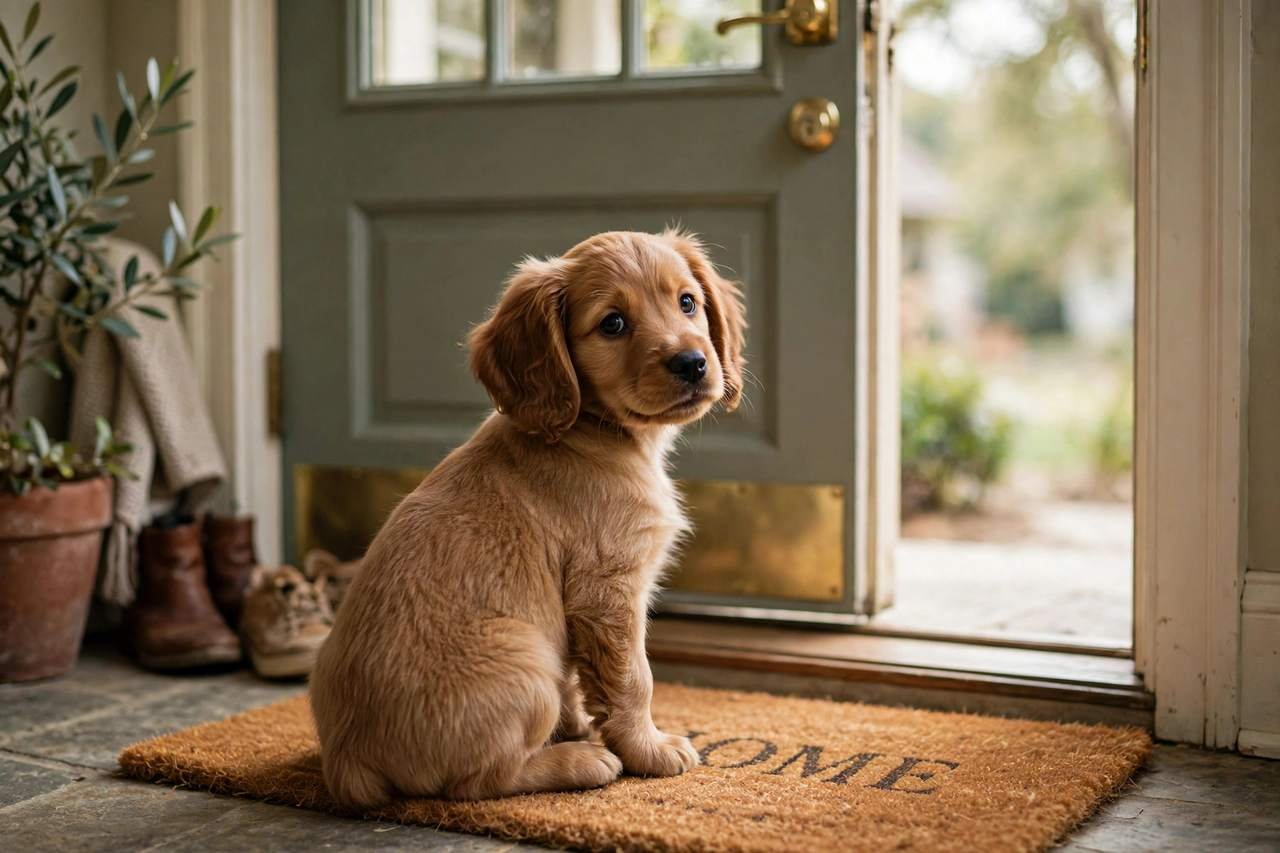
What Does Puppy Separation Anxiety Look Like?
A puppy with separation anxiety is not being naughty. It is a baby animal panicking because its pack just vanished. The signs appear within minutes of your departure: whining, barking, or howling, scratching at doors and crate bars, drooling, panting, and pacing in a restless loop. You may also see accidents in a puppy that was otherwise house training well. On camera, the telltale sign is a puppy that never settles, never naps, and never touches its toys.
One filter before you label it anxiety: boredom looks similar but feels different. A bored puppy chews the couch, then naps. An anxious puppy chews the door frame, then keeps pacing. And a bored puppy eats the stuffed Kong, while an anxious puppy ignores food entirely when alone. If your puppy will not eat while you are gone, that is anxiety, and it is exactly what this plan is built for.
Crate vs Pen: Setting Up the Safe Space
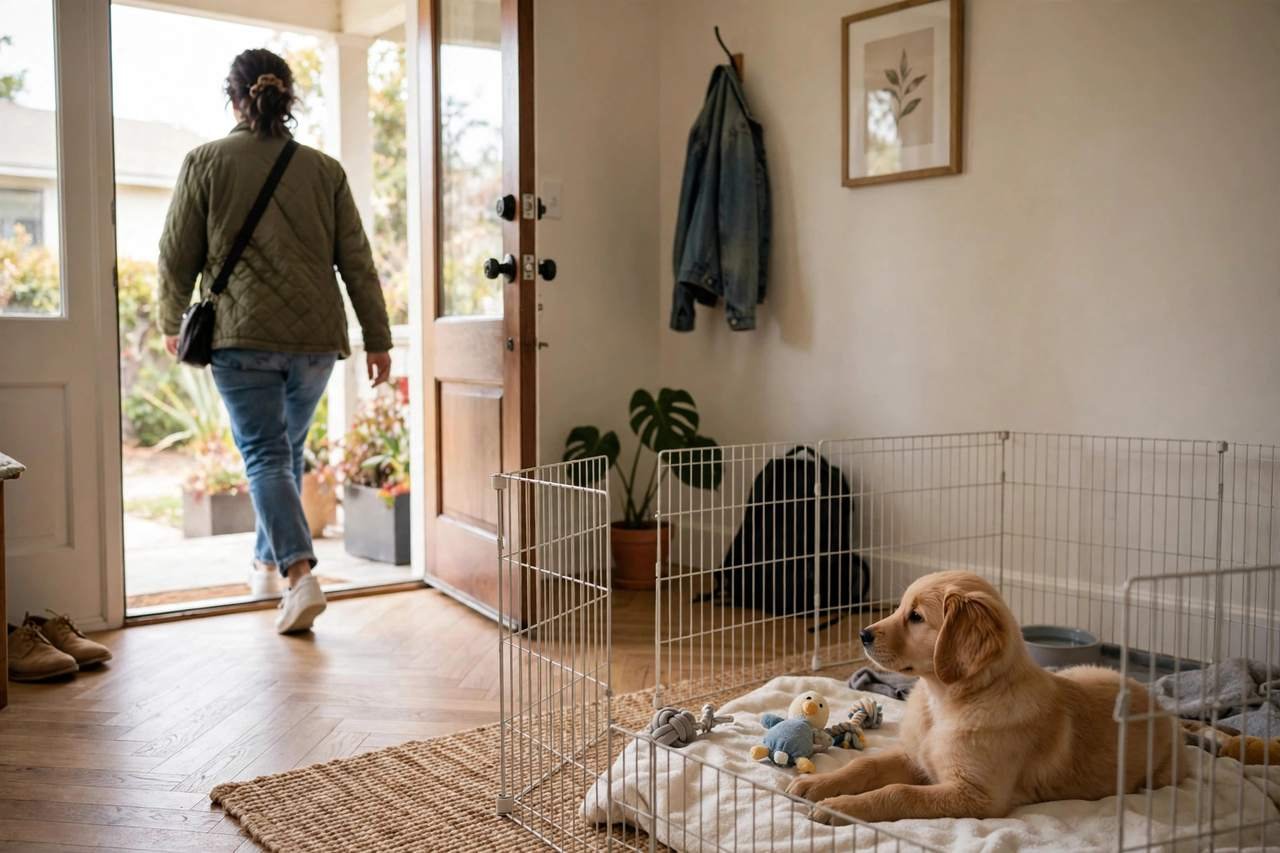
Alone training needs a stage, and you have two good options. A crate is a den: small, enclosed, and comforting to puppies that like tight spaces. A pen (an exercise pen or a puppy-proofed room) is a studio apartment: more room to play, stretch, and choose a spot. The right pick is the one your puppy settles in fastest. Crates suit puppies that nap in enclosed spaces or squeeze under furniture, while pens suit very young puppies, longer absences, and puppies that fuss in confinement. Puppies under 12 weeks can usually hold it for about as many hours as they are months old. So a very young puppy often does better in a pen with a potty area.
Whichever you pick, the setup rules are the same. Make the space boring on purpose: a comfortable bed, a safe chew, water, and nothing else. Feed every meal in the space for the first week so it becomes the good-things room. And start using the space while you are home first. A crate that only appears when you leave becomes a departure cue itself, which is the opposite of what you want.

The 7-Day Alone-Training Plan
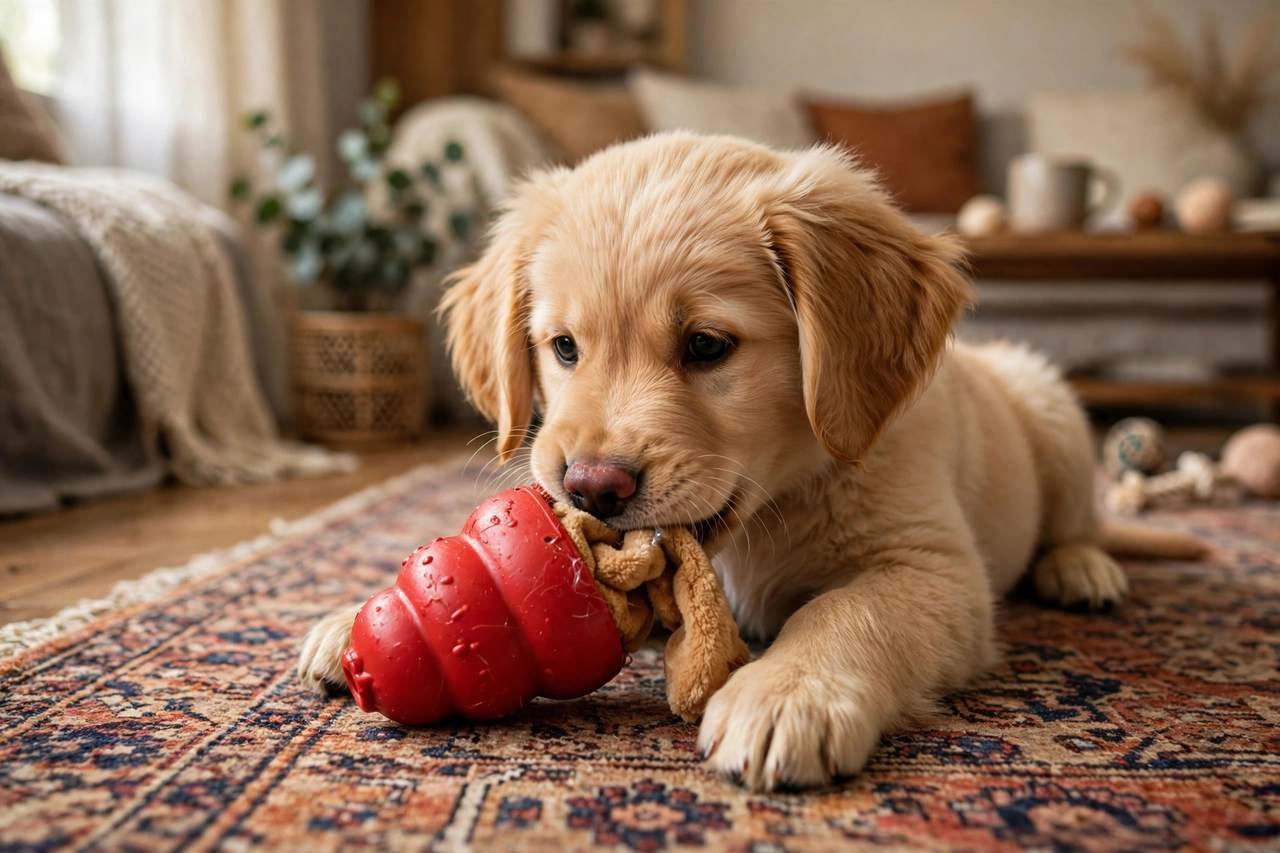
This is the core of this puppy separation anxiety plan, and the principle never changes. Leave for less time than it takes your puppy to get upset, then stretch the time a little each day. Progress is measured in calm, not minutes. Three rules run under the whole week: exercise before every session (a tired puppy has less panic fuel), and keep hellos and goodbyes boring. Give a special enrichment item, like a stuffed Kong, that only appears when you leave and disappears when you return. Calm in, calm out.
| Day | Alone Time Target | Exercise Before You Leave | Enrichment During | Success Looks Like |
|---|---|---|---|---|
| Day 1 | 1 to 2 minutes, behind a closed interior door | 20 minutes of play and a short training session | Stuffed Kong with peanut butter, given only at departure | Puppy notices you leave, then goes back to the Kong. No howling. |
| Day 2 | 5 minutes, still inside the house | A 15-minute walk plus fetch in the yard | Kong plus a snuffle mat with kibble hidden in it | Settles within 30 seconds of your exit. Eats the food. |
| Day 3 | 10 minutes, step outside the front door | Morning walk with 5 minutes of leash training | Frozen Kong (harder and longer lasting) in the crate or pen | No scratching at the door. Calm body on your return. |
| Day 4 | 20 minutes, actually leave the property | A proper 25 to 30 minute walk with sniffing time | Frozen Kong plus a lick mat with a thin smear of wet food | On camera: puppy works the toys, then lies down. |
| Day 5 | 40 minutes, run a real errand | Big morning: walk, play, and a short training session | Rotate two puzzles so the novelty stays high | Puppy naps at some point during the absence. |
| Day 6 | 1 hour 15 minutes | Full morning routine: walk, play, training, potty | Long-lasting chew plus the frozen Kong | No distress sounds at departure cues. Relaxed on return. |
| Day 7 | 2 hours, a normal workday morning rehearsal | Your real weekday routine, start to finish | Full enrichment lineup, radio or TV on low | You come home to a calm puppy and an intact house. |
The golden rule of the week: if the puppy panics at any step, you did not fail, you moved too fast. Go back one full day, repeat it until it is boring, then try the next step again. Puppies do not learn calm from flooding. They learn it from rehearsing calm at a difficulty they can handle.
A phone camera pointed at the crate or pen is your best training tool this week. Watch the first five minutes of each session back: a puppy that whines for twenty seconds and settles is learning. One that escalates, drools, or ignores food is too stressed to take in anything (over threshold). Adjust tomorrow, not during the session. Never return while the puppy is in full panic, because that teaches panic works. Wait for a quiet moment, even a brief one, then walk in calmly.
Departure Cues to Desensitize, Ranked
Long before you touch the doorknob, your puppy is reading you. Shoes, keys, coat, bag: each cue predicts your disappearance, and anxious puppies start unraveling at the first cue, not the last. Break the prediction by practicing each cue many times a day without leaving, until it becomes meaningless noise. Work the list from the most panic-triggering cue down:
| Rank | Departure Cue | Why It Triggers Panic | How to Neutralize It This Week |
|---|---|---|---|
| 1 | Picking up keys or bag | The final signal: leaving is seconds away | Pick them up, put them down, sit on the couch. Repeat 10 times daily. |
| 2 | Putting on shoes and coat | The uniform of departure, recognized fast | Wear the full outfit to watch TV. Take it off. Repeat. |
| 3 | Heading for the front door | Direction of travel predicts the exit | Walk to the door, touch the handle, walk back to the kitchen. |
| 4 | Shutting down the house (lights, TV off) | The routine that wraps up the morning | Do the shutdown, then make coffee and stay. Break the pattern. |
| 5 | Your “going out” energy and pace | Puppies read body language before objects | Move briskly around the house, then sit down and read. Boring wins. |
This is the same graduated approach behaviorists recommend: start with absences so short the puppy never gets upset, then build duration over many sessions. The ASPCA’s guide to separation anxiety covers the same desensitization method, including the predeparture-cue stage.
7 Mistakes That Make Puppy Separation Anxiety Worse
Most puppy separation anxiety is manufactured by well-meaning habits in the first weeks home. Fix whatever you recognize below.
- Going from zero to a full workday. The single biggest cause of panic. A puppy that has never been alone for ten minutes cannot handle eight hours.
- Dramatic goodbyes and reunions. Long farewells teach the puppy that departures are a big deal. Wild greetings teach it that your return is the event of the day. Keep both boring and the middle becomes boring too.
- Punishing the panic. Scolding a puppy for chewing the door or having an accident teaches nothing about calm. It adds fear of you to fear of being alone.
- Only crating when you leave. If the crate door only closes when you walk out, the crate becomes a departure cue. Use it for naps and meals while you are home so it means rest, not abandonment.
- Skipping exercise before departures. A puppy with a full tank of energy has no chance of settling. The pre-departure exercise in the plan is not optional.
- Returning during peak panic. If you walk back in while the puppy is screaming, you just taught it that screaming summons you. Wait for any quiet moment, even two seconds of silence, then enter calmly.
- Ignoring the camera evidence. Owners guess; cameras know. A puppy that looks “fine” when you leave may pace and drool for an hour. Film the first week and let the footage, not your hope, set the pace.
What If Your Puppy Panics Anyway?
Some puppies do everything right on paper and still fall apart. That usually means one of three things. The steps were too big. The puppy was overtired or under-exercised that day. Or the puppy separation anxiety is simply stronger than a first-week plan can handle alone.
First, shrink the steps. If 10 minutes causes panic, drop to 3 minutes and build in 2-minute increments. There is no minimum step size. Second, audit the basics: was the puppy exercised, fed, pottied, and rested before the session? A puppy that missed its nap will fail sessions it passed yesterday.
Third, know when to bring in help. Talk to your veterinarian if the puppy injures itself trying to escape or refuses all food when alone, even at tiny durations. Also call if you see no improvement after two consistent weeks. Severe cases sometimes need professional behavior support, and there is no shame in that. The earlier a serious case gets expert guidance, the faster it resolves.
Related Guides
- Puppy Diarrhea: What’s Normal and What’s an Emergency
- Crate Training a Puppy: The First 7 Nights
Frequently Asked Questions
How long can I leave my puppy alone at 8 weeks?
At 8 weeks, think in minutes, not hours: start with a few minutes and build up using the 7-day plan above. Very young puppies need frequent potty breaks, meals, and sleep, so long absences are not fair or realistic yet. By 4 to 6 months, most puppies handle a few hours if the training foundation is solid.
Should I let my puppy cry it out?
No. Letting a panicking puppy scream until it gives up does not teach calm; it teaches that panic is pointless, which is not the same as feeling safe. Brief fussing that resolves in under a minute is fine to ride out, but true distress means you went too far and should step back a day.
Is it better to crate my puppy when I leave?
It depends on the puppy. A crate suits puppies that find small spaces comforting and can hold their bladder for the planned absence. A pen suits young puppies, long absences, and puppies that stress in confinement. The deciding test is simple: film both setups and use whichever one the puppy settles in faster.
Can a puppy grow out of separation anxiety on its own?
Usually the opposite happens: unaddressed anxiety tends to get worse. The good news is that young puppies learn new routines fast, which is why week one is the highest-leverage time to train. A week of gradual practice now prevents months of entrenched panic later.
When should I call a professional about puppy separation anxiety?
Call your veterinarian if the puppy injures itself escaping or will not eat when alone at any duration. Also call if you see no improvement after two weeks of consistent gradual training. Your vet can rule out medical contributors and refer you to a qualified behavior professional if the case needs more than a home plan.
This guide is for informational purposes and doesn’t replace professional veterinary advice.