

Quick answer: A ball python care guide starts with the essentials. You need a secure enclosure with a warm side at 88 to 92°F and a cool side at 75 to 80°F. Keep humidity around 50 to 60 percent and provide two snug hides. Feed frozen-thawed rodents every 7 to 14 days depending on age, and keep handling sessions to 10 to 15 minutes. These calm, 3 to 5 foot snakes can live 20 to 30 years, so setup is a decades-long commitment, not a weekend project.
Contents
- Is a ball python good for beginners?
- What does a ball python need in its setup?
- How do I keep heating and humidity right?
- What do ball pythons eat and how often?
- How do I handle a ball python safely?
- What happens when a ball python sheds?
- What are common ball python health issues?
- How much does a ball python cost to keep?
- What mistakes do first-time owners make?
- Related Guides
- Frequently Asked Questions
Is a ball python good for beginners?
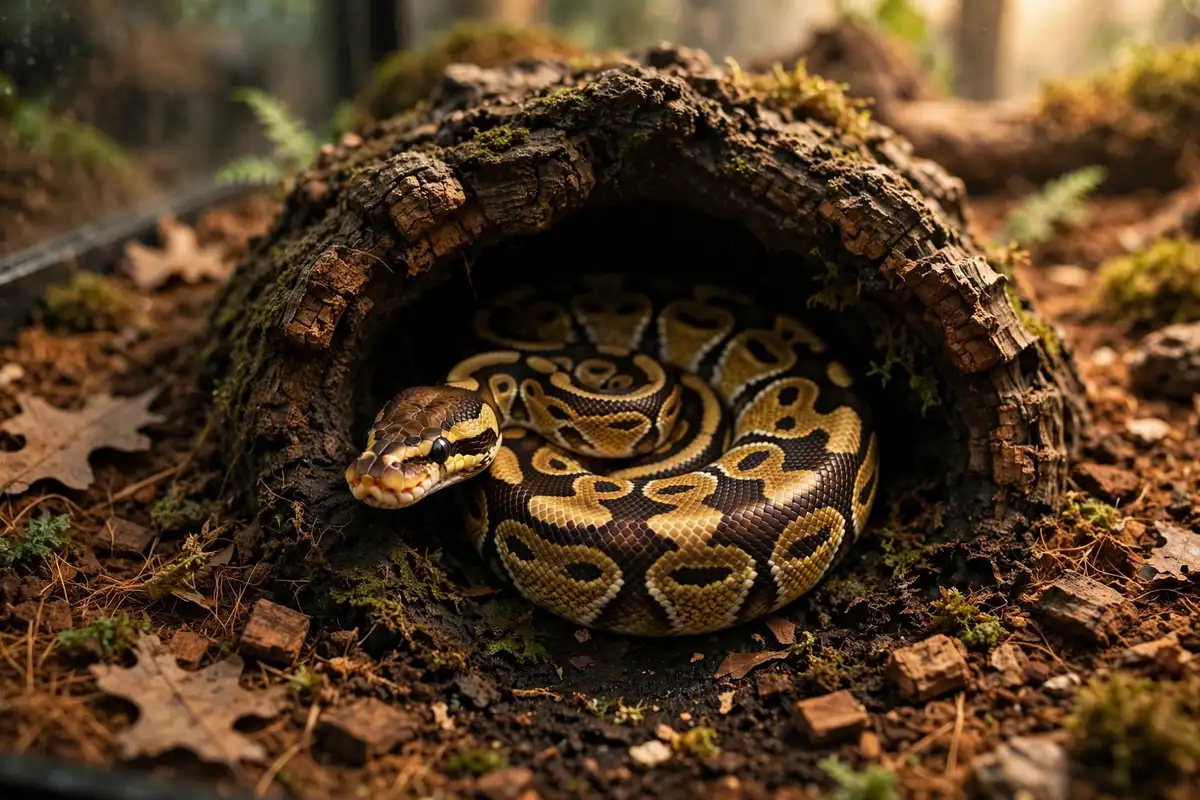
Yes, ball pythons are one of the best snakes for beginners. They are calm, slow-moving, and tolerant of handling, and adults stay a manageable 3 to 5 feet long. Unlike fast, flighty species, a ball python’s default response to stress is to curl into a tight ball, which is how it got its name. It does not bite or bolt. They are also widely available, relatively affordable, and come in dozens of color morphs.
That said, “beginner-friendly” does not mean “low-effort.” Ball pythons live 20 to 30 years in captivity. They need precise temperature and humidity control, and they are famous for going on hunger strikes that worry new owners. Before buying, ask yourself whether you are ready for a pet that may outlive your car, your lease, and possibly your current career. If the answer is yes, and you can commit to stable day-to-day care rather than constant tinkering, a ball python is a genuinely rewarding first snake.
One honest caveat: these snakes are nocturnal and secretive. A happy ball python spends most of the day hidden and does its exploring after lights-out. If you want a pet that is always visible and active, a ball python may bore you. If you want a calm, low-drama reptile that tolerates gentle handling a few times a week, it is close to ideal. The rest of this ball python care guide shows you exactly how to set one up right.
What does a ball python need in its setup?
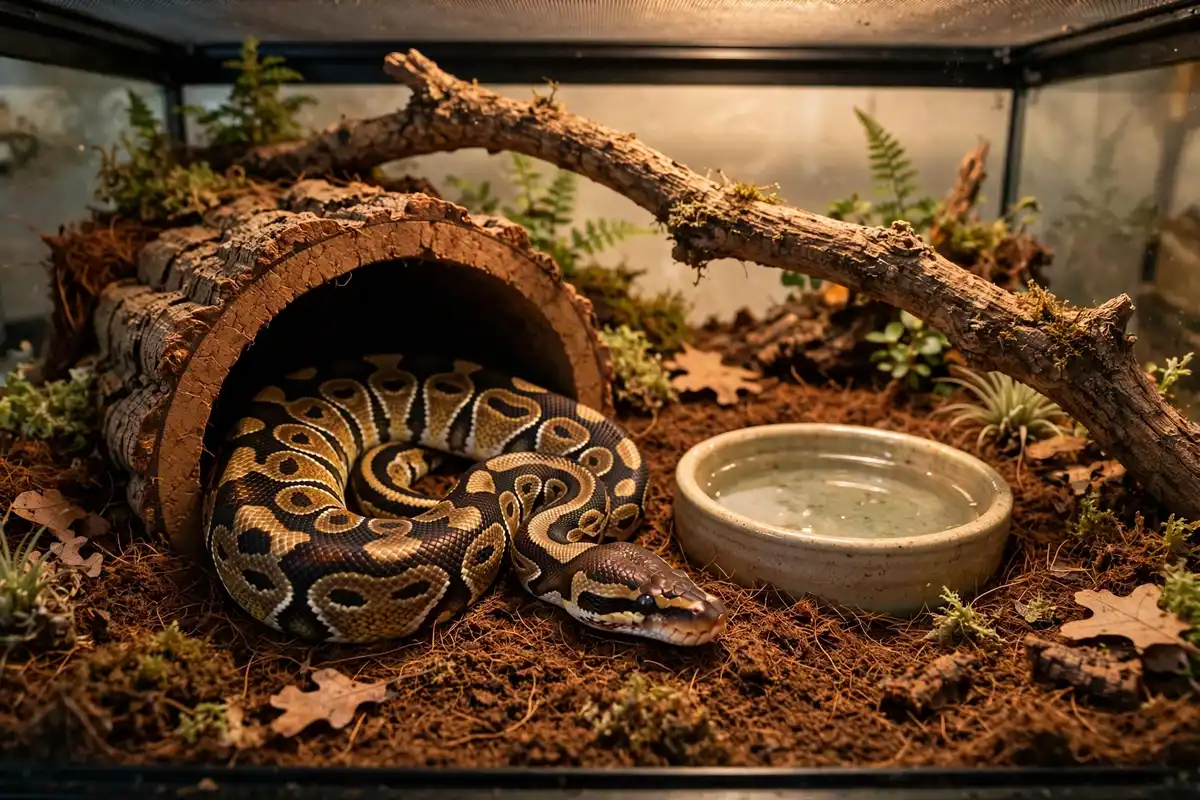
A ball python needs a secure, escape-proof enclosure sized to its age. It also needs a proper temperature gradient, stable humidity, two snug hides (one warm, one cool), an appropriate substrate, a heavy water bowl, and clutter such as branches or artificial plants for cover. Every heat source must be regulated by a thermostat; this is the single most important safety rule in ball python housing.
Enclosure size by age
- Hatchlings and juveniles: a 10 to 20 gallon tank or a ventilated tub works well. Babies feel safer in smaller spaces with lots of cover.
- Subadults: a 40 gallon enclosure (about 36 x 18 x 18 inches) is a common minimum as they grow.
- Adults: a 4 x 2 x 2 foot enclosure (roughly 120 gallons) is ideal. PVC-front enclosures hold heat and humidity far better than screen-top glass tanks.
Complete setup checklist
| Item | What to get | Why it matters |
|---|---|---|
| Enclosure | Locking tank or PVC vivarium, sized to age | Ball pythons are escape artists; a sliding lid without a lock is a lost snake |
| Heat source | Under-tank heat mat or ceramic heat emitter, always on a thermostat | Creates the warm side; unregulated heat sources cause burns |
| Thermometer + hygrometer | Two digital probes, one per side | Dial gauges are unreliable; you need real numbers at snake level |
| Substrate | Coconut fiber, cypress mulch, or paper towels | Holds humidity, allows burrowing; avoid pine, cedar, and aspen |
| Hides | Two identical snug hides, one on each side | A secure snake is a feeding snake; identical hides prevent side preference |
| Water bowl | Heavy ceramic bowl, wide enough to soak in | Drinking, soaking, and humidity all in one |
| Cover | Branches, cork bark, artificial plants | Clutter between hides reduces stress and encourages normal behavior |
Place the water bowl on the cool side to slow evaporation. Make sure hides are snug: a ball python should touch the sides when curled inside. A hide that is too roomy does not feel like a hide to them.
How do I keep heating and humidity right?
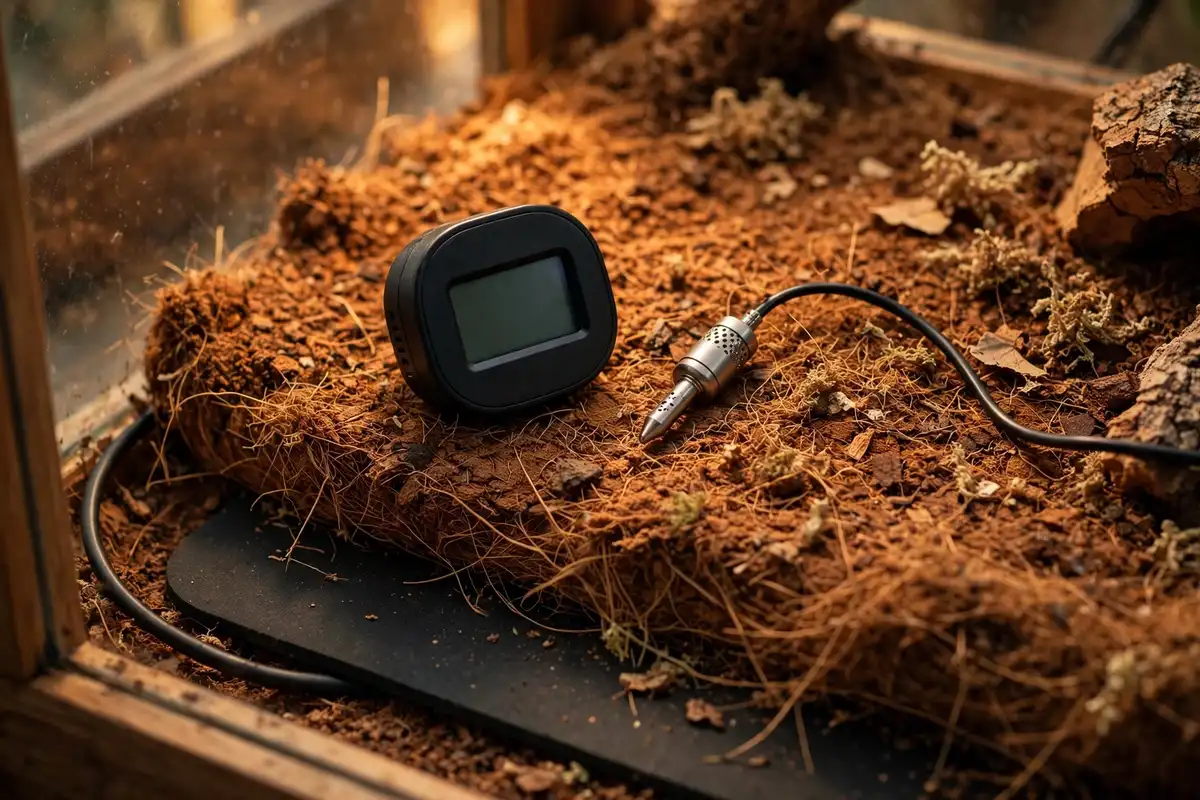
Set the warm side to 88 to 92°F. Keep the cool side at 75 to 80°F. Never let nighttime temperatures drop below 75°F. Aim for humidity at 50 to 60 percent, raised to about 70 percent during shedding. Measure both sides with digital probe thermometers. Place the probes at snake level, not stuck to the top of the glass. Check humidity with a digital hygrometer.
The thermostat is non-negotiable. Plug every heat source into one. Set the probe on the substrate over the heat mat. For overhead heat, set it under the basking area. Heat mats without thermostats are the most common cause of thermal burns in pet snakes. Glass and plastic can get far hotter than the air above them. Never use heat rocks: they develop dangerous hot spots and cannot be regulated reliably.
For humidity, start with a deep layer of moisture-holding substrate, like coconut fiber or cypress mulch. Add a large water bowl. For screen-top tanks, partly cover the lid to slow evaporation. Mist the substrate and enclosure walls when readings dip, not the snake itself, since direct spraying stresses most ball pythons. Live in a dry climate or run air conditioning? A PVC enclosure makes humidity control much easier than glass.
Watch the snake for feedback. Constant soaking in the water bowl can signal mites or temperatures that are too high. A perpetually damp substrate invites scale rot. No ball python care guide replaces daily observation. Good daily care is a loop: measure, adjust, and watch how your individual snake responds.
What do ball pythons eat and how often?
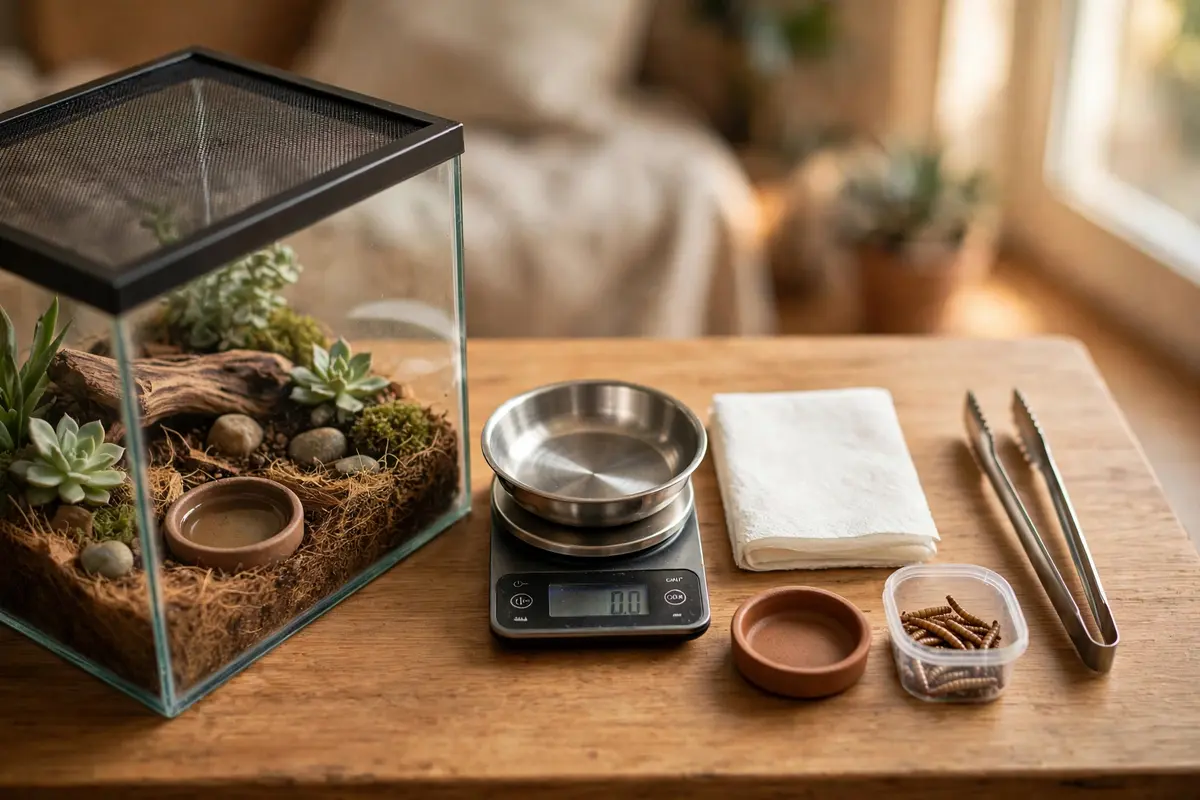
Ball pythons eat whole rodents. In captivity, feed frozen-thawed mice or rats, sized to roughly the width of the snake’s thickest body section. Feeding frequency drops with age. Hatchlings eat every 5 to 7 days, juveniles every 7 to 10 days, and adults every 10 to 14 days. Always thaw prey completely and warm it to roughly body temperature before offering.
Start babies on rats if you can. Many keepers report that ball pythons raised on mice later refuse to switch to rats. Adult ball pythons need rat-sized meals to stay well nourished. Offer the prey with long feeding tongs, wiggling it gently to mimic live movement. Feed inside the enclosure rather than moving the snake to a separate tub. Moving to feed is outdated advice that adds stress and a bite risk.
Feeding schedule by age
| Age | Prey type and size | Frequency | Notes |
|---|---|---|---|
| Hatchling (0 to 6 months) | Hopper mice or rat pups | Every 5 to 7 days | Start on rats if possible to avoid a later switch |
| Juvenile (6 to 18 months) | Small rats | Every 7 to 10 days | Weigh monthly; steady growth matters more than the calendar |
| Adult (18 months and up) | Medium rats | Every 10 to 14 days | Prey about as wide as the snake’s thickest section |
The most important feeding behavior to understand is the hunger strike. Ball pythons famously refuse food for weeks or months, especially in winter or during shed cycles. As long as the snake’s weight stays stable and husbandry is correct, a fast is usually not an emergency. Track weight monthly on a kitchen scale. A slow decline is expected during a long fast, but rapid loss or a visible spine means a vet visit.
Never feed live rodents unsupervised. A live rat can seriously injure a snake in minutes. Frozen-thawed is safer, cheaper, easier to store, and accepted by the vast majority of ball pythons. If your snake refuses thawed prey, try warming it a little more or offering at night when the snake is naturally active. Try scenting techniques too before assuming there is a real problem.
How do I handle a ball python safely?
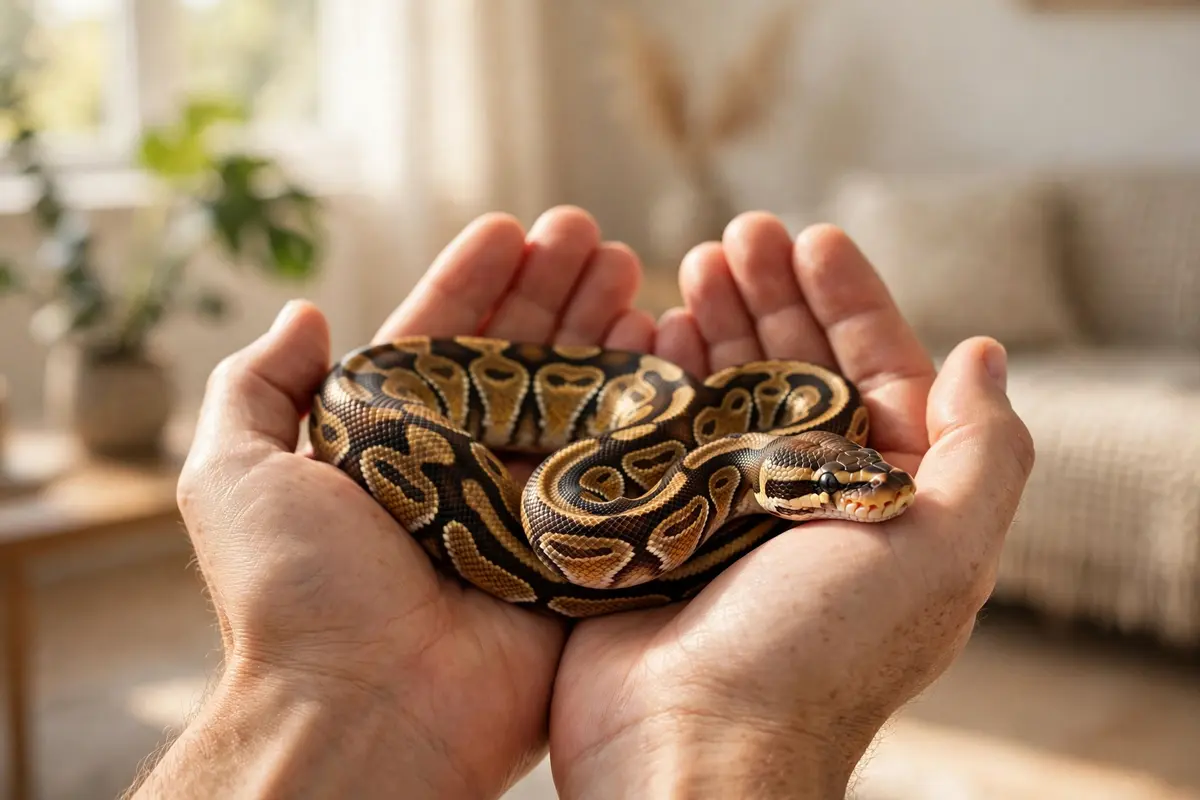
Handle a ball python safely by letting it settle for one to two weeks after arriving home. Then start with short 10 to 15 minute sessions a few times a week. Support the full body with both hands and avoid sudden movements. Approach from the side rather than from above (a descending hand looks like a predator), and never grab the head or the tail tip.
Good handling reads the snake’s body language. Slow tongue flicking means the snake is calmly exploring; that is your green light. A tightly coiled ball with the head tucked, hissing, or sudden jerky movement means stress; put the snake back and try another day. Let the snake move through your hands rather than restraining it, and keep sessions away from faces and high edges.
Handling rules that prevent 90 percent of problems:
- Wait at least 48 hours after feeding before handling, to avoid regurgitation.
- Do not handle during the shed cycle, when the snake’s vision is clouded and its temper is short.
- Wash your hands before and after, especially if you have handled rodents; a snake that smells prey may strike at fingers.
- Keep handling sessions brief at first and lengthen them only as the snake stays relaxed.
- Supervise children closely and teach them the same gentle, full-body support.
With consistent, calm handling, most ball pythons become remarkably placid. Many owners find their snake eventually rests quietly in their hands or draped over an arm. Trust builds slowly with this species, and that is part of the appeal.
What happens when a ball python sheds?
When a ball python sheds, its skin turns dull. Its belly may look pink, and its eyes go milky blue and opaque for a few days as fluid builds up under the old skin. Then the eyes clear, and the snake sheds its skin in one piece within the next few days. The whole cycle typically takes 7 to 14 days, during which the snake may hide more, refuse food, and act grumpy.
Raise humidity to around 70 percent when you notice the blue phase starting. A proper shed comes off in one complete piece, including the eye caps (the clear spectacles over the eyes). A shed that comes off in fragments is called dysecdysis, and it almost always points to low humidity.
If the shed is stuck, do not peel it off dry. Provide a humid hide (damp sphagnum moss in a closed container with an entrance hole) or a brief lukewarm soak. Let moisture do the work. Retained eye caps or bands of stuck shed that constrict the body need a reptile vet. Never pull at stuck shed around the eyes or tail tip yourself.
What are common ball python health issues?
Common ball python health issues include respiratory infections, mouth rot (stomatitis), snake mites, shedding problems, scale rot, and constipation. Most of them trace back to daily care: wrong temperatures, low humidity, dirty enclosures, or chronic stress. A snake kept at correct temperatures and humidity, in a clean enclosure, with minimal stress, rarely gets sick.
- Respiratory infection: wheezing, open-mouth breathing, mucus or bubbles around the nostrils. Usually caused by temperatures that are too low. Needs a reptile vet; antibiotics are prescription-only.
- Mouth rot (stomatitis): red, swollen gums or cheesy-looking patches inside the mouth. Often follows an injury or chronic stress. Veterinary treatment required.
- Snake mites: tiny black or red dots moving on the snake, especially around the eyes and heat pits, plus excessive soaking. Treat the snake and fully disinfect the enclosure; mites spread fast.
- Dysecdysis (bad sheds): fragmented shedding or retained eye caps from low humidity. Fix humidity first, then assist gently with moisture.
- Scale rot: discolored, soft belly scales from sitting on perpetually wet substrate. Keep substrate damp, not soaked, and let the enclosure dry between mistings.
- Constipation or impaction: no droppings for several weeks, sometimes from dehydration or swallowing substrate. A warm soak can help; persistent cases need a vet.
Find a reptile vet before you need one. Not every small-animal clinic treats snakes, and searching during an emergency wastes critical time. An annual checkup is good practice for a pet that will live for decades.
How much does a ball python cost to keep?
A ball python costs roughly $250 to $600 to set up properly, plus about $200 to $400 per year in ongoing costs. The snake itself ranges from around $60 for a normal morph to several hundred for popular designer morphs. The enclosure and thermostat are the big one-time expenses; food is the main recurring one.
| Expense | Typical range | Notes |
|---|---|---|
| Snake (normal morph) | $60 to $150 | Designer morphs run $200 to $500+; buy from a reputable breeder |
| Enclosure | $80 to $300 | Tank now, larger PVC vivarium later as the snake grows |
| Heating + thermostat | $60 to $120 | Never skip the thermostat; it protects a decades-long investment |
| Substrate, hides, decor, bowls | $50 to $100 | Mostly one-time; substrate is replaced periodically |
| Food (annual) | $100 to $200 | Frozen rats bought in bulk are far cheaper per meal |
| Substrate + incidentals (annual) | $50 to $100 | Replacement bedding, disinfectant, spare bulbs |
| Vet (annual) | $75 to $150 | Budget for at least one checkup a year, more if issues arise |
Multiply the annual figure by 25 years and the real cost of a ball python lands in the low thousands of dollars. That is still modest for a pet, but it is worth seeing the number before you commit. Rehoming a 20-year animal is much harder than rehoming a hamster.
What mistakes do first-time owners make?
The most common beginner mistakes with ball pythons are skipping the thermostat, housing the snake with a cage mate, and feeding live prey unsupervised. Other classics are using pine or cedar bedding and handling too much too soon. Almost every one of these comes from treating the snake like a decoration instead of an animal with specific needs.
- No thermostat on the heat source: the number one cause of burns. If you buy one piece of equipment after reading this, make it the thermostat.
- Cohabitation: ball pythons are solitary. Housing two together causes chronic stress, feeding competition, and disease risk, no matter what a pet store employee suggests.
- A giant, empty enclosure for a baby: hatchlings in huge open tanks feel exposed and stop eating. Start smaller and add clutter; upgrade as the snake grows.
- Handling during the settle-in period: give new arrivals one to two weeks of total peace. A snake that will not eat is often a snake that was handled on day two.
- Chasing humidity with constant misting: soaking wet substrate causes scale rot. Fix the enclosure design (deeper substrate, covered lid, PVC) instead of spraying five times a day.
- Panicking over a hunger strike: a healthy-weight ball python refusing food for a few weeks is normal behavior. Weigh monthly and check husbandry before assuming illness.
- Buying on impulse at a show or store: research breeders, choose an established eater, and have the full setup running with stable temperatures for at least a few days before the snake arrives. The best ball python care guide in the world cannot save a purchase made before the homework.
Related Guides
- Aquatic Turtle Care Manual for Beginners
- Sugar Glider Care Manual: The Beginner’s Complete Guide
- Pet Rat Care Guide: 10 Myths About the Smartest Pet
Frequently Asked Questions
Do ball pythons bite?
Rarely. Ball pythons are famously docile and usually curl into a ball rather than bite when stressed. Most bites are feeding mistakes, when a hand smells like a rodent. That is why you should wash your hands and use tongs at feeding time. A bite from an adult is startling but minor, and true aggression is uncommon in this species.
How long do ball pythons live?
Ball pythons live 20 to 30 years in captivity with proper care, and some individuals pass 30. This is one of the longest commitments in the reptile hobby, longer than most dogs. Anyone buying a hatchling should plan for decades of feeding, enclosure upgrades, and veterinary care.
Can two ball pythons live together?
No. Ball pythons are solitary animals and should always be housed alone. Cohabitation causes chronic stress, competition for the warm hide, feeding accidents, and faster disease spread. Each snake needs its own enclosure with its own temperature gradient and hides.
Why is my ball python not eating?
The most common reasons are shedding, seasonal fasting (especially in winter), and stress from a new home or too much handling. Incorrect temperatures or humidity are common causes too. Check husbandry first, weigh the snake monthly, and offer food at night. If weight drops steadily or the snake shows other symptoms, see a reptile vet.
Do ball pythons need UVB lighting?
They do not strictly require UVB since they are nocturnal, but a simple 12-hour light and dark cycle helps maintain a natural rhythm. Low-intensity UVB is considered optional enrichment by many keepers. What they absolutely need is correct heat and humidity, which matter far more than lighting for this species.
Are male or female ball pythons better pets?
Temperament does not differ meaningfully between the sexes; both make equally calm pets. The practical difference is size. Males usually reach 3 to 4 feet, while females reach 4 to 5 feet and need slightly larger enclosures and prey. Choose based on the individual snake’s feeding history and health, not its sex.
This guide is for informational purposes and doesn’t replace professional veterinary advice.