

Quick answer: How much should I feed my dog? Most adult dogs need about 1 to 4 cups of dry food per day depending on their weight, with small dogs near 1 cup and large breeds over 4 cups. Puppies need more calories per pound and should eat 3 to 4 times a day, while seniors usually need about 20 percent fewer calories. The chart below gives you exact daily amounts by weight and age.
Contents
- What is a dog feeding chart?
- How much food does a dog need per day?
- How do I adjust my dog’s food by weight and age?
- Related Guides
- Frequently Asked Questions
What is a dog feeding chart?
A dog feeding chart is a simple reference table that shows how much food your dog should eat each day based on body weight and life stage (puppy, adult, or senior). If you keep asking how much should I feed my dog, this chart is the practical starting point. Most commercial dog foods print one on the back of the bag, but those tables are a starting point, not a final answer. They cannot account for your individual dog’s metabolism or activity level.
The idea is straightforward. Instead of guessing, you look up your dog’s ideal weight (not their current weight, if they are carrying extra pounds) and match it to a daily range in cup measurements by weight. Then you adjust up or down based on how your dog looks and feels over the next few weeks. The chart below follows the same pattern used by major pet food makers and feeding guides, covering puppies, adults, and seniors in one place.
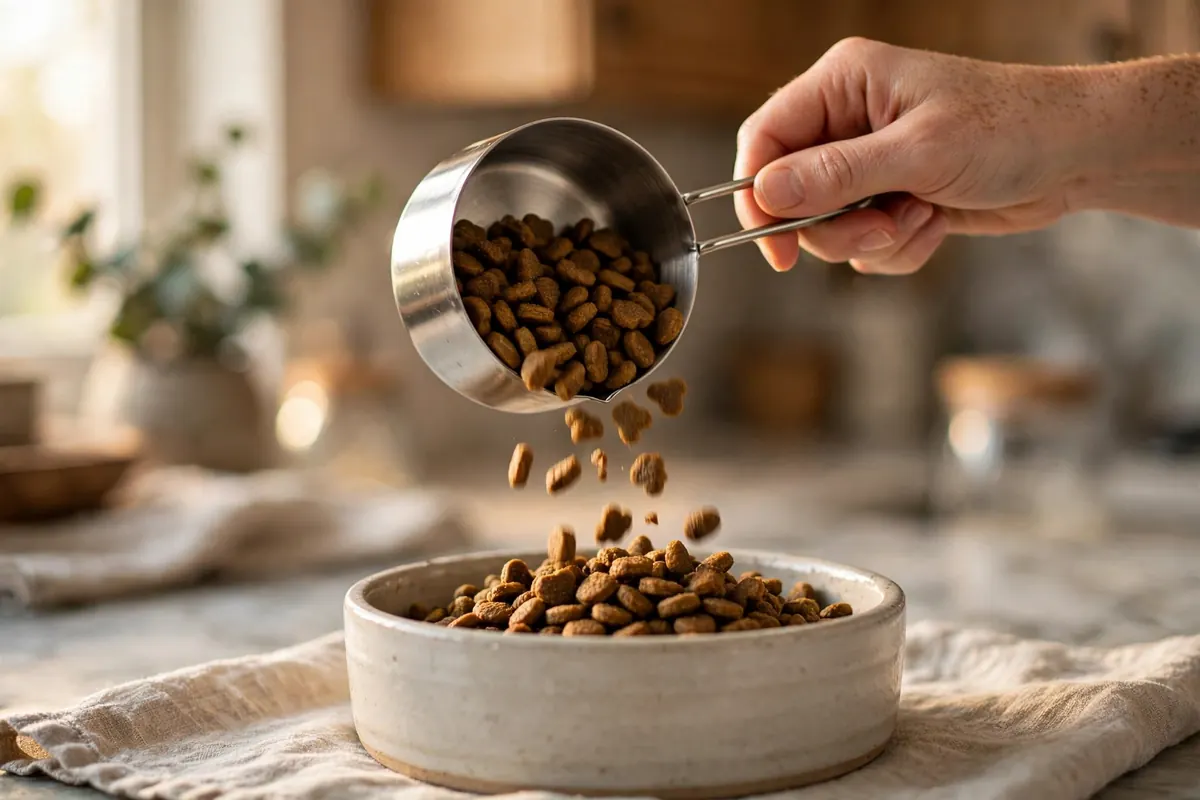
Why does this matter so much? Because eyeballing portions is the number one reason dogs gain weight. A scoop that “looks right” can easily be double the recommended amount. A chart plus a measuring cup turns feeding into a repeatable routine, which makes it far easier to notice when your dog’s weight starts drifting and to fix it before it becomes a real problem.
How much food does a dog need per day?
How much should I feed my dog each day? An adult dog of average activity typically needs roughly 1 cup of dry food for every 20 pounds of body weight. That works out to about 2 cups for a 40-pound dog and 3 to 4 cups for a 60 to 80-pound dog. Puppies need significantly more calories per pound of body weight than adults, and seniors need fewer, so use the chart below as your daily total.
The table assumes a standard dry food with average calorie density (roughly 340 to 380 calories per cup). Richer or leaner foods shift the numbers, which is why the bag of your food is always the final reference. Split the daily total into meals: two meals for adults, three to four for puppies, and one to two for seniors.
| Dog’s Weight | Puppy (up to 12 months) | Adult (1 to 7 years) | Senior (7+ years) |
|---|---|---|---|
| 5 lbs | 1 to 1 1/4 cups | 1/2 to 3/4 cup | 1/2 cup |
| 10 lbs | 1 1/2 to 2 cups | 3/4 to 1 cup | 3/4 cup |
| 20 lbs | 2 1/2 to 3 cups | 1 1/4 to 1 2/3 cups | 1 to 1 1/4 cups |
| 40 lbs | 4 to 4 3/4 cups | 2 1/3 to 3 cups | 2 to 2 1/3 cups |
| 60 lbs | 5 1/2 to 6 1/2 cups | 3 to 3 3/4 cups | 2 1/2 to 3 cups |
| 80 lbs | 6 3/4 to 8 cups | 3 3/4 to 4 2/3 cups | 3 to 3 3/4 cups |
| 100 lbs | 8 to 9 1/2 cups | 4 2/3 to 5 1/2 cups | 3 3/4 to 4 1/2 cups |
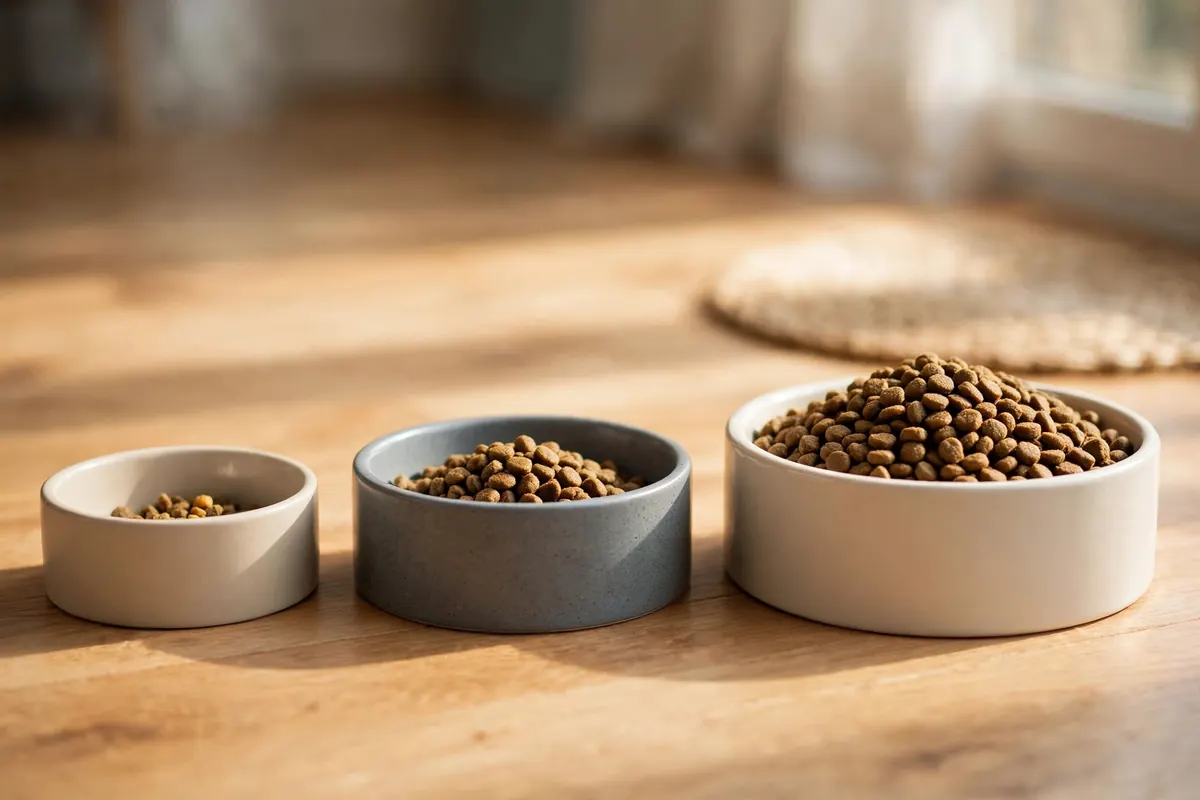
Notice how puppy vs adult amounts differ. A growing puppy at 40 pounds may need close to double the adult amount because growth is energy hungry work. Giant breeds mature slower, so keep large-breed puppies on a large-breed puppy formula until about 18 months. Feed per the puppy column but watch growth so they stay lean, since too-rapid growth stresses developing joints.
Meal timing matters almost as much as amount. Here is a schedule that works for most households:
- Puppies under 6 months: 3 to 4 meals a day, spaced evenly, because their small stomachs empty fast.
- Puppies 6 to 12 months: drop to 3 meals, then 2 as they approach adult size.
- Adults: 2 meals a day, morning and evening, which supports digestion and blood sugar.
- Seniors: 2 smaller meals, or 3 if appetite is low or digestion is sensitive.
When you switch brands or formulas, do it gradually over 7 to 10 days, mixing increasing amounts of the new food into the old. A sudden switch often causes digestive upset, which many owners mistake for the new food being wrong. Recalculate portions during the switch too, because the new bag’s calorie density may differ from the old one. That hidden difference is exactly where “mystery weight gain” comes from.
For maximum accuracy, consider weighing food on a cheap kitchen scale for one week instead of using cups. Cups are convenient but imprecise: the same cup of kibble can vary by 20 percent in weight depending on how settled the pieces are. Weighing once teaches you what the right amount actually looks like, and you can go back to cups with far better judgment afterward.

How do I adjust my dog’s food by weight and age?
Start with the chart amount for your dog’s ideal weight, feed it consistently for 2 to 4 weeks, then adjust based on what you see. The two tools that matter most are the body condition score (how your dog looks and feels) and honest tracking of activity. If the ribs are hard to feel under a layer of fat, cut portions by about 10 percent. If ribs are too visible and energy is low, increase by the same amount.
The body condition score is the vet’s preferred scale for judging whether a dog is at a healthy weight. Aim for the middle range: you should be able to feel the ribs easily with a light covering of fat, see a visible waist when viewed from above, and see a tummy tuck from the side. Most household dogs score slightly above ideal, which is a sign portions have crept up.

Activity level adjustment is the other big dial. An agility competitor or farm dog can need 30 to 50 percent more food than the chart suggests, while a couch-loving apartment dog may need 10 to 20 percent less. Seasonal changes count too: dogs that swim and hike all summer often need extra calories in those months and should be scaled back when winter shortens their walks.
Age brings its own shifts. Seniors usually need about 20 percent fewer calories than their adult amount because metabolism slows and activity drops, but protein quality matters more, not less, since older dogs lose muscle. Switch to a senior formula rather than just feeding less adult food, and weigh your dog every month or two, because gradual weight loss in seniors can also signal health issues worth a vet visit.
Finally, follow the 10% treat calorie rule: treats, chews, table scraps, and training rewards should make up no more than 10 percent of daily calories. For a dog eating 2 cups a day, that is only about 3 tablespoons of treats. Count them into the daily total instead of adding them on top, or the chart amount stops meaning anything.
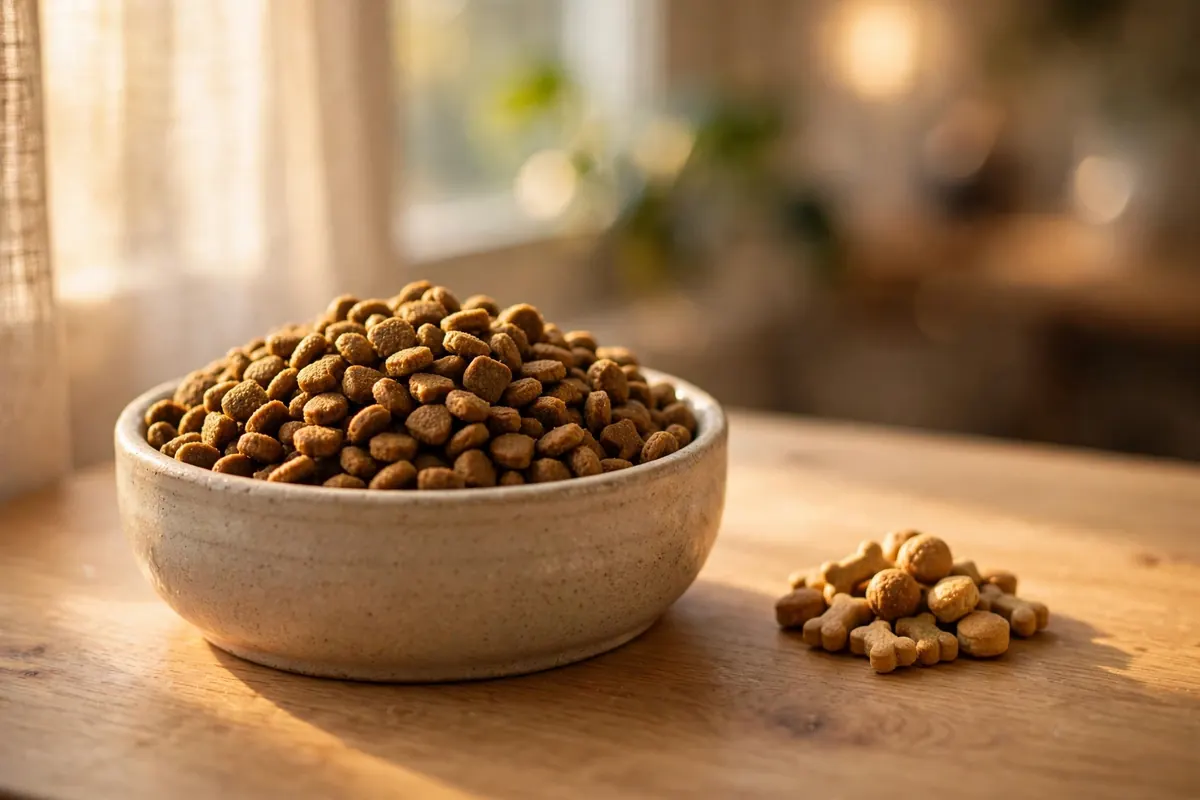
Signs you got it right: a defined waist, steady energy, firm stools, and a shiny coat. Signs you need to adjust: a disappearing waist, begging that never stops even after meals, loose stools from overfeeding, or a dull coat. When in doubt, weigh the food for a week and weigh the dog, because numbers beat memory every time.
One more habit worth building: feed on a schedule rather than leaving food down all day. Scheduled meals make it possible to measure exactly what goes in, which is the whole point of a feeding chart. Free-feeding works for almost no dog in practice, since most will graze past their needs, and it hides appetite changes that can be the first sign of illness. Put the bowl down for 15 to 20 minutes, then pick up whatever is left.
Related Guides
- Puppy Diarrhea: What’s Normal and What’s an Emergency
- Dog Throwing Up? 12 Causes Ranked by Urgency
- Labrador Care Guide: Training, Health, and Daily Care
Frequently Asked Questions
How many cups of food should a 50 pound dog eat per day?
A 50-pound adult dog with average activity typically needs about 2 2/3 to 3 1/3 cups of standard dry food per day, split into two meals. Start there, then adjust by 10 percent up or down based on your dog’s body condition score over 2 to 4 weeks. Very active dogs may need more, and sedentary dogs may need less.
Should I feed my puppy more than an adult dog?
Yes, puppies need noticeably more calories per pound of body weight than adults because they are growing. A puppy may need nearly twice the adult amount at the same weight, fed in 3 to 4 smaller meals. Switch to adult portions gradually around 12 months (18 months for giant breeds) as growth slows down.
Is it better to feed a dog once or twice a day?
Twice a day is better for almost all adult dogs. Two meals support steadier energy, easier digestion, and more predictable bathroom breaks. One large daily meal increases the risk of bloat in deep-chested breeds, and puppies definitely need 3 to 4 smaller meals because their stomachs cannot hold a full day of food.
How do I know if I am overfeeding my dog?
The clearest signs are a disappearing waist, ribs you cannot feel without pressing, and steady weight gain month to month. Also watch for constant begging, low energy, and soft stools. Do the rib check weekly: you should feel ribs easily with light pressure. If not, cut daily portions by about 10 percent.
Does the feeding chart on the dog food bag apply to my brand?
The bag chart is the most accurate starting point for that specific food, because calorie density varies a lot between brands and formulas. Our chart assumes average calories per cup, so always compare it against your bag’s chart and follow the bag when they differ. Then adjust based on your dog’s body condition.
This guide is for informational purposes and doesn’t replace professional veterinary advice.