

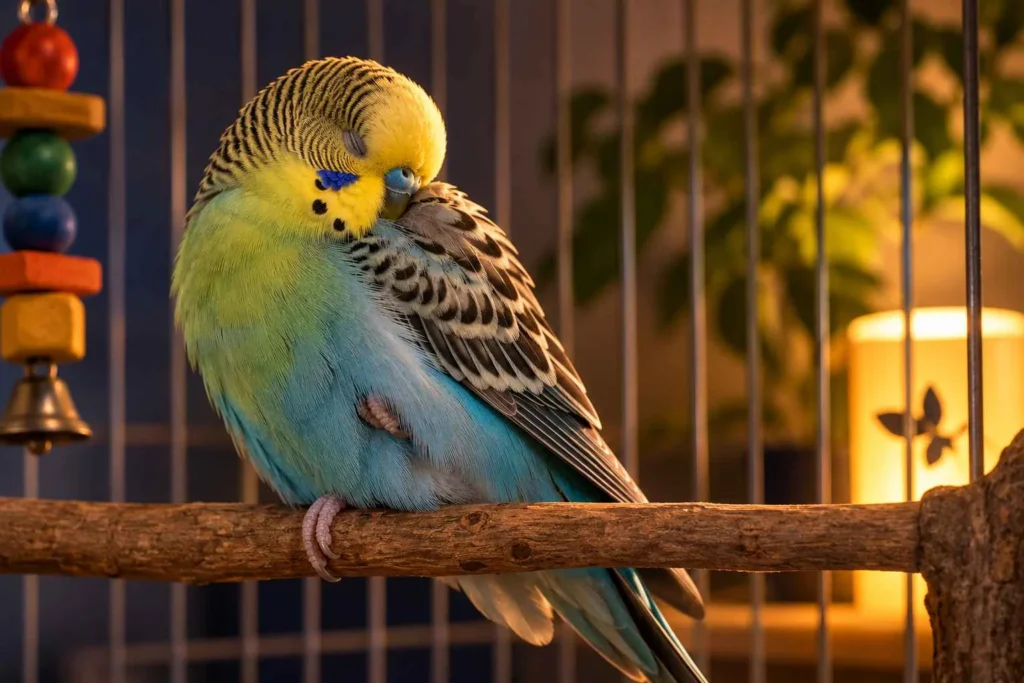
Your bird could be getting enough food, a clean cage, and plenty of attention but if it’s missing just a few hours of sleep each night, it may become noisy, irritable, or even start plucking its feathers.
A bird that screams at odd hours, plucks its feathers, or seems constantly on edge isn’t always sick or badly trained; it might just be sleep-deprived. How much sleep do birds need or, phrased the way most owners search it, how much sleep do pet birds need is one of the most underestimated questions in pet bird care, and getting it wrong quietly causes some of the most common behavior complaints new owners deal with.
Most companion birds need far more sleep than people expect, often more than most humans get. This guide breaks down exactly how long do birds need to sleep by species, what a proper bird sleeping schedule looks like, how to set up a sleep environment that actually works, and how to tell when a bird isn’t getting enough rest.
In this guide, you’ll learn:
- How many hours of sleep birds need, broken down by species
- What a healthy pet bird sleep routine looks like day to day
- How to build a sleep environment birds actually settle into
- The early warning signs of a sleep-deprived bird
- Whether daytime napping is normal or a red flag
- How to fix a disrupted bird sleeping schedule
Key Takeaways:
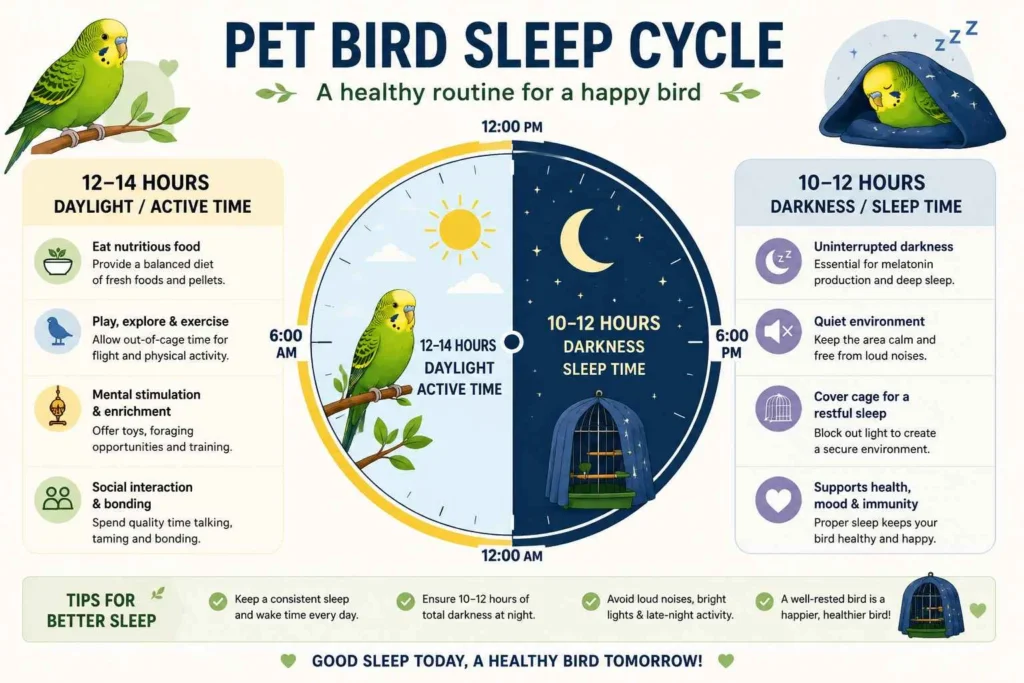
- Most companion birds need 10–12 hours of uninterrupted sleep nightly, more than most owners assume
- Darkness and quiet matter more than temperature for good bird sleep
- Consistent bedtime and wake time matter as much as total hours
- Sleep-deprived birds often become irritable, loud, or feather-destructive before anything else
- Covering the cage isn’t required for every bird, but it helps in shared or bright rooms
Let’s start with what actually determines a bird’s sleep needs.
Table of Contents
- What Determines How Much Sleep Birds Need
- How Many Hours Do Birds Sleep at Night?
- Why Bird Sleep Matters More Than Owners Expect
- Signs of a Sleep-Deprived Bird
- Building the Best Sleep Environment for Birds
- Daytime Napping: Normal or Warning Sign?
- How to Help a Bird Sleep Better
- Sleep Schedule by Bird Species
- Frequently Asked Questions
What Determines How Much Sleep Birds Need
How much sleep do birds need is defined by three main factors: species origin, age, and how close to natural daylight hours their environment mimics. Most companion bird species originated near the equator, where day and night run close to 12 hours each which is part of why 10 to 12 hours of nightly sleep is the benchmark most avian sources point to.
Bird sleep cycle explained simply: unlike humans, birds sleep in shorter cycles and can enter a light, alert state called unihemispheric sleep, where one half of the brain rests while the other stays semi-aware of surroundings. This is a survival trait from the wild, where staying fully unconscious made a bird vulnerable to predators.
How do pet birds sleep, practically speaking? Most perch upright, often on one leg, with feathers fluffed for warmth, head tucked toward the back or under a wing. What do pet birds sleep on matters too. A stable, appropriately sized perch away from cage bars gives a bird secure footing through the night, unlike cage flooring or swaying toys.
How Many Hours Do Birds Sleep at Night?
How many hours do birds sleep at night? Most companion bird species need 10 to 12 hours of uninterrupted, dark, quiet sleep noticeably more than the 7–9 hours typical for adult humans. Asked another way, how many hours do birds need to sleep to stay healthy and even-tempered comes down to that same 10–12 hour range for nearly every common pet species.
How long do pet birds sleep for, broken down by general category:
- Small birds (budgies, canaries, finches) Around 10–12 hours nightly, plus occasional short daytime rest
- Medium birds (cockatiels, lovebirds, conures) Around 10–12 hours nightly, sensitive to light disruption
- Large parrots (African greys, amazons, macaws) Often need closer to 12 hours, with noticeable behavior changes when consistently under-slept
Do pet birds sleep at night exclusively? For the most part yes, since most companion species are diurnal active by day, resting after dark unlike genuinely nocturnal animals. A bird kept in a brightly lit living room until midnight isn’t adapting to a new schedule; it’s simply losing sleep.
Why Bird Sleep Matters More Than Owners Expect
Bird sleep behavior connects directly to mood, immune function, and hormonal regulation. So how much do birds sleep actually changes day to day? A bird running on insufficient sleep doesn’t just seem tired, it often becomes reactive, loud, and harder to handle, in ways that get misread as a training or temperament problem rather than a rest problem.
Pro Tip: If a bird’s biting, screaming, or general crankiness spiked around the same time its schedule changed later TV nights, a moved cage, new household noise check the sleep schedule before assuming it’s a behavior issue to train away.
Quotable insight: a tired bird is rarely a calm bird; most sudden behavior changes in an otherwise healthy pet bird trace back to either diet or sleep before anything more complicated.
Signs of a Sleep-Deprived Bird
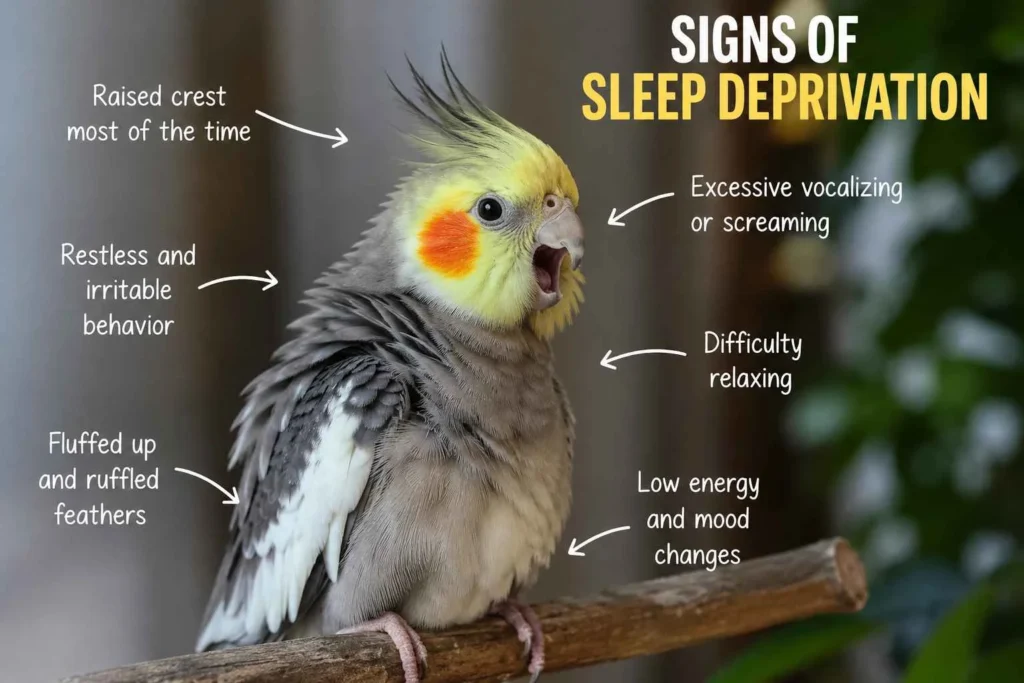
Signs of sleep deprived bird behavior tend to show up in mood and activity first, well before anything else changes. Watch for:
- Increased irritability or biting A normally easygoing bird becoming snappy without an obvious trigger
- Excessive daytime vocalization Screaming or loud calling that’s new or noticeably more frequent
- Restlessness on the perch Shifting, pacing, or an inability to settle even in a quiet room
- Feather-related stress behaviors Increased preening intensity or early feather-plucking tendencies tied to a stretch of poor sleep
- Reduced appetite or activity A bird that seems “off” without other obvious explanation
These are behavioral sleep-deprivation signs specifically if a bird shows physical symptoms like labored breathing, changes in droppings, or discharge, that points toward a broader health issue rather than sleep alone, and is worth addressing as its own concern.
Building the Best Sleep Environment for Birds
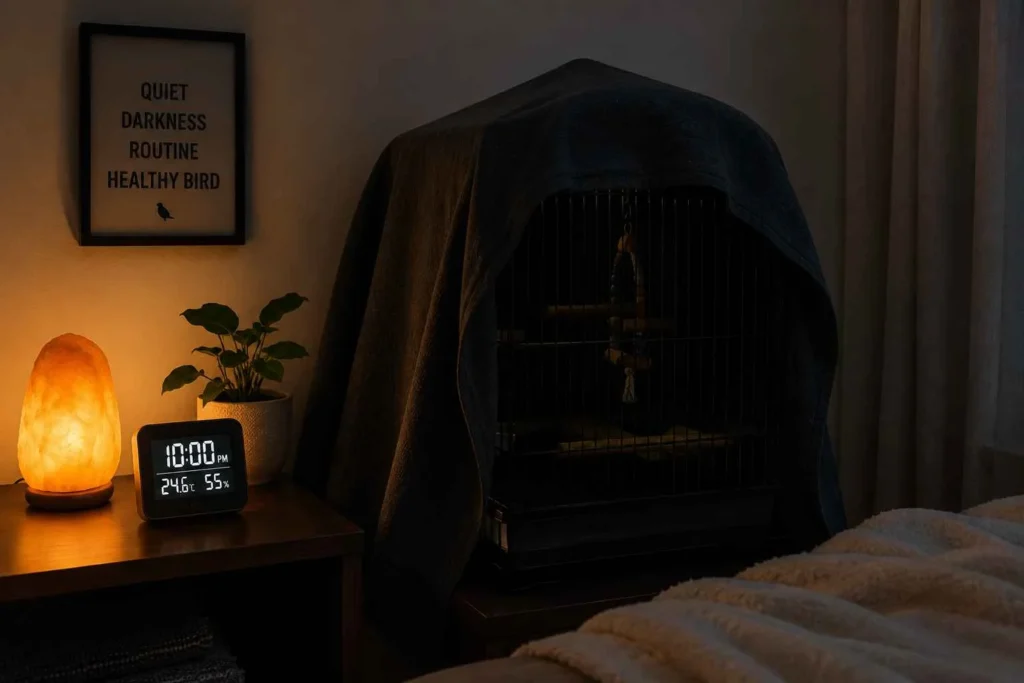
Best sleep environment for birds comes down to three controllable factors The 3D Sleep Environment Method:
- Dark Birds are highly sensitive to light; even a hallway light or TV glow can disrupt sleep onset. This is where bird night light sensitivity matters most for owners in shared living spaces
- Draft-free and temperature-stable A consistent, moderate room temperature without direct drafts from windows or AC vents
- Disturbance-free Away from foot traffic, other pets, and sudden noise during the sleep window
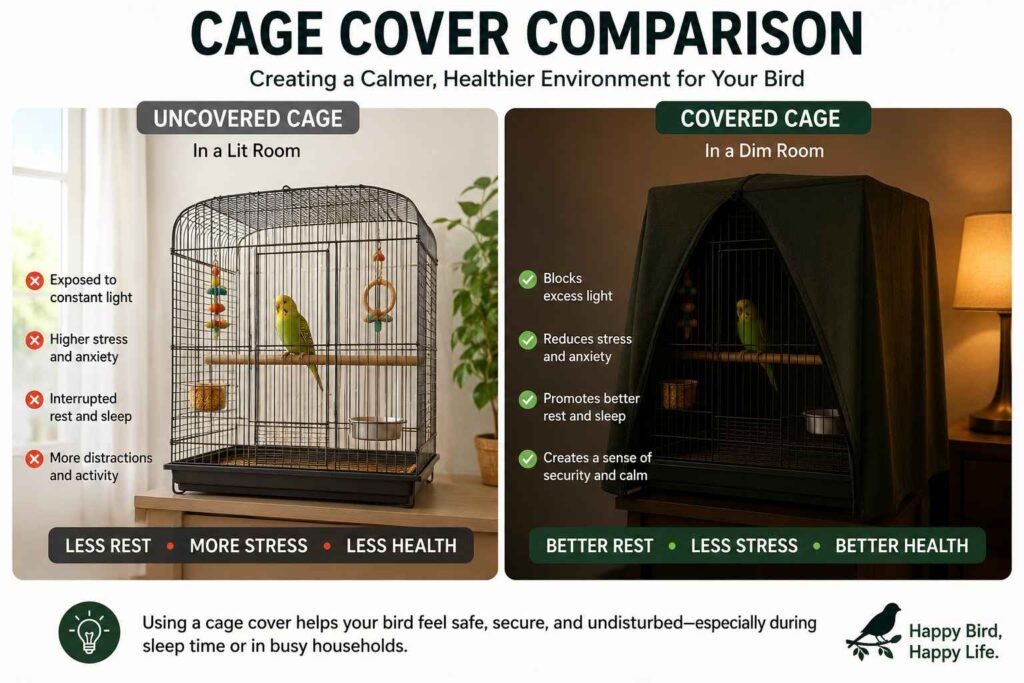
Covering bird cage at night and using a cage cover for sleeping birds is one practical way to hit the “dark” factor in a bright or shared room, though it’s not mandatory for every bird to settle in a naturally dark, quiet room without one. Do birds need darkness to sleep? Not absolute darkness, but meaningfully dimmer and quieter than daytime conditions, consistently, at roughly the same time each night.
Sleep is one part of a much bigger daily routine for the full picture on supplies, feeding, cage cleaning, and bonding, see the complete [ Pet Bird Care Guide].
Daytime Napping: Normal or Warning Sign?
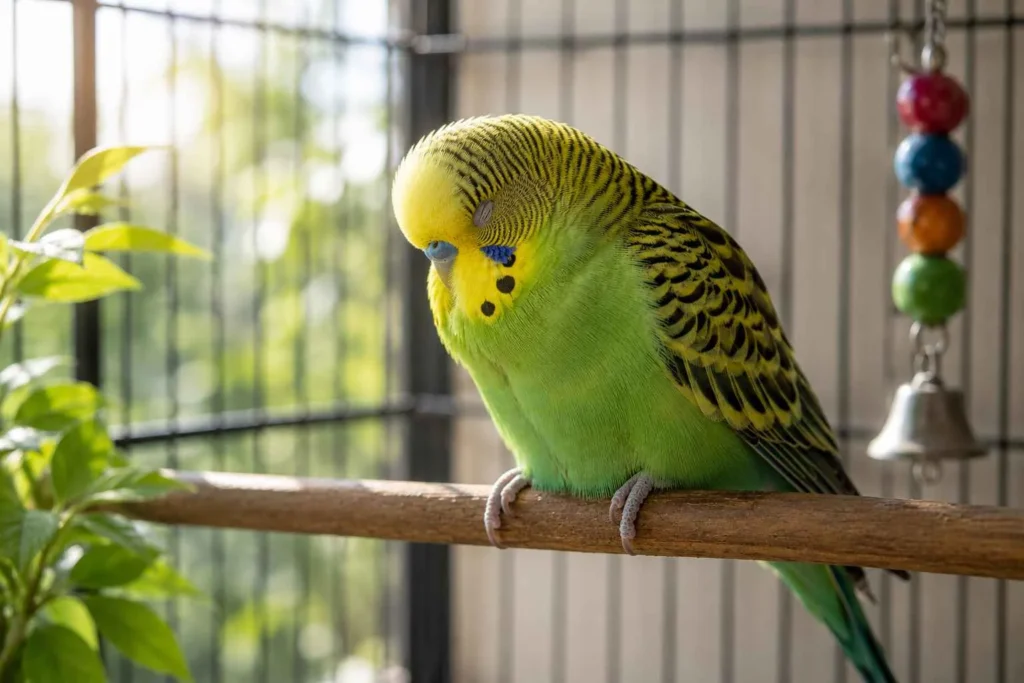
Daytime napping in pet birds is normal in small amounts. A short nap here and there, especially after a big meal or active play session, is typical and not a concern.
Frequent, prolonged daytime sleeping is different. Nocturnal disturbance in birds, anything interrupting proper nighttime rest is one of the most common causes of unusually heavy daytime napping, since the bird is trying to make up for lost sleep during the day instead of resting properly at night.
Real-world example: A cockatiel kept in a living room with the television on until 11 p.m. started napping heavily through the afternoon and became noticeably snappier by evening. Moving the cage to a quieter room with a consistent 8 p.m. lights-out routine resolved both the excessive napping and the evening irritability within about ten days.
How to Help a Bird Sleep Better
How to help bird sleep better a simple nightly process:
- Set a consistent bedtime Aim for the same time each night, ideally allowing for 10–12 hours before the bird needs to be active again
- Dim the environment 20–30 minutes before Gradually lowering light helps signal wind-down rather than an abrupt lights-out
- Cover or relocate if needed Use a breathable cage cover, or move the cage to a dark, quiet room if the current spot gets light or noise late in the evening
- Keep the sleep space consistent Avoid moving the cage frequently, since a stable location supports a stable pet bird sleep routine
- Protect morning wake time too A predictable wake time matters as much as bedtime for a stable bird sleeping schedule
The 10-12-1 Sleep Formula is a simple way to remember the target: 10–12 hours of nightly sleep, plus up to 1 hour of normal daytime napping. Anything well beyond that ratio is worth investigating.
Sleep Schedule by Bird Species
How Much Sleep Do Birds Need: Sleep Schedule by Species
| Species | Nightly Sleep Needed | Light Sensitivity | Cage Cover Recommended | Typical Bedtime Window |
| Budgerigar | 10–12 hours | Moderate | Optional | 7–9 PM |
| Cockatiel | 10–12 hours | High | Often helpful | 7–9 PM |
| Lovebird | 10–12 hours | High | Often helpful | 7–9 PM |
| Canary | 10–12 hours | Moderate | Optional | 7–9 PM |
| African Grey | 11–12+ hours | High | Recommended | 6–8 PM |
Recommendation: Treat 10–12 hours as the baseline sleep schedule by bird species, leaning toward the higher end for larger parrots and any bird showing early signs of sleep deprivation.
Conclusion
How much sleep do birds need comes down to a simple, often-overlooked number: 10 to 12 hours of dark, quiet, consistent nightly rest for nearly every companion species. Owners who protect that window tend to see calmer, less reactive birds and owners who don’t often mistake a tired bird for a difficult one.
Quick Summary:
- Most pet birds need 10–12 hours of nightly sleep, more than most owners expect
- Darkness, consistency, and a disturbance-free room matter more than temperature
- Irritability and excess daytime screaming are early sleep-deprivation signs, not just “attitude”
- Daytime napping should be brief heavy napping usually points to poor nighttime sleep
- A stable bedtime and wake time fix most sleep-related behavior issues within two weeks
Next steps:
- Track your bird’s current bedtime for a week and compare it to the 10–12 hour benchmark
- Move the cage to a quieter, darker spot if light or noise runs late into the evening
- If irritability or screaming has increased recently, rule out a sleep issue before assuming it’s a training problem.
Frequently Asked Questions
How much sleep do birds need per day?
Most companion birds need 10 to 12 hours of uninterrupted nightly sleep, plus occasional short daytime naps. Larger parrot species often do better closer to 12 hours than 10. However you phrase it how much sleep do pet birds need per day or how much sleep do pet birds need in a day the answer lands in that same 10–12 hour range.
How many hours do birds sleep at night?
Most pet birds sleep 10 to 12 hours at night when their environment is dark and quiet enough. Species with higher light sensitivity, like cockatiels and lovebirds, often need extra care to protect that full window.
Do pet birds sleep at night or during the day?
Pet birds are diurnal, meaning they’re primarily active during the day and sleep at night, unlike nocturnal animals. Daytime rest should only be short naps, not a replacement for proper nighttime sleep.
What are the signs of a sleep-deprived bird?
The clearest signs are increased irritability, excessive daytime screaming, restlessness on the perch, and stress-related feather behaviors. These often appear before any other visible change and are easy to mistake for a behavior problem.
Should I cover my bird’s cage at night?
Covering the cage helps in bright or noisy rooms by blocking light and reducing visual stimulation, though it isn’t mandatory for every bird. A naturally dark, quiet room can work just as well without one.
How much do birds need to sleep compared to humans?
Birds generally need more sleep than adult humans, who typically need 7–9 hours. Most companion birds need a consistent 10–12 hours nightly to stay healthy and even-tempered.
Is daytime napping normal for pet birds?
Short daytime naps are normal, especially after meals or active play. Frequent, prolonged daytime sleeping usually signals disrupted nighttime rest rather than a normal napping pattern.
How do I fix a disrupted bird sleeping schedule?
Set a consistent bedtime with 10–12 hours before the bird needs to be active, dim the room gradually beforehand, and keep the cage location and wake time stable. Most disrupted schedules improve within one to two weeks of consistency.