

Quick answer: Loose leash walking training teaches your dog that a tight leash stops the walk while a loose leash keeps it going. The core technique is the stop-and-go method: freeze the moment the leash tightens, then reward your dog the second it slackens. With 5 to 10 minute daily sessions, most dogs show real improvement within 2 to 4 weeks.
Contents
- Why Does My Dog Pull on the Leash?
- How Do I Stop My Dog From Pulling on Walks?
- What Gear Helps With Loose Leash Walking Training?
- What Are the Steps of Loose Leash Training?
- What Are the Biggest Mistakes in Loose Leash Walking Training?
- Related Guides
- Frequently Asked Questions
Why Does My Dog Pull on the Leash?
Your dog pulls because pulling works. Every time the leash tightens and you follow, your dog gets closer to something exciting. It could be an interesting smell, another dog, or the park gate. That is a reward, and dogs repeat whatever gets rewarded. By the time most owners start loose leash walking training, the habit has thousands of successful repetitions behind it.
Dogs also naturally walk faster than humans, especially young, high-energy breeds. Add excitement, a new environment, and weak impulse control, and pulling is the default setting, not a character flaw.
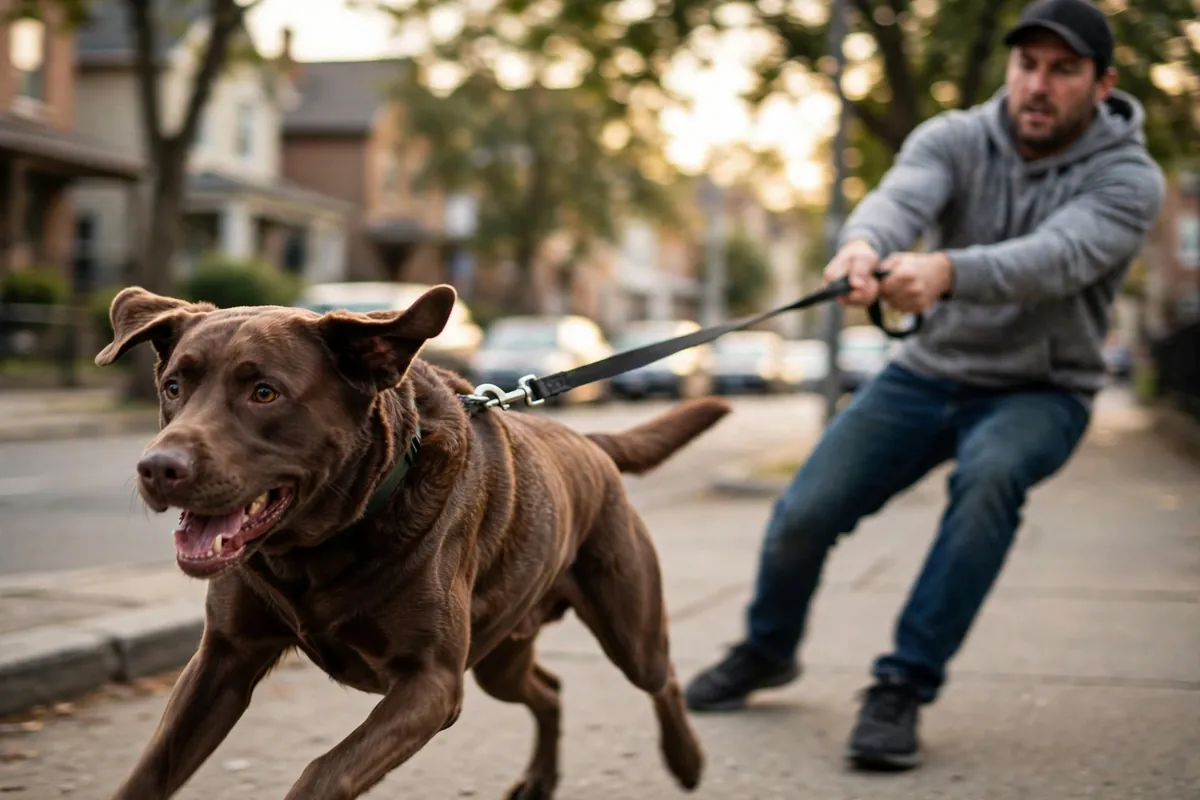
Understanding this changes how you train. You are not fighting a stubborn personality. You are installing a new, clearer rule: tight leash means the fun stops, and loose leash means the walk continues. Once that rule is consistent, pulling loses its payoff.
There is one more thing to know. Many owners accidentally reinforce pulling by moving with the dog to keep up, or by only paying attention when the dog lunges. From your dog’s perspective, the conversation goes like this: “Leash tight, human follows, I win.” Your job is to rewrite that script.
How Do I Stop My Dog From Pulling on Walks?
Stop moving the moment the leash goes tight, and reward your dog the moment it goes slack. That is the entire mechanism. Everything else in loose leash walking training is scaffolding around that one rule. If you are consistent for a few weeks, the behavior changes because the old strategy stops working.
This approach is called the stop-and-go method. It is the most reliable technique for everyday owners because it needs no special equipment and no perfect timing, just patience. Here is how to apply it on a real walk:
- Walk normally with a relaxed arm and the leash in a loose U shape.
- The second the leash tightens, plant your feet. Do not yank back, do not scold, do not say a word. Just become still.
- Wait for slack. Your dog will eventually look back, step toward you, or ease off. The instant the leash droops, say “yes” and step forward.
- Reward position, not just slack. When your dog is walking near you with a loose leash, deliver a high-value treat at your leg. You are paying for the exact position you want.
- Repeat every single time. Consistency is the whole program. Three perfect days followed by one day of being dragged teaches your dog that persistence pays.
The first sessions can feel painfully slow. Some owners barely cover half a block. That is normal and even good. Your dog is learning that leash tension turns the fun off, and their own choice to soften the leash turns it back on.
What Gear Helps With Loose Leash Walking Training?
The right gear makes training easier, but no gadget trains your dog for you. Think of equipment as training wheels: useful while the skill develops, not a substitute for it. For loose leash walking training, you need a standard 4 to 6 foot leash and one of the harnesses below. Never use a retractable leash: it teaches your dog that constant tension is normal.

| Equipment | How It Helps | Best For |
|---|---|---|
| Front-clip harness | Leash attaches at the chest, turning your dog sideways when they lunge, which reduces pulling power | Strong pullers of any size |
| Back-clip harness | Comfortable and tangle-free, but gives your dog full sled-dog leverage | Dogs that already walk politely |
| Flat collar | Simple and fine for trained dogs, but offers zero anti-pull mechanics | Calm dogs in low-distraction areas |
| Head halter | Gives maximum control over the head, and where the head goes the body follows | Large, powerful dogs as a temporary management tool |
| Standard 4-6 ft leash | Fixed length keeps your criteria clear; your dog always knows how far they can go | Every dog in training |
A front-clip harness is the best all-round choice for training because it gently removes the reward of pulling without pain or fear. Pair it with pea-sized, soft, high-value treats. Small pieces of boiled chicken, cheese, or commercial training treats work well even with distractions around.
What Are the Steps of Loose Leash Training?
Follow these five steps in order, spending 3 to 7 days on each before moving on. Each step builds on the last, so rushing costs you time instead of saving it. Sessions should last 5 to 10 minutes, once or twice a day.
- Practice indoors first. Start in a hallway or quiet room where distractions are near zero. Walk a few steps; the moment your dog is beside you with a slack leash, say “yes” and treat at your pant seam. Indoor practice builds the habit of checking in with you before the real world ever enters the picture.
- Teach the reward zone. Stand still with your leash hand resting at your hip. When your dog’s shoulder lines up with your leg and the leash droops, mark and treat. Do 10 clean repetitions. Your dog is learning that one specific spot, right next to you, is where the good things happen.
- Add motion with stop-and-go. Take one step. Slack stays? Mark and treat. Leash tightens? Freeze like a statue. Gradually stretch to two steps, then five, then ten between treats. Your stillness turns the fun off; your dog’s choice to soften the leash turns it back on.
- Add direction changes. When your dog surges ahead, pivot 180 degrees and walk the other way without warning. This teaches your dog to watch you instead of fixating on what’s ahead, and it breaks the pulling habit mid-stride.
- Raise distractions in tiers. Move from hallway to backyard, then a quiet street, then a busier block. Keep each new tier easy by going back to frequent treats at first. Fade the food gradually: replace every second treat with praise or a sniff break at an interesting bush. Real-world perks keep the manners alive long after the treat pouch is empty.
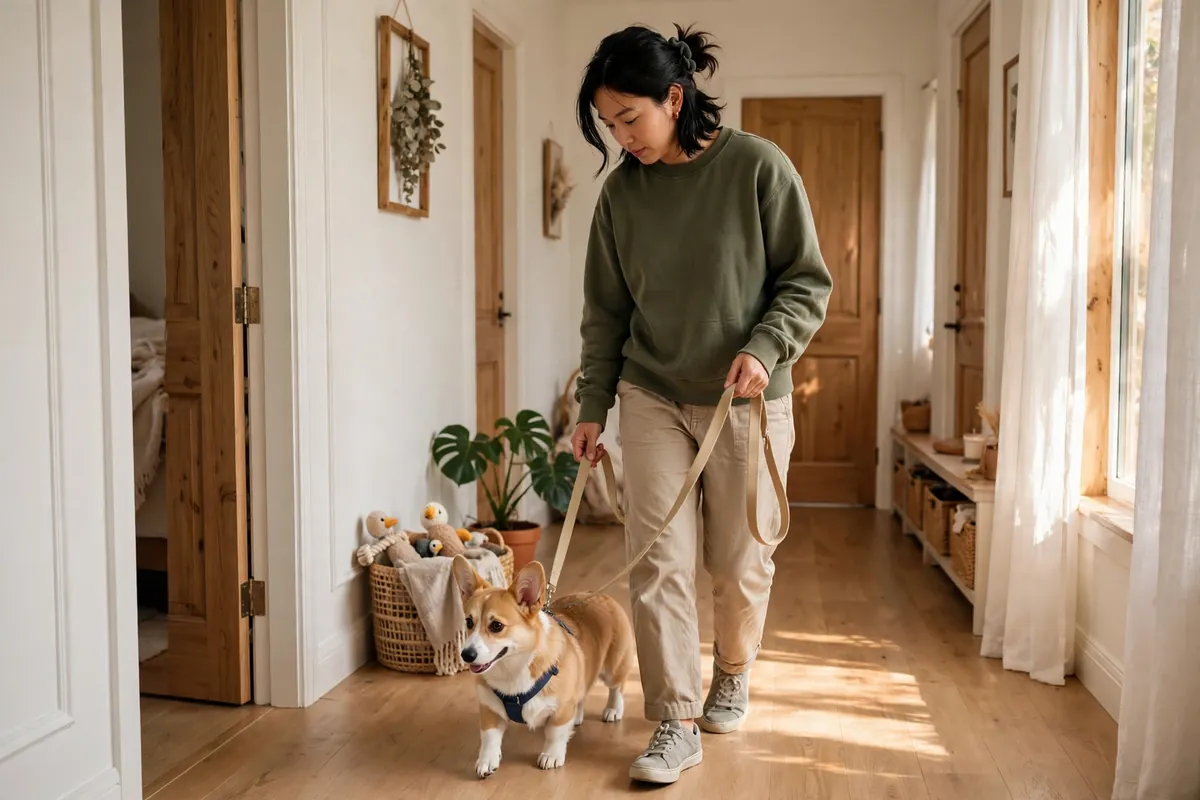
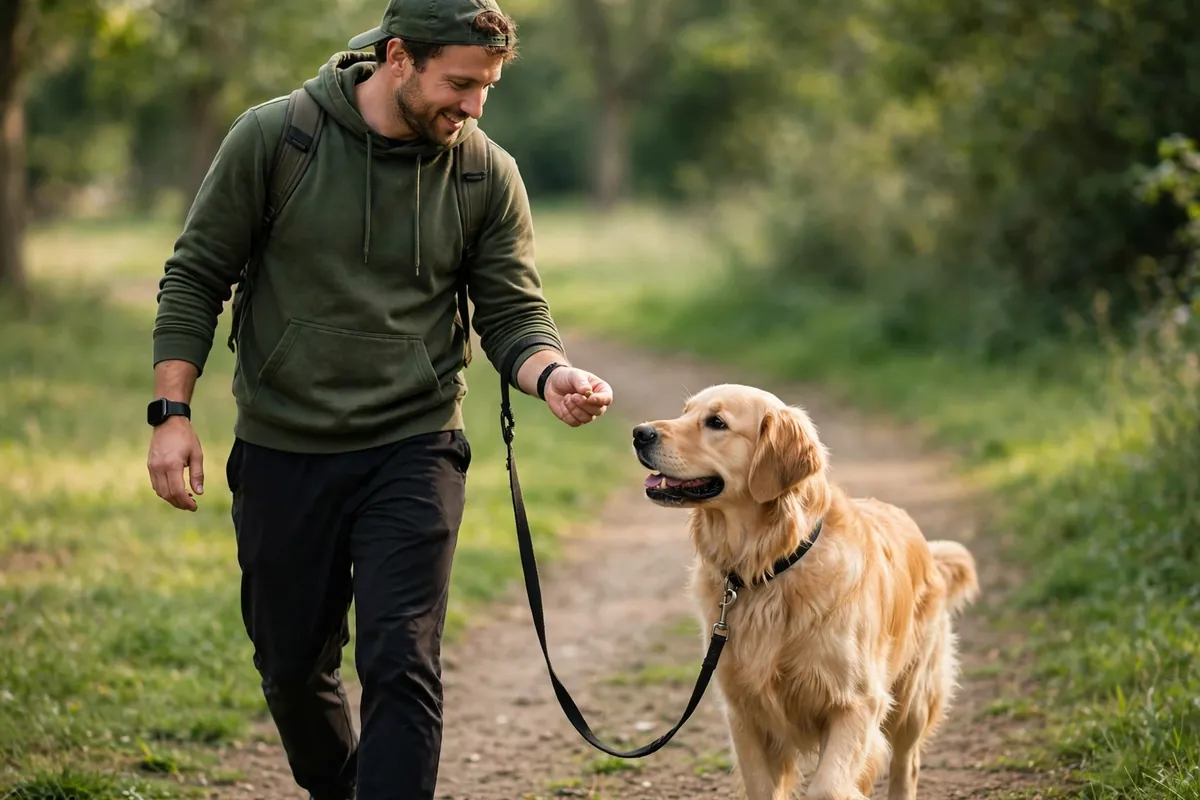
A note on expectations: loose leash walking is not heel. Heel vs loose leash is a real distinction. Heel means the dog’s shoulder glued to your leg with focused attention, which is a formal obedience position. Loose leash walking means the leash stays slack while your dog is allowed to sniff, explore, and be a dog. Most owners want the second one, and it is far easier to maintain on a 30 minute walk.
What Are the Biggest Mistakes in Loose Leash Walking Training?
Most failed training attempts die from the same few errors. Fixing these matters more than finding a new technique, because the stop-and-go method only works when it is applied cleanly.
- Moving when the leash is tight. Every step you take while your dog pulls is a paycheck for pulling. If you must get somewhere before training is solid, use a front-clip harness or head halter as a management tool. Just do not use gear as permission to skip training.
- Training only on exciting walks. If your dog’s first practice of the day is the route past the dog park, the difficulty is way too high. You are asking for calculus during a fireworks show. Practice indoors first, then graduate outward.
- Sessions that are too long. After 10 minutes, most dogs (and owners) get sloppy, and sloppy practice rehearses mistakes. Short, sharp sessions win.
- Rewarding late. If you fumble in your pocket for five seconds, your dog has no idea what the treat is for. Have treats ready in your hand or a treat pouch.
- Only correcting, never rewarding. Dogs learn fastest from knowing what earns rewards. Mark and treat loose-leash moments proactively, especially near distractions, not just as a response to pulling.
Related Guides
- Puppy Separation Anxiety: First Week Alone Training Plan
- How to Clean Your Dog’s Ears at Home Safely
- Why Is My Dog So Itchy? 10 Common Causes
Frequently Asked Questions
Should I use a retractable leash for loose leash walking training?
No. Retractable leashes teach your dog that the leash is always under tension and that pulling extends their range, which is the exact opposite of what you are training. Use a fixed 4 to 6 foot leash so your dog always knows where the boundary is.
Is heel the same as loose leash walking?
No. Heel is a formal position with the dog’s shoulder aligned to your leg and focused attention on you. Loose leash walking simply means the leash stays slack while your dog may walk slightly ahead, behind, or beside you and sniff freely. Most pet owners only need loose leash walking.
How long does loose leash walking training take?
Most dogs show clear improvement within 2 to 4 weeks of daily 5 to 10 minute sessions. Strong, long-term pullers and adolescent dogs may take 6 to 8 weeks. The biggest factor is consistency: letting the dog pull “sometimes” resets the clock.
Can an older dog learn loose leash walking?
Yes. Older dogs often learn faster than puppies because they have better impulse control, even though the pulling habit is more rehearsed. The stop-and-go method works at any age; expect the first week to be slow as the old habit loses its payoff.
What if my dog only pulls around other dogs?
That is a distraction problem, not a leash problem. Go back to step five. Practice at a distance from other dogs where your dog can still think, reward check-ins heavily, and close the distance gradually over sessions. Rushing this step creates rehearsal of lunging.
What are the best treats for loose leash training?
Use small, soft, high-value treats your dog will choose over distractions: tiny pieces of boiled chicken, turkey, cheese, or freeze-dried liver. Keep pieces pea-sized so you can reward often without overfeeding, and deliver them at your leg to build the reward zone.
This guide is for informational purposes and doesn’t replace professional veterinary advice.